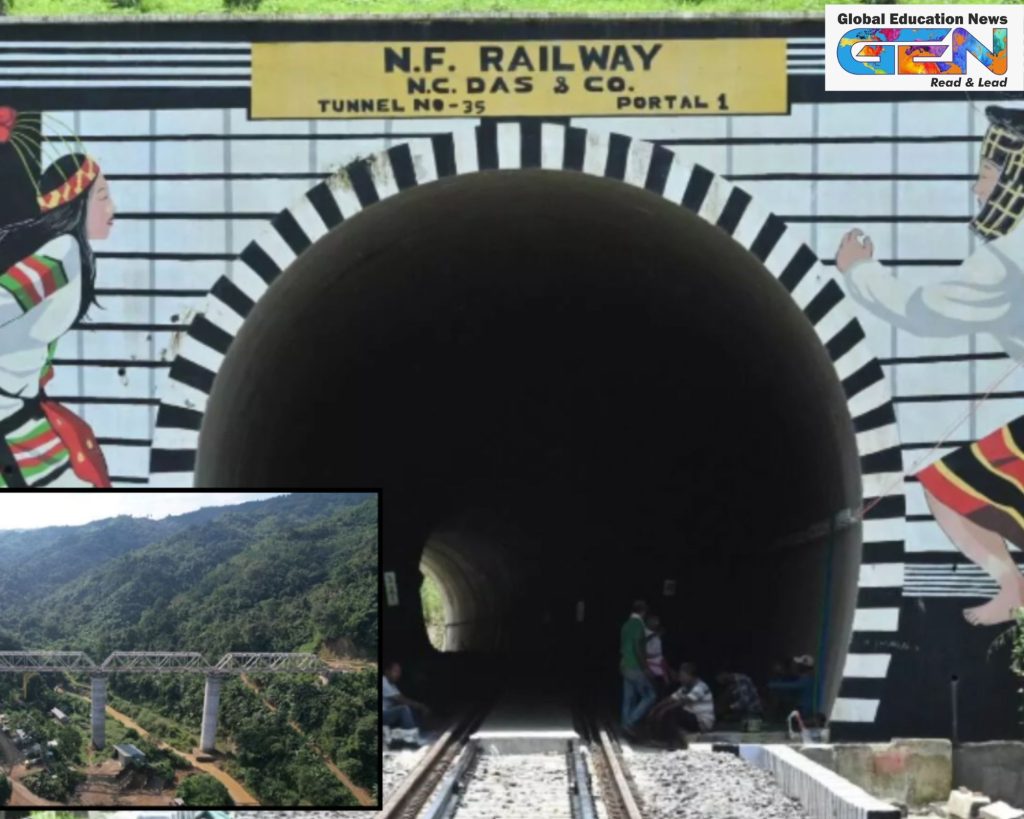
The Bairabi-Sairang railway project, completed in June 2025, marks a transformative milestone for Mizoram, a landlocked northeastern state. Stretching 51.38 km from Bairabi to Sairang, just 20 km from the capital Aizawl, this railway integrates Mizoram into India’s national rail network for the first time. Costing over ₹8,213 crore, the project overcame formidable challenges like landslide-prone terrain and prolonged monsoons, enhancing trade, tourism, and strategic connectivity under India’s Act East Policy.
Key Points:
- 51.38 km railway connects Bairabi to Sairang, near Aizawl.
- Completed in June 2025, with trial runs successful by May 2025.
- Boosts Mizoram’s integration with India and Southeast Asia.
Engineering Marvel in a Rugged Landscape
Initiated in 2008-09 as a “National Project,” the Bairabi-Sairang line faced delays due to difficult terrain, frequent landslides, monsoons, and manpower shortages. The project features 48 tunnels (12.85 km total), 55 major bridges, 87 minor bridges, and a 104-meter-tall pier—42 meters taller than the Qutub Minar. Despite a tragic bridge collapse in 2023 claiming 18 lives, the Northeast Frontier Railway (NFR) completed the line, with the Hortoki-Sairang section receiving safety clearance in June 2025.
Key Points:
- Includes 48 tunnels, 142 bridges, and four stations: Hortoki, Kawnpui, Mualkhang, Sairang.
- Tallest pier at 104 meters, a feat in Seismic Zone V.
- Overcame monsoon disruptions and a 2023 bridge collapse tragedy.
Transforming Mizoram’s Economy and Accessibility
Before the railway, Mizoram relied on air travel or a five-hour road journey from Aizawl to Silchar, Assam. The new rail link slashes travel time to 1.5 hours, reducing transport costs and dependence on trucks. This is expected to boost tourism, enable farmers to access wider markets, and facilitate trade in goods like construction materials. The line’s eco-friendly services align with sustainable development, fostering growth in small-scale industries.
Key Points:
- Cuts Aizawl-Silchar travel time from 5 hours to 1.5 hours.
- Enhances tourism, trade, and access to markets for farmers.
- Reduces reliance on costly road freight, promoting sustainability.
Strategic Anchor for the Act East Policy
Launched in 2014 by Prime Minister Narendra Modi, the Act East Policy builds on the 1991 Look East Policy, aiming to transform Northeast India into a gateway to ASEAN countries. The Sairang railhead supports this by enabling transhipment from India-funded Sittwe Port in Myanmar, reducing transport costs via sea routes. Budget allocations for the Northeast have surged 300% since 2014, with over 10,000 km of highways and 800 km of railway tracks built, alongside new airports and waterways.
Key Points:
- Aligns with Act East Policy to connect Northeast with ASEAN.
- Facilitates goods transhipment via Sittwe Port, Myanmar.
- Northeast infrastructure budget increased from ₹36,108 crore (2014-15) to over ₹1,00,000 crore (2024-25).
Regional Challenges and Geopolitical Hurdles
The project’s broader vision faces setbacks due to regional instability. The 2021 Myanmar coup and 2024 political turmoil in Bangladesh have stalled cross-border projects like the Agartala-Akhaura railway and the Kaladan Multi-Modal Transit Transport Project, which could cut Mizoram-Kolkata distance by 1,000 km. These delays hinder India’s goal of seamless connectivity with Southeast Asia, impacting trade and security cooperation.
Key Points:
- Myanmar and Bangladesh unrest delays cross-border connectivity.
- Agartala-Akhaura and Kaladan projects stalled, affecting trade routes.
- Challenges underscore the need for stable regional partnerships.
Future Prospects and Northeast Integration
The Sairang railway is part of a broader mission to connect all Northeastern state capitals by 2030. Projects like the 82.5 km Dimapur-Zubza line (Nagaland) and Imphal-Moreh line (Manipur) are underway, though Meghalaya faces local opposition. A proposed 223 km Sairang-Hbichhuah line near the Myanmar border could further link to the Kaladan project, enhancing access to Sittwe Port. These efforts, backed by a ₹10,440 crore budget for 2025-26, aim to integrate the Northeast economically and strategically.
Key Points:
- Part of plan to connect all Northeast capitals by 2030.
- Sairang-Hbichhuah line to enhance Myanmar border connectivity.
- ₹10,440 crore allocated for Northeast rail projects in 2025-26.
A New Era for Mizoram
The Bairabi-Sairang railway, celebrated on X as a “game-changer,” marks Mizoram as the fourth Northeast state with rail-linked capital, following Assam, Tripura, and Arunachal Pradesh. Despite its high cost and challenges, the project promises to transform Mizoram’s economy, accessibility, and strategic relevance, while advancing India’s vision of a connected Northeast. Its success could inspire further infrastructure breakthroughs, though regional stability remains critical.
Key Points:
- Mizoram becomes fourth Northeast state with rail-linked capital.
- Social media hails project as vital for commerce and tourism.
- Success hinges on overcoming regional geopolitical challenges.