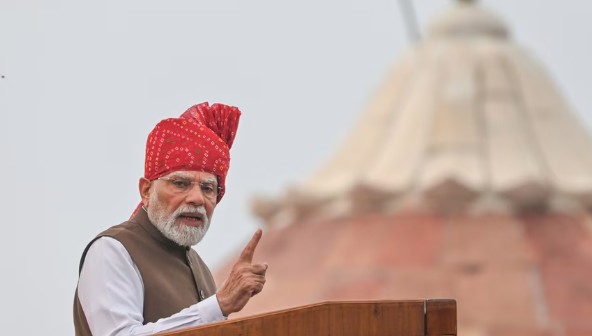
Prime Minister Narendra Modi’s Independence Day address has put free online coaching for competitive examinations at the centre of a fresh government push to reduce the financial pressure on students and their families.
Speaking from the Red Fort on August 15, Modi said coaching for competitive examinations has become a major financial burden, particularly for poor and middle-class households. He announced plans to use India’s existing digital public infrastructure, teachers and available academic talent to create a wider network of free coaching for young people preparing for competitive examinations.
The announcement is significant, but it does not come in an education system starting from scratch.
Over the past several years, India has already developed a substantial digital learning ecosystem through platforms such as DIKSHA, SWAYAM, SWAYAM Prabha and SATHEE. The next challenge is to connect these existing assets and turn them into a coherent, high-quality public coaching system.
Why Free Coaching Has Become a Major Education Issue
Competitive examinations have created an enormous coaching economy in India.
For students preparing for examinations such as JEE, NEET, SSC and other national-level tests, coaching can become a substantial additional expense on top of regular school or college education.
The latest National Sample Survey-related data cited in the discussion around the announcement indicates that around 27% of students use private coaching. The financial burden also tends to increase as students move to higher levels of education.
For families, the cost is not restricted to classroom fees.
Students who move to major coaching centres may also have to pay for:
- Accommodation
- Food and daily expenses
- Travel
- Study material
- Test series
- Additional academic support
This means that a student’s preparation can become considerably more expensive than the headline coaching fee suggests.
A free online alternative could therefore have an impact well beyond tuition savings—particularly for students who cannot afford to relocate to established coaching hubs.
India Is Not Starting From Zero: The DIKSHA Experience
One of the strongest arguments for the government’s latest proposal is that India already has experience building large-scale digital education infrastructure.
The Digital Infrastructure for Knowledge Sharing (DIKSHA) platform was launched in 2017 and became a major component of the PM e-Vidya initiative during the COVID-19 pandemic.
DIKSHA provides curriculum-linked digital learning material to students and teachers in multiple languages and across school education levels. The government describes it as a national digital platform for school education.
By March 2026, DIKSHA had crossed 2 crore registered users, according to a Ministry of Education backgrounder.
The significance of DIKSHA is not simply its user base.
Its experience demonstrates that a digital education platform created or expanded during a crisis can continue to serve the education system after classrooms return to normal.
That makes DIKSHA an important part of the blueprint for any larger public digital-learning initiative.
SATHEE Is Perhaps the Closest Existing Model
If DIKSHA represents India’s school-level digital education infrastructure, SATHEE is the more direct precedent for free competitive-exam preparation.
SATHEE—Self-Assessment, Test and Help for Entrance Examination—was launched by the Ministry of Education in collaboration with IIT Kanpur in November 2023.
Its purpose is to provide free educational content and guidance for competitive examinations, including JEE, NEET and SSC, with a particular emphasis on making quality preparation accessible to students across the country.
The platform has been designed around several elements that are directly relevant to the government’s latest free-coaching proposal:
- Free learning resources
- Practice and assessment
- Video lessons
- Live classes
- Doubt-clearing support
- AI-enabled tools
- NCERT-linked learning resources
- Mobile and web access
- DTH-based educational delivery
Earlier government information noted that SATHEE had already crossed four lakh registered learners. By 2026, the platform had expanded substantially, with recent reporting putting its registered learner base at more than 15 lakh.
That makes SATHEE an important real-world experiment in what publicly supported digital coaching can look like at scale.
The Digital Education Network Is Bigger Than SATHEE
The government’s existing infrastructure extends beyond one platform.
The PM e-Vidya ecosystem brings together multiple modes of education designed to reach students with different levels of connectivity and access.
According to the Ministry of Education, the ecosystem includes:
DIKSHA
Digital curriculum-linked resources for school students and teachers.
SWAYAM
India’s major online course platform, offering learning opportunities across higher education and other areas.
SWAYAM Prabha
A network of DTH educational channels providing learning content through television.
SATHEE
A dedicated platform for competitive-examination preparation.
The March 2026 government backgrounder reported more than 5.80 crore SWAYAM enrolments, while 48 SWAYAM Prabha DTH channels were delivering educational content around the clock.
The infrastructure therefore already exists across several layers of education.
The new challenge is to make these systems work together more effectively.
The Real Opportunity: Build a National Public Coaching Network
The most interesting question following the Prime Minister’s announcement is whether India needs another standalone platform.
The answer may be no.
Instead, the government could build on the existing infrastructure and create a national public coaching network that connects:
Students + teachers + digital content + testing + AI tools + mentoring + existing platforms
Such an approach could reduce duplication while allowing students to move seamlessly from school-level learning to competitive-exam preparation.
SATHEE could provide the competitive-exam layer, while DIKSHA and other PM e-Vidya resources could support foundational learning.
The objective would not simply be to put more lectures online.
It would be to create an integrated learning journey.
Free Content Alone Is Not Enough
There is, however, a major distinction between free education content and free coaching.
A student can have access to hundreds of recorded lectures and still struggle to prepare effectively.
Traditional coaching provides several services beyond classroom teaching:
- Structured study schedules
- Regular testing
- Personalised feedback
- Doubt resolution
- Mentoring
- Performance tracking
- Peer competition
- Motivation and accountability
A successful government coaching programme will need to address these elements.
Otherwise, students may receive plenty of content but still lack the guidance needed to use it effectively.
This is perhaps the biggest test facing the new initiative.
The Access Problem: Internet Is Not the Same as Equality
Digital education can reduce geographical barriers, but it cannot automatically eliminate the digital divide.
A student in a metropolitan city may have access to:
- A personal laptop
- High-speed broadband
- A quiet study space
- Reliable electricity
- Multiple digital devices
Another student may depend on a shared smartphone and intermittent connectivity.
A genuinely inclusive free online coaching programme therefore needs multiple delivery channels.
India’s experience with PM e-Vidya offers one possible model because it combines online platforms with television and other modes of delivery.
Offline-accessible resources, downloadable lessons, low-bandwidth content, television-based learning and community facilities could make the programme significantly more inclusive.
Teachers Will Be the Key to Making the Model Work
Technology may provide the infrastructure, but teachers will determine the quality of the learning experience.
The Prime Minister’s announcement specifically referred to bringing together available teachers and talent for the proposed coaching network.
That raises several practical questions:
- Who will teach the courses?
- How will teachers be selected?
- Will content be centrally prepared?
- How will teaching quality be monitored?
- How will students receive personalised support?
- How frequently will content be updated?
- How will regional-language instruction be expanded?
A large digital platform cannot succeed simply because it has a large number of videos.
Students need accurate, current and well-structured instruction.
AI Could Add a New Layer to Public Coaching
Artificial intelligence could become one of the most useful components of the proposed system.
SATHEE already incorporates AI-based tools, including chatbot functionality and features designed to support students in examination preparation. Government documents have also highlighted AI-based personalisation and feedback mechanisms within the platform.
A scaled-up system could potentially use AI to help students:
- Identify weak topics
- Generate personalised practice
- Explain difficult concepts
- Track progress
- Recommend revision
- Analyse test performance
But AI should complement—not replace—qualified teachers.
For high-stakes competitive examinations, accuracy, transparency and human oversight remain essential.
Can Free Coaching Reduce the Coaching Divide?
The central policy goal is not necessarily to eliminate private coaching.
That would be unrealistic.
Instead, the objective could be to reduce the advantage created solely by a family’s ability to pay for expensive coaching.
If a student from a small town can access high-quality lectures, test series, mentoring and doubt resolution without moving to a coaching hub, the geographical and financial barriers to competitive examinations could be reduced.
That could make the examination ecosystem more equitable.
But quality will determine whether this happens.
A free platform that students do not trust will not significantly change behaviour.
Government Already Has Targeted Free-Coaching Schemes
The idea of publicly supported coaching is also not entirely new.
The government already operates targeted free-coaching programmes for particular groups.
For example, the Free Coaching Scheme for SC and OBC students aims to provide quality coaching to economically disadvantaged candidates preparing for competitive examinations and employment opportunities.
Government data also shows ongoing free-coaching support covering examinations and career pathways such as JEE/NEET, public-sector recruitment, banking, CLAT, civil services and other examinations.
The new proposal could therefore represent an attempt to move from targeted schemes and individual platforms towards a much broader national digital offering.
What Could Make the New Initiative Different?
The scale is the biggest potential difference.
Existing programmes generally target particular examinations, communities or educational levels.
The new proposal appears to envisage a broader network for young people preparing for various competitive examinations.
If implemented effectively, it could bring together:
School education → foundational preparation → entrance examinations → recruitment examinations → skill development
within a common digital ecosystem.
That would make the initiative considerably more ambitious than simply adding another set of online lectures.
The Biggest Challenge: Turning Infrastructure Into Outcomes
India has already demonstrated that it can build digital education infrastructure.
The harder question is whether that infrastructure can consistently produce better learning outcomes.
For competitive examinations, success can be measured through concrete indicators:
- Student participation
- Course completion
- Practice-test performance
- Improvement in scores
- Qualifying rates
- Regional participation
- Participation among economically disadvantaged students
These outcomes should be publicly monitored.
Without transparent evaluation, it will be difficult to determine whether free digital coaching is genuinely narrowing the coaching gap.
What Students Could Gain
If the proposed system is implemented well, students could benefit in several ways.
Lower preparation costs
Students may not need to pay large coaching fees or relocate to coaching centres.
Access from smaller towns
Quality resources could become available irrespective of geographical location.
Flexible learning
Recorded classes and digital resources allow students to revise according to their own schedules.
Multiple languages
India’s multilingual digital infrastructure could help students learn in languages with which they are most comfortable.
Data-driven preparation
AI-enabled assessment could help students understand where they need improvement.
What the Government Needs to Get Right
The success of the free-coaching promise will ultimately depend on execution.
Five areas will be particularly important:
1. Quality
Free content must be academically credible and regularly reviewed.
2. Accessibility
The system must work for students with limited devices and connectivity.
3. Personalisation
Students need more than a library of videos.
4. Human support
Teachers and mentors must remain central to the model.
5. Accountability
The government should publish measurable outcomes and independent assessments.
These factors will determine whether the programme becomes a meaningful alternative to expensive coaching or simply another digital education portal.
The Bigger Picture: From Digital Education to Digital Public Coaching
India’s experience during COVID demonstrated that digital education could be deployed at enormous scale when circumstances demanded it.
DIKSHA showed that the infrastructure could survive beyond the pandemic.
SATHEE demonstrated that the same public digital approach could be extended to competitive-exam preparation.
The Prime Minister’s latest announcement now raises the possibility of taking the model one step further: from digital learning platforms to a nationwide public coaching ecosystem.
That is a much bigger ambition.
The opportunity is equally significant.
If India’s existing platforms, teachers, assessment systems and AI capabilities can be brought together, the country may already possess much of the technological blueprint needed to make free competitive-exam preparation a practical reality.
Final Takeaway
PM Modi’s announcement of free online coaching for competitive examinations has opened a major conversation about affordability, access and equality in India’s examination system.
But perhaps the most important point is that the country is not starting from zero.
DIKSHA, PM e-Vidya, SWAYAM, SWAYAM Prabha and SATHEE have already created much of the digital foundation. DIKSHA has reached more than two crore registered users, while SATHEE has evolved into a large-scale platform for competitive-exam preparation.
The next step is not necessarily to build another platform.
It is to make the existing ecosystem connected, accessible, high-quality and outcome-oriented.
If that happens, the free-coaching promise could become more than an Independence Day announcement. It could become a significant shift in how India approaches competitive-exam preparation—moving at least part of the coaching burden away from family income and towards public digital infrastructure, qualified teachers and open access to learning.