Artificial intelligence has moved from being a futuristic technology to an everyday workplace tool. From writing and coding to data analysis and customer support, AI is already handling tasks that once required significant human effort.
But that does not mean every profession is heading towards extinction.
The more important question in 2026 is which parts of a job can AI perform, and which still require a human being?
Recent research increasingly points towards a more nuanced picture. PwC’s 2026 Global AI Jobs Barometer found that AI is reshaping occupations rather than simply eliminating them, with skills such as empathy, judgement, creativity and leadership becoming increasingly important in highly AI-exposed jobs.
The OECD similarly notes that AI frequently complements human workers, while jobs involving non-routine cognitive and social skills remain less susceptible to complete automation.
Against this backdrop, several career fields stand out as relatively resilient.
1. Doctors and Healthcare Professionals
Healthcare is among the clearest examples of a profession where AI can be powerful without necessarily replacing the professional.
AI can assist doctors with:
- Analysing medical images
- Identifying patterns in health data
- Supporting diagnosis
- Managing documentation
- Monitoring patients
- Assisting research
But healthcare involves much more than recognising patterns.
Doctors must communicate with patients and families, weigh uncertain information, make decisions in complex circumstances and take responsibility for clinical outcomes.
Nursing and other patient-facing healthcare roles involve an additional layer of physical care and emotional support that is difficult to automate. Research on healthcare and AI similarly finds that roles requiring high-stakes decision-making, human connection and physical skills are less vulnerable to complete replacement.
The future: Doctors and healthcare workers are more likely to work with AI than compete directly against it.
2. Nurses and Care Professionals
Nursing is particularly dependent on human interaction.
A nurse may need to observe a patient’s condition, respond quickly to unexpected changes, communicate with relatives and provide reassurance during stressful situations.
These responsibilities require empathy, physical presence, judgement and adaptability.
India’s Economic Survey 2025–26 also identified nursing, elder care and other empathy-driven occupations among roles relatively resistant to AI disruption.
Technology can reduce administrative workloads, but the human relationship at the centre of care remains difficult to automate.
3. Teachers and Educators
AI can explain concepts, generate practice questions, create lesson plans and provide personalised learning material.
So, does that make teachers unnecessary?
Not necessarily.
Teaching involves understanding how individual students learn, recognising confusion or disengagement, motivating learners and creating a supportive classroom environment.
A teacher also performs a social and mentoring role that extends beyond delivering information.
The future classroom is therefore more likely to involve AI-assisted teachers rather than classrooms without teachers.
For students considering education as a career, developing communication, mentoring, leadership and interpersonal skills alongside subject expertise could become increasingly valuable.
4. Psychologists, Counsellors and Therapists
Mental-health and counselling professions depend heavily on trust and human connection.
AI systems can provide information, organise records or assist professionals with certain routine tasks. However, establishing a meaningful therapeutic relationship involves understanding emotions, context and individual experiences.
A professional must also exercise judgement about complicated personal situations and respond appropriately when circumstances change.
This is precisely the type of work where human empathy and responsibility remain central.
The broader evidence on AI and employment supports this distinction: occupations requiring social and emotional capabilities are generally less amenable to complete automation than routine tasks.
5. Skilled Tradespeople
Plumbers, electricians, mechanics, construction workers and other skilled tradespeople operate in environments that are rarely perfectly predictable.
A machine can be programmed to perform a specific task under controlled conditions. Real-world repair work is different.
A tradesperson may encounter:
- Unexpected structural problems
- Different building layouts
- Damaged or unusual components
- Safety constraints
- Situations requiring improvisation
The professional must inspect the situation, determine what is wrong and physically carry out the solution.
The Economic Survey has highlighted hands-on occupations such as plumbing, electrical work, construction, repair and maintenance as relatively resistant to AI disruption because they require physical dexterity and adaptability in unpredictable environments.
6. Emergency and Crisis-Response Professionals
Jobs involving emergencies require rapid decisions under uncertain conditions.
Firefighters, emergency medical personnel and other crisis-response workers may need to assess a constantly changing environment and act immediately.
AI can support emergency response through forecasting, communication and data analysis, but the professional on the ground remains responsible for interpreting the situation and making decisions.
This combination of physical presence, risk assessment, teamwork and accountability makes complete automation particularly challenging.
The broader trend is clear: the more unpredictable the physical environment and the greater the need for immediate human judgement, the harder a role becomes to automate completely.
7. Leaders, Managers and Entrepreneurs
AI can analyse enormous amounts of information and provide recommendations.
But leadership involves deciding what should happen, not simply determining what the data says.
Managers must build teams, resolve conflicts, communicate difficult decisions, negotiate with stakeholders and take responsibility for outcomes.
Entrepreneurs face an even more uncertain environment. They must identify opportunities, understand customers, take calculated risks and persuade people to support their ideas.
PwC’s 2026 research found that AI-exposed jobs are increasingly adding human-intensive skills, with leadership, strategic thinking and judgement becoming more important.
That suggests AI could actually increase the value of effective leadership rather than eliminate it.
8. Creative and Experience-Based Professionals
Creativity is another area where the impact of AI is more complicated than simple job replacement.
AI can generate text, images, music concepts, designs and other forms of content at remarkable speed.
Yet professional creative work involves more than producing an output.
Designers, creative directors, chefs, performers and other creative professionals make decisions based on taste, cultural context, audience understanding, originality and personal experience.
Human creativity is also closely connected with lived experience and the ability to understand what an audience may find meaningful.
The likely future is therefore one in which AI becomes a powerful creative assistant while humans remain responsible for direction, judgement and final decisions.
What Makes These Jobs More Resistant to AI?
Although these professions look very different, they share several characteristics.
Human empathy
People need genuine understanding and emotional connection in healthcare, education and counselling.
Complex judgement
Professionals often have to make decisions when there is no single correct answer.
Physical presence
Many skilled trades and emergency professions require someone to physically operate in the real world.
Accountability
A human professional may need to take responsibility for an important decision.
Creativity
Original ideas and contextual judgement remain difficult to reduce to predictable rules.
Leadership and teamwork
Building trust and coordinating people requires social intelligence that AI cannot simply reproduce.
AI Exposure Does Not Mean AI Replacement
One of the biggest misconceptions about the future of work is that an occupation being exposed to AI automatically means the occupation will disappear.
The evidence does not support such a simple conclusion.
PwC’s 2026 Global AI Jobs Barometer found that organisations with greater AI exposure can experience strong productivity and employment growth, while jobs are being redesigned around increasingly valuable human skills.
The OECD likewise distinguishes between AI exposure and actual automation risk. Some highly AI-exposed professional occupations remain difficult to automate because they depend on non-routine cognitive and social capabilities.
In other words, AI may replace tasks without replacing the entire profession.
The Real Career Advantage in 2026
For students thinking about future careers, the lesson is not to search for a job that is supposedly “100% AI-proof.”
No occupation can be guaranteed to remain unchanged.
Instead, young people should look at careers where technology can become a tool that makes their expertise more powerful.
A strong future-ready combination could be:
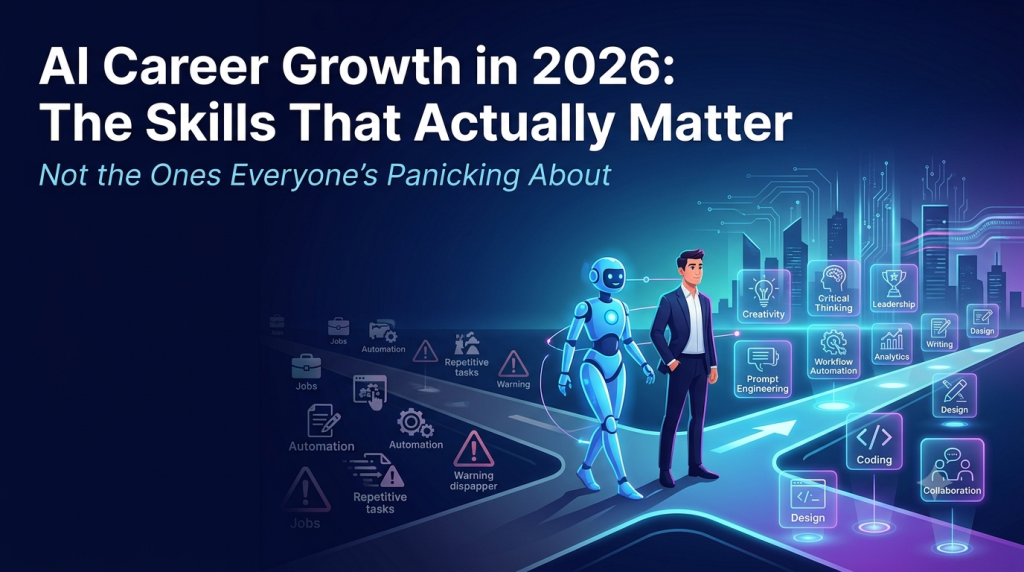
Subject knowledge + AI literacy + communication + judgement + creativity + adaptability
This approach prepares a professional not only to survive technological change but to benefit from it.
The Future May Belong to People Who Know How to Use AI
The workplace of the future is unlikely to be divided simply into humans versus machines.
A more realistic picture is emerging:
Humans decide. AI assists. Humans remain accountable.
A doctor may use AI to analyse information more quickly. A teacher may use it to personalise learning. An engineer may use it to test designs. A designer may use it to explore concepts. A manager may use it to analyse business data.
The advantage will increasingly belong to professionals who can combine human expertise with technological capability.