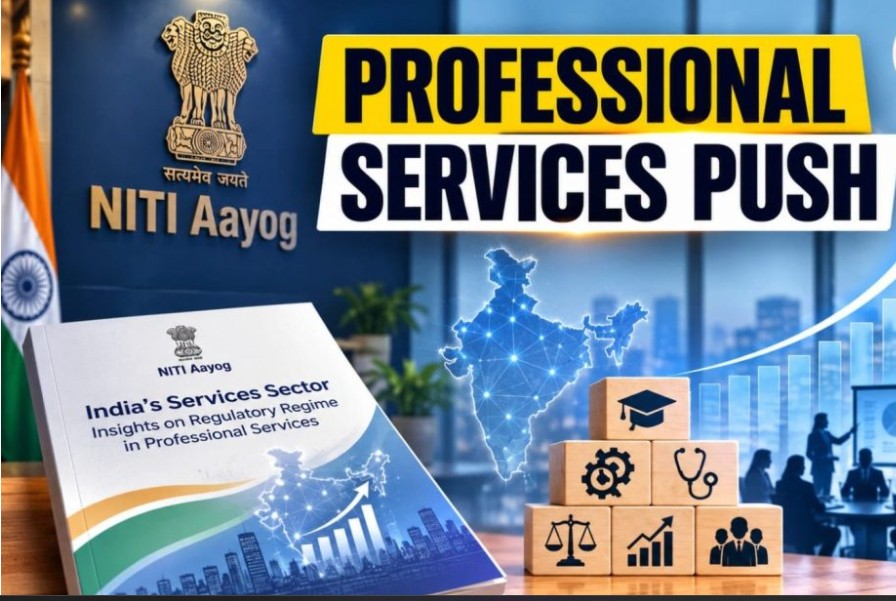
India’s rapidly expanding services economy could be heading for a significant regulatory overhaul.
A new NITI Aayog report on the regulatory regime governing professional services examines how existing rules affect sectors including law, accounting, architecture, engineering, healthcare and allied health professions. The report argues that regulatory barriers, fragmented licensing systems and restrictions on professional mobility can limit the ability of India’s skilled workforce to respond to a changing economy.
The recommendations come at a time when India is trying to strengthen its position as a global services hub. Artificial intelligence, automation, technological change and the growing demand for specialised knowledge are rapidly reshaping professional work.
For students, the discussion is especially relevant because many of the proposed changes concern how professionals qualify, obtain licences, move between states and have their qualifications recognised in India and abroad.
Why Professional Services Matter to India’s Growth
The services sector has become one of the most important pillars of the Indian economy.
NITI Aayog’s report examines the regulatory environment in professional services against this larger economic backdrop. India’s services sector accounted for roughly 55% of national output in FY2023–24, while the country ranked among the world’s leading services exporters.
The expansion is not limited to traditional IT and business-process services. Professional and management consulting, engineering, healthcare, legal services, accounting, architecture and other knowledge-intensive activities are increasingly connected to global markets.
That creates a policy challenge: Can India’s professional regulations keep pace with the speed at which the services economy is changing?
NITI Aayog’s report attempts to address that question.
The Four Big Regulatory Issues Identified
The report broadly examines several recurring challenges across professional sectors.
1. Professional licensing
Licensing determines who can legally practise a profession. NITI Aayog examines whether existing systems are sufficiently clear, efficient and consistent with the needs of a modern services economy.
2. Recognition of qualifications
Professionals increasingly study, train and work across borders. The report therefore looks at mechanisms for recognising qualifications obtained in different jurisdictions.
3. Interstate professional mobility
Different rules and registration requirements can make it difficult for professionals to move from one state to another.
Greater licence portability could make professional mobility easier, particularly in sectors such as healthcare.
4. International recognition
The report also highlights mutual recognition arrangements, which could help Indian professional qualifications gain greater acceptance in international markets.
Together, these issues point towards a broader objective: making India’s professional workforce more mobile, competitive and globally integrated.
Healthcare: NExT, Licence Portability and Allied Health Regulation
Healthcare is one of the sectors where regulatory fragmentation can have particularly visible consequences.
NITI Aayog has recommended the timely implementation of the National Exit Test (NExT) alongside greater regulatory clarity for healthcare professionals. It has also highlighted interstate licence portability and the need for full implementation of the National Commission for Allied and Healthcare Professions Act.
For doctors and other healthcare professionals, the larger issue is whether registration and licensing systems can support mobility without compromising professional standards.
A more portable system could make it easier for qualified professionals to work across states while maintaining appropriate regulatory oversight.
For students, this could eventually mean a clearer pathway from medical education → qualifying examination → professional registration → employment.
Engineering: Need for a Clearer Professional Framework
Engineering is another area receiving attention.
India has a large and increasingly global engineering-services industry, spanning infrastructure, construction, product design, technology and consulting.
Recent data cited in reporting on the NITI Aayog report shows that India’s engineering-services exports have expanded sharply over the past decade.
Against this background, NITI Aayog has called attention to the need for a clearer statutory framework for engineers involved in areas such as construction and infrastructure, along with clearly defined professional responsibilities and practice boundaries.
The underlying objective is to establish greater clarity about professional standards while allowing India’s engineering workforce to compete more effectively in global markets.
Legal Services: Foreign Lawyers and Business Structures in Focus
The legal profession faces a different set of regulatory questions.
The report examines issues including:
- Recognition of different categories of legal professionals
- The position of foreign lawyers and foreign law firms
- Permitted business structures
- Professional advertising norms
- Wider questions surrounding market entry and competition
These issues sit at the intersection of professional regulation and India’s ambition to expand its role in international services.
As cross-border commercial activity grows, demand for lawyers with expertise in international transactions, arbitration, technology and global regulatory systems is also changing.
The regulatory framework will therefore have to balance professional standards, domestic interests and India’s global services ambitions.
Accounting: ICAI, NFRA and Regulatory Clarity
Accounting and auditing are also included in the proposed reforms.
The report examines questions involving foreign professional participation, the respective roles of the Institute of Chartered Accountants of India (ICAI) and the National Financial Reporting Authority (NFRA), as well as regulation of bookkeeping services.
The issue is significant because financial reporting and auditing are fundamental to investor confidence and corporate governance.
At the same time, India’s accounting profession is becoming increasingly connected to international business.
The regulatory challenge is therefore to maintain high standards of financial reporting while ensuring that the profession remains competitive and adaptable.
Architecture and Other Professional Services Also Under Review
The report’s scope extends beyond medicine, law and engineering.
Architecture and other professional services are also examined through the broader questions of licensing, recognition, market entry, business structures and professional mobility.
This is important because the modern services economy is increasingly built around interdisciplinary teams.
An infrastructure project, for example, may involve engineers, architects, lawyers, accountants, consultants and technology specialists working together.
Regulatory systems that operate in isolation can create friction across such projects.
AI Is Changing the Nature of Professional Work
One of the most important aspects of the NITI Aayog report is its recognition that professional services are being reshaped by technology.
Artificial intelligence and automation are changing how many professional tasks are performed, while creating demand for areas such as advanced analytics, strategic advisory services and technology-intensive professional work.
This creates a new question for regulators:
Should professional rules designed for a largely traditional workplace continue unchanged when technology is transforming how services are delivered?
The report suggests that regulation needs to evolve alongside these changes.
For students, the message is equally important. Future professionals will need more than conventional qualifications. Digital skills, analytical ability, interdisciplinary knowledge and the ability to work with emerging technologies are becoming increasingly valuable.
From Degrees to Professional Licences: Why Students Should Pay Attention
For students planning careers in regulated professions, the proposed reforms could eventually affect the transition from education to employment.
A professional career often involves several stages:
School → Professional Degree → Qualification/Examination → Registration or Licence → Continuing Professional Development → Professional Practice
If licensing and recognition systems become more streamlined, movement through these stages could become clearer.
The report also highlights continuing professional development, accreditation and professional mobility, all of which could become increasingly important as professional knowledge changes rapidly.
Could Interstate Licence Portability Change Professional Careers?
One of the most practical proposals is the idea of interstate licence portability.
At present, professionals working in regulated sectors can encounter different registration requirements when moving between states.
A more portable licensing framework could make it easier for qualified professionals to relocate for employment.
This could be particularly significant in healthcare, where the availability of skilled professionals can vary considerably across regions.
For young professionals, greater mobility could also widen the national employment market.
Instead of viewing a professional licence as being closely tied to one state, a more integrated system could allow qualified workers to move more easily where their skills are needed.
Mutual Recognition Could Open More Global Opportunities
Another important theme is the recognition of Indian professional qualifications overseas.
Mutual Recognition Agreements (MRAs) can allow professional qualifications obtained in one country to receive recognition in another, subject to agreed standards and conditions.
For Indian professionals, stronger international recognition could potentially improve access to overseas markets.
This is particularly relevant as India seeks to increase exports of high-value professional services rather than relying primarily on lower-cost service delivery.
The long-term goal would be to move towards a system where Indian qualifications, professional standards and skills are more easily understood and accepted internationally.
The Shift Towards Higher-Value Services
NITI Aayog’s recommendations are also connected to a broader change in India’s services economy.
The report identifies areas such as:
- Research and development
- Engineering design
- Strategic technology operations
- Consulting
- Advanced analytics
- Specialised professional services
as part of the movement towards more knowledge-intensive activities.
This shift matters for education because the jobs of the future may increasingly reward specialised expertise rather than routine professional tasks.
Universities and professional institutions may consequently need to place greater emphasis on practical skills, interdisciplinary learning, technology and continuous upskilling.
What the Proposed Reforms Could Mean for Students
Although the report is primarily about regulation, its implications extend directly into education and careers.
For medical students
Greater clarity around NExT, registration and interstate mobility could influence the transition from medical education to professional practice.
For engineering students
A clearer professional framework could strengthen recognition of engineering expertise, particularly in infrastructure and construction-related work.
For law students
Changes involving professional categories, foreign legal services and business structures could influence the future legal-services market.
For commerce and accounting students
Changes involving ICAI, NFRA and bookkeeping regulation could reshape parts of the accounting and auditing ecosystem.
For all professional students
Greater emphasis on continuing professional development means graduation may increasingly become the beginning of professional learning rather than its endpoint.
Regulation vs Reform: What Needs to Be Balanced?
Regulatory reform does not simply mean reducing rules.
Professional regulation exists for a reason.
Patients need qualified doctors. Clients need competent lawyers. Investors need reliable financial reporting. Infrastructure projects require appropriately trained engineers and architects.
The challenge is therefore to eliminate unnecessary regulatory friction without weakening professional standards.
That balance will determine whether the proposed reforms improve India’s services economy.
A system that makes licensing easier but weakens quality control would create new risks. Conversely, a system that maintains excessive barriers could prevent qualified professionals from moving freely and reduce India’s competitiveness.
The real test will be implementation.
What Happens Next?
The NITI Aayog document is a set of recommendations and analysis, not an automatic change to every professional regulation in the country.
Actual changes would require action by the relevant ministries, regulators, professional bodies and, where necessary, legislative or regulatory processes.
Students and professionals should therefore not assume that existing licensing requirements have already changed.
Instead, the report should be viewed as an indication of the direction in which policymakers are considering reforms.
India’s Professional Workforce at an Inflection Point
India’s services economy is entering a period in which skills, technology and regulation are becoming increasingly interconnected.
The country has a large pool of doctors, engineers, lawyers, accountants, architects and other professionals. But the ability to convert that human capital into greater economic value depends partly on how easily professionals can enter markets, move between jurisdictions and have their qualifications recognised.
NITI Aayog’s recommendations attempt to address precisely these questions.
If implemented carefully, reforms could reduce regulatory fragmentation, improve professional mobility and strengthen the global recognition of Indian expertise.
For students, the bigger lesson is straightforward: professional education is changing, and the rules governing professional careers are changing with it.
Bottom Line
NITI Aayog’s latest examination of India’s professional-services regulations puts licensing, qualification recognition, interstate mobility and international recognition at the centre of a wider services-sector reform agenda.
The proposals touch professions that millions of students aspire to enter—from medicine and engineering to law, accounting and architecture.
The reforms are not yet a new set of rules, but they signal an important policy conversation. As AI, automation and global competition reshape professional work, India will need regulatory systems that protect quality while allowing skilled professionals to move, adapt and compete.
For today’s students, that could eventually mean a professional career that is more mobile, more technology-driven and more internationally connected than the one available to previous generations.