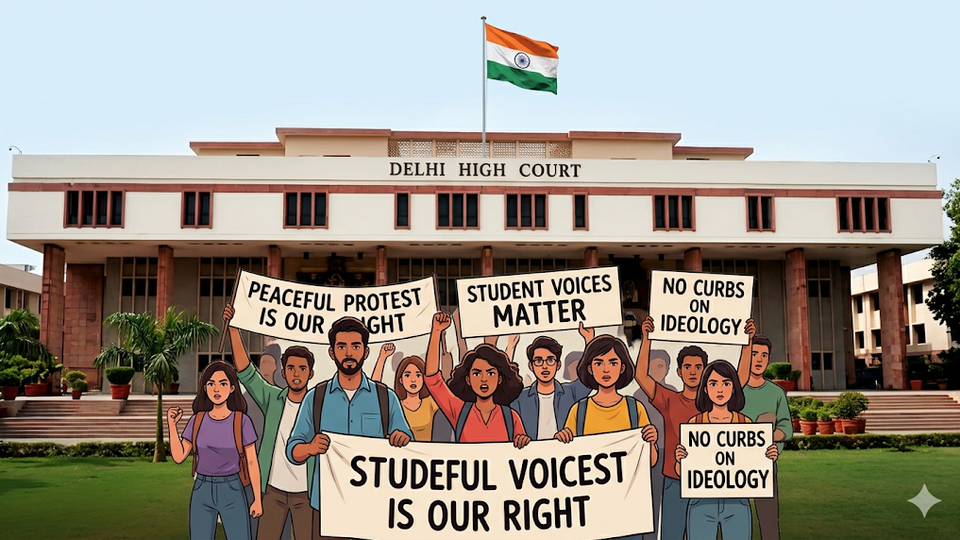
In a significant judgment reinforcing constitutional values on campuses, the Delhi High Court has ruled that universities cannot restrict peaceful expression of ideas or protests merely because they do not align with the management’s ideology. The court emphasised that educational institutions, as instrumentalities of the State, must foster an environment of free thought, independent thinking, and healthy dissent rather than suppress it.
Justice Jasmeet Singh made these observations while setting aside the expulsion/suspension of a student from Dr. B.R. Ambedkar University Delhi (AUD) for her alleged participation in a peaceful sit-down protest. The court described the university’s disciplinary action as “highly disproportionate” and held that penalising non-violent dissent strikes at the heart of democracy, freedom of speech and expression (Article 19(1)(a)), and the right to peaceful assembly (Article 19(1)(b)).
Key Highlights of the Delhi High Court Judgment (March 13, 2026)
- Core Observation: “The university cannot restrict speech and peaceful expression of ideas, merely because the views expressed by a group of students do not align with the ideology of the management.”
- University’s Role: A university’s duty is not to suppress every form of dissent but to ensure such expression is answered and catered to through dialogue. It must create an atmosphere where students feel free to discuss academic or public issues.
- Peaceful Protest Protected: When students express disagreement in a peaceful and orderly manner — without violence or serious disruption — such conduct forms a natural part of holistic development and cannot be penalised.
- Disciplinary Action Quashed: The court set aside two university orders (dated June 27, 2025, and August 11, 2025) that led to the student’s expulsion, restoring her status.
- Constitutional Backing: The ruling draws from Supreme Court precedents, including Ramlila Maidan Incident and Mazdoor Kisan Shakti Sangathan, which affirm the right to peaceful protest as a crucial pillar of democracy and an inherent part of Article 19 and Article 21 rights.
Background of the Case
The student (reportedly named Nadia in some accounts), pursuing MA in Development Studies at Dr. B.R. Ambedkar University Delhi, faced disciplinary proceedings after participating in campus protests. These protests reportedly stemmed from demands for action against incidents of bullying and ragging involving other students. The university imposed suspension in March 2025, followed by further orders in June and August 2025, leading to expulsion.
The student challenged these actions in the Delhi High Court, arguing that the punishment violated her fundamental rights to free speech and assembly.
Analysis: What This Ruling Means for Indian Campuses
This judgment sends a clear message to higher education institutions across India: Campus democracy must be protected. Universities cannot function as echo chambers where only views aligning with administrative ideology are tolerated. Instead, they should encourage critical thinking, debate, and non-violent expression — essential elements for shaping informed citizens.
Strengths of the Ruling:
- Reinforces that peaceful sit-ins or protests, when orderly, fall within constitutional protections.
- Highlights the disproportionate nature of expulsion for non-violent acts.
- Reminds institutions that enforcement of court orders is the judiciary’s domain, not a ground to curb expression.
Broader Implications:
- Provides legal precedent for students facing similar disciplinary actions in other universities.
- Aligns with the spirit of the National Education Policy (NEP) 2020, which envisions holistic and multidisciplinary education fostering critical thinking.
- Serves as a reminder that while universities can regulate conduct to maintain order, they cannot use ideological misalignment as justification for punitive measures.
However, the ruling does not grant absolute freedom — it explicitly protects only peaceful and non-disruptive expression. Violence, vandalism, or serious disruption of academic activities would likely remain punishable.