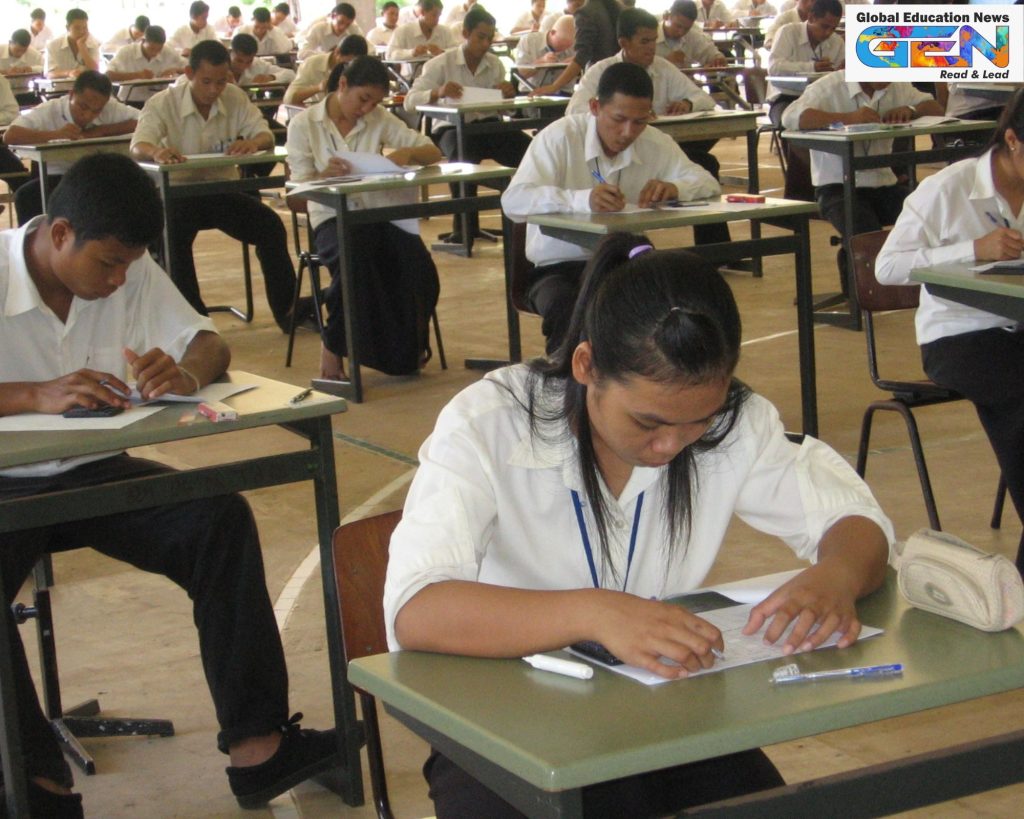
The Uttar Pradesh Madhyamik Shiksha Parishad (UPMSP), commonly known as UP Board, is set to implement transformative reforms for the 2026 high school and intermediate examinations, aiming for a “nakal viheen” (cheat-free) environment. Announced on December 9, 2025, these updates focus on revamping answer sheet designs to curb swapping and irregularities, alongside streamlining exam center selections. With over 52 lakh students registered, the changes—driven by Secretary Bhagwati Singh’s directive—promise enhanced transparency and equity, aligning with the National Education Policy (NEP) 2020’s emphasis on integrity in assessments. Exams will span February 18 to March 12, 2026, marking a pivotal shift in one of India’s largest board systems.
Background: Addressing Persistent Cheating Challenges
UP Board exams have historically faced scrutiny over paper leaks and copy swapping, with incidents in 2024 prompting stricter oversight. The 2026 reforms build on prior digital interventions like OMR sheets and CCTV monitoring, responding to stakeholder demands for foolproof mechanisms. Secretary Bhagwati Singh highlighted the need for innovation: “To prevent the swapping of copies, the layout of the copies has been completely changed this time.” This overhaul reduces vulnerabilities in manual evaluations while accommodating the board’s massive scale—handling evaluations for millions annually.
- Historical Context: Past reforms included biometric attendance and randomized seating; 2026 extends this to physical sheet redesigns.
- Policy Alignment: Supports NEP’s focus on credible certifications, ensuring merit-based outcomes for higher education and jobs.
Key Reforms: Answer Sheet Redesign and Anti-Cheating Measures
The centerpiece of the updates is a comprehensive redesign of answer sheets, transforming their physical attributes to eliminate tampering risks. These changes, coupled with center rationalization, aim to foster a secure testing ecosystem.
- Answer Sheet Modifications:
- Size and Shape: Shift from wide to longer dimensions, making swaps detectable during evaluation.
- Color Coding: Introduction of distinct color schemes for easy identification and verification.
- Layout Overhaul: Complete reconfiguration of pages, including watermarks and unique identifiers, to prevent unauthorized exchanges.
- Anti-Cheating Enhancements:
- CCTV Mandate: All 7,448 exam centers must be equipped with surveillance, prioritizing secure venues.
- Center Reduction: Streamlined from previous years to 7,448 schools (910 government, 3,484 aided, 2,354 self-financed), minimizing logistical leaks.
- Printing and Distribution: 26 million answer books to be printed securely and dispatched to districts in January 2026.
These measures are expected to cut irregularity complaints by 40-50%, based on pilot implementations.
Exam Center Selection Process: Timelines and Objection Handling
To ensure fair allocation, UP Board has introduced a rigorous, time-bound process for center approvals, addressing over 8,700 objections received from schools.
- Breakdown of Centers:CategoryNumber of CentersGovernment910Aided3,484Self-Financed2,354Total7,448
- Key Timelines:
- Objections Resolution: By December 11, 2025.
- Revised List Upload: By December 17, 2025.
- Final Center List: December 30, 2025.
- Non-Selected Schools: Decided by district-level committees.
This structured approach minimizes disputes, with digital portals for real-time tracking.
Student Enrollment and Exam Schedule: Scale and Logistics
The 2026 exams will cater to a record 52,30,297 registrants, underscoring UP Board’s vast footprint.
Enrollment Statistics
| Level | Registered Students |
|---|---|
| High School | 27,50,945 |
| Intermediate | 24,79,352 |
| Total | 52,30,297 |
- Schedule Overview: Theory exams from February 18 to March 12, 2026; practicals and evaluations to follow standard protocols.
- Logistical Prep: Hall tickets in late January; results anticipated by April-May 2026, with online grievance redressal.
Implications: Enhancing Fairness and Student Experience
These reforms prioritize integrity, potentially boosting pass rates (85% in 2025) by deterring malpractices. Students benefit from standardized, tamper-proof sheets that reduce evaluation errors, while reduced centers ensure better invigilation. However, rural candidates may face travel challenges; the board plans compensatory transport aids. Long-term, this aligns with NEP’s digital equity goals, preparing Uttar Pradesh’s youth for competitive landscapes like JEE and NEET.