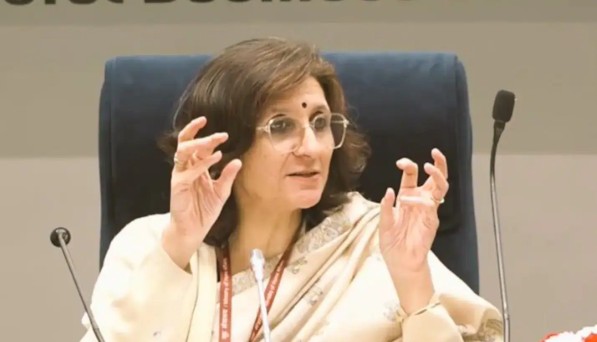
The Centre has appointed Deepti Gaur Mukerjee as the new Secretary of the Department of Higher Education, Ministry of Education, in a significant bureaucratic reshuffle announced on August 10, 2026.
A 1993-batch Indian Administrative Service (IAS) officer of the Madhya Pradesh cadre, Mukerjee brings extensive experience across central government departments and senior administrative positions. Her appointment comes at a time when India’s higher-education system is undergoing major policy and institutional changes.
She succeeds Vineet Joshi as Higher Education Secretary. The latest move is part of a wider reshuffle of senior government officials and marks another change at the top administrative level of the Education Ministry.
The appointment is significant because the Department of Higher Education oversees some of India’s most important higher-education institutions, regulatory frameworks and national programmes.
Who Is Deepti Gaur Mukerjee?
Deepti Gaur Mukerjee is a senior civil servant with more than three decades of administrative experience.
A member of the 1993 IAS batch, she belongs to the Madhya Pradesh cadre and has held several important positions in both the state and Central governments.
Her career has included assignments involving:
- Public administration
- Health-sector governance
- Corporate affairs
- Financial and investor-related administration
- Central government policy implementation
- Institutional management
Her varied experience could prove particularly relevant to a higher-education system that increasingly requires coordination between government, regulators, universities, industry and research institutions.
From JNU and LSE to the Higher Education Ministry
Mukerjee’s academic background has also attracted attention following her appointment.
She studied at Jawaharlal Nehru University (JNU) and later pursued higher studies at the London School of Economics and Political Science (LSE), according to reports on her career profile.
Her academic exposure, combined with her long administrative career, gives her experience across both Indian and international institutional environments.
That background could be useful as Indian universities increasingly engage with global rankings, international collaborations, foreign universities, research partnerships and cross-border academic programmes.
A Career Spanning Major Central Government Assignments
Before moving to the higher-education department, Mukerjee served in several significant positions at the Centre.
She served as Secretary, Ministry of Corporate Affairs, following an earlier tenure as Chief Executive Officer of the National Health Authority. Government records also show her appointment as Secretary in the Ministry of Corporate Affairs in 2024.
Her experience in the corporate and health sectors means that her administrative career has not been confined to a single policy area.
This breadth could become valuable in higher education, where universities increasingly intersect with technology, healthcare, industry, innovation, entrepreneurship and research.
Why Her Appointment Matters
The appointment comes at a particularly important moment for India’s higher-education sector.
Universities and colleges are currently dealing with multiple issues, including:
Regulatory Reform
Higher education is moving through changes involving university governance, accreditation, funding and regulatory structures.
Research and Innovation
India is seeking to strengthen research output, innovation ecosystems and links between universities and industry.
Internationalisation
Institutions are expanding international collaborations and exploring new models of global academic engagement.
Digital Education
Online learning, digital credentials, artificial intelligence and technology-enabled education are transforming the higher-education landscape.
Faculty and Infrastructure
Universities continue to face challenges involving faculty availability, infrastructure, student capacity and research facilities.
The new Higher Education Secretary will therefore have a wide-ranging policy agenda.
Higher Education Reform Will Be a Major Challenge
India’s higher-education system is one of the world’s largest, with thousands of universities, colleges and other institutions serving millions of students.
Managing such a system requires coordination between the Union government, states, regulators, universities and professional bodies.
Mukerjee’s immediate challenge will be to help translate national policy objectives into effective implementation.
This means moving beyond policy announcements towards measurable improvements in:
Access → Quality → Affordability → Research → Employability → Innovation
National Education Policy 2020 Remains a Key Agenda
One of the biggest policy frameworks shaping Indian education is the National Education Policy (NEP) 2020.
The policy seeks major changes in higher education, including:
- Multidisciplinary education
- Flexible academic pathways
- Greater research orientation
- Institutional autonomy
- Internationalisation
- Technology integration
- Skill development
- Vocational education
- Academic and administrative reforms
Implementation of these objectives across India’s highly diverse higher-education system remains a complex task.
The new secretary will therefore inherit an agenda that involves both policy continuation and implementation challenges.
Universities Face a Changing Regulatory Landscape
Higher-education regulation has also become an important area of policy discussion.
The University Grants Commission (UGC) remains a central institution in regulating and supporting universities, while professional councils and other agencies oversee specific disciplines.
At the same time, there has been increasing discussion about restructuring the higher-education regulatory architecture.
The challenge for the Department of Higher Education will be to ensure that regulatory reforms improve quality without creating unnecessary administrative burdens for universities.