The Assam government has announced an additional ₹100 crore investment in Guwahati Science City, giving a major financial push to the ambitious science and education project at Sonapur.
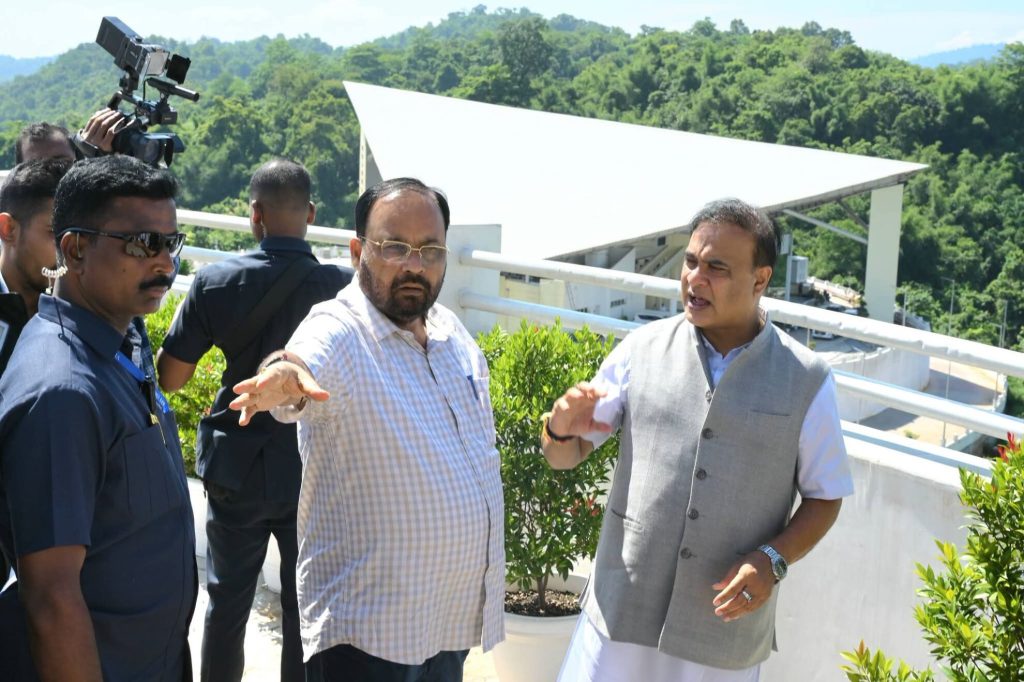
Chief Minister Himanta Biswa Sarma reviewed the ongoing development work at the Science City on August 10 and directed officials to accelerate construction and infrastructure development. The government has set an ambitious target of completing the remaining works by March 2027.
The additional investment is expected to support the next phase of development and help transform the Science City into a major destination for students, educators, families and science enthusiasts across Assam and the wider Northeast.
The announcement comes only months after the first phase of the project was inaugurated in March 2026.
Why the ₹100 Crore Investment Matters
The additional funding is not simply an infrastructure allocation.
The larger objective is to create a science-learning ecosystem where students can experience scientific concepts through interactive exhibits, immersive technology and hands-on learning.
The project is designed to complement conventional classroom education by giving students opportunities to explore science outside textbooks.
The Science City is expected to strengthen:
- Scientific curiosity among school students
- Experiential learning
- STEM education
- Public understanding of science
- Science communication
- Student exposure to emerging technologies
- Educational tourism in Assam
For a region seeking to strengthen its scientific and technological ecosystem, the project could become an important educational asset.
Guwahati Science City: From Vision to Reality
The first phase of Science City, Guwahati, was inaugurated on March 10, 2026, at Tepesia in Sonapur.
The project has been conceptualised, designed and developed by the National Council of Science Museums (NCSM) under the Ministry of Culture’s Scheme for Promotion of Culture of Science (SPoCS).
The first phase covers around 82 acres and has been designed around immersive and interactive approaches to science learning.
Rather than functioning simply as a conventional museum, the Science City is intended to encourage visitors to interact with scientific concepts.
What Can Students Expect at Guwahati Science City?
The first phase already includes several major attractions.
Eureka Building
The Eureka Building houses:
- An interactive Eureka Gallery
- VR Theatre
- Digital Adventure Gallery
These facilities are designed to make scientific concepts more engaging through interactive and digital experiences.
Space Odyssey Building
The Space Odyssey Building focuses on astronomy and space-related learning.
Its facilities include:
- Astronomy Gallery
- Knowledge on Sphere installation
- Astronomy-related exhibitions
A panel exhibition titled “Carved in Time: The Ascent of Astronomy” is also part of the facility.
Omni Theatre
Another major attraction is the Omni Theatre, which offers an immersive 360-degree film experience.
The inaugural presentation features “Lion of Saraighat – Veer Lachit Barphukan”, bringing together technology, history and visual storytelling.
More Than a Science Museum
One of the most important aspects of the project is its potential role in education.
Traditional science education often depends heavily on classrooms, textbooks and laboratory demonstrations.
Science centres can provide another layer:
Classroom learning → Interactive experience → Experimentation → Curiosity → Deeper understanding
This approach can be especially valuable for younger students who may find abstract scientific concepts difficult to understand through text alone.
A student studying astronomy, for example, can encounter planets, stars and cosmic phenomena through immersive visual experiences rather than relying entirely on diagrams in a textbook.
Assam’s Push for STEM Education
The investment also comes amid a wider effort to strengthen science, technology, engineering and mathematics (STEM) education.
STEM skills are increasingly important as India expands its capabilities in areas such as:
- Artificial intelligence
- Space technology
- Semiconductor manufacturing
- Robotics
- Biotechnology
- Electronics
- Digital technologies
Science infrastructure that encourages students to engage with these subjects at an early age can help build long-term interest in scientific careers.
For Assam and the Northeast, such facilities can provide students with exposure to scientific ideas that may otherwise require travel to major metropolitan centres.
Guwahati Science City Could Become a Regional Hub
The project’s location gives it significance beyond Guwahati.
As one of the Northeast’s largest urban centres, Guwahati has the potential to serve as a gateway for students from across the region.
A well-developed Science City could attract:
- School groups
- College students
- Teachers
- Researchers
- Families
- Science enthusiasts
- Educational institutions
This could eventually turn the facility into a regional science-learning destination for the Northeast.
Science Education Beyond the Classroom
The central idea behind facilities such as Science City is simple:
Students learn science better when they can experience it.
Interactive learning can encourage students to ask questions rather than simply memorise answers.
For example:
Instead of only reading about a physical phenomenon, students can interact with a model.
Instead of only studying astronomy from a textbook, they can explore an immersive space exhibit.
Instead of learning about digital technology theoretically, they can experience technology-driven installations.
This makes science more tangible and potentially more memorable.
The Role of Interactive Technology
Technology is becoming increasingly important in science communication.
The Guwahati Science City already incorporates technologies such as virtual reality and immersive digital experiences.
Such tools can help explain concepts that are otherwise difficult to demonstrate physically.
Virtual environments can potentially allow students to explore:
- Space
- Scientific simulations
- Historical scientific developments
- Complex physical processes
- Digital environments
The challenge, however, will be to ensure that technology remains a tool for learning rather than becoming an attraction disconnected from educational objectives.
₹100 Crore Push for the Next Stage
The newly announced ₹100 crore allocation is intended to accelerate the next stage of development.
The additional funding comes as authorities review ongoing works and seek to complete the broader project within the targeted timeline.
The Assam government has set March 2027 as the target for completion of the remaining development work.
The next phase could therefore determine how comprehensively the Science City evolves from its initial facilities into the larger science and educational hub envisioned for the site.
Why the Project Matters for Assam’s Students
For students in Assam, the Science City could provide an important new avenue for experiential learning.
Its potential benefits include:
Better Science Exposure
Students can encounter scientific concepts outside the classroom.
Greater STEM Awareness
Interactive experiences may encourage students to consider science and technology careers.
Learning Through Exploration
Students can learn by observing, questioning and interacting.
Teacher Support
Science centres can also serve as supplementary resources for teachers planning educational visits.
Wider Access
A major science facility in Assam can reduce the need for students to travel outside the Northeast for certain science-learning experiences.
Could Science City Boost Educational Tourism?
The project also has potential implications for educational tourism.
School trips can combine education with travel, giving students exposure to scientific and cultural attractions.
If Guwahati Science City develops into a major regional facility, schools from different parts of Assam and neighbouring states could potentially include it in educational itineraries.
This could create an ecosystem involving:
Schools + Science City + Teachers + Tourism + Local Economy
The wider impact would depend on accessibility, programming and the quality of visitor experiences.
Science City and Assam’s Emerging Technology Ecosystem
Assam is also positioning itself for growth in technology and advanced manufacturing.
The state’s broader development ambitions include expanding opportunities in areas connected with electronics, digital technologies and industrial innovation.
In that context, a large public science facility can play a complementary role by encouraging students to develop interest in science and technology before they enter higher education.
Long-term technology development depends not only on infrastructure and investment but also on the availability of skilled human resources.
That pipeline begins in schools.
From Curiosity to Careers
One of the project’s most important long-term objectives could be to inspire students to consider careers in scientific fields.
A child who develops an interest in astronomy through an immersive exhibition may later study physics.
A student fascinated by robotics may choose engineering.
Another student attracted to digital technology may pursue computer science or artificial intelligence.
The pathway can begin with something as simple as curiosity.
Curiosity → Exploration → Interest → Education → Skills → Career
This is where science centres can have an impact that extends beyond visitor numbers.