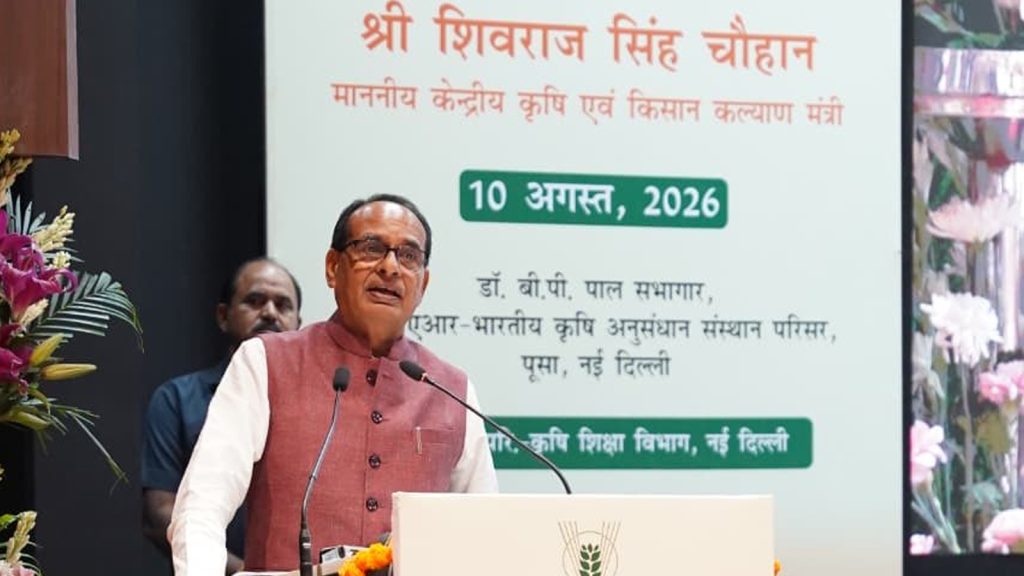
The Centre has launched a new National Scholarship Portal (NSP)-based scholarship disbursement system for agriculture students, with more than 6,000 students receiving ₹21.35 crore through Direct Benefit Transfer (DBT).
Union Agriculture and Farmers’ Welfare Minister Shivraj Singh Chouhan launched the initiative at the ICAR-Indian Agricultural Research Institute (ICAR-IARI), Pusa, with the government positioning the new system as a step towards making scholarship payments faster, more transparent and easier for students.
Under the new arrangement, eligible agriculture students will receive scholarship and fellowship assistance directly through DBT on a monthly basis, reducing dependence on traditional payment processes and helping minimise delays.
The initiative comes at a time when agricultural education is being increasingly linked with research, technology, entrepreneurship and practical skills.
₹21.35 Crore Transferred to More Than 6,000 Students
The first major outcome of the new system is already visible.
According to the government, over 6,000 agriculture students have received a combined ₹21.35 crore through the NSP-DBT mechanism. The money has been transferred directly to beneficiaries rather than being routed through lengthy conventional disbursement procedures.
The move is intended to address one of the recurring concerns associated with scholarship schemes: timely access to financial assistance.
For students relying on scholarships or fellowships to support their education, delays can create uncertainty around living expenses, academic requirements and other education-related costs.
A direct-transfer system is designed to make the process more predictable.
What Is the NSP-DBT System?
The National Scholarship Portal-Direct Benefit Transfer (NSP-DBT) system combines a centralised digital scholarship platform with direct transfers to eligible students’ bank accounts.
In practical terms, the system is intended to create a simpler chain:
Scholarship approval → Digital processing → DBT → Student’s bank account
The government says the new arrangement will make scholarship distribution transparent, faster and seamless, while reducing unnecessary delays.
The new initiative is particularly relevant for agriculture students receiving scholarships and fellowships under the system supported through the agricultural education ecosystem.
Monthly Scholarship Payments: What Changes for Students?
One of the most significant features of the initiative is the move towards monthly scholarship payments through DBT.
Instead of students having to wait for lengthy disbursement cycles, the new system is designed to provide financial support at regular intervals.
This could help students manage their educational expenses with greater certainty.
The government has described timely payment as an important part of an effective scholarship system, alongside timely examinations and admissions.
For beneficiaries, the practical benefit is straightforward:
Less uncertainty about payment. More predictable financial support.
Why Timely Scholarships Matter
Scholarships are more than financial awards.
For many students, financial assistance can determine whether they are able to continue their education comfortably and focus on their academic work.
Agricultural education can involve expenses connected with:
- Academic materials
- Practical training
- Field-based activities
- Accommodation
- Travel
- Research
- Educational projects
Regular financial assistance can therefore provide students with greater stability while they pursue their studies.
The government’s focus on direct and timely payment is intended to make scholarship support more effective at the student level.
Shivraj Singh Chouhan Emphasises Practical Agricultural Education
Speaking at the launch, Agriculture Minister Shivraj Singh Chouhan stressed that agricultural education cannot remain confined to classrooms.
He emphasised the importance of practical training and hands-on exposure, arguing that students need to understand real agricultural conditions and develop skills that can be applied outside academic settings.
This approach reflects the changing nature of agriculture itself.
Modern agriculture increasingly involves:
- Scientific crop management
- Biotechnology
- Artificial intelligence
- Data-based farming
- Climate-resilient agriculture
- Agricultural engineering
- Food processing
- Agri-business
- Entrepreneurship
Students therefore need both theoretical knowledge and practical capabilities.
From Classrooms to Fields: The Changing Face of Agricultural Education
Agriculture is no longer simply associated with traditional farming methods.
The sector is increasingly influenced by science and technology.
Today’s agriculture students may eventually work in fields such as:
Agricultural Technology
Technology can help farmers improve productivity, monitor crops and make better-informed decisions.
Biotechnology
Scientific research is contributing to crop improvement, disease management and other agricultural applications.
Climate-Smart Agriculture
Changing weather patterns are increasing the need for farming systems that use resources efficiently and withstand environmental challenges.
Food Technology
Agriculture increasingly connects with food processing, storage, supply chains and nutrition.
Agri-Entrepreneurship
Young professionals can develop businesses around farm technology, inputs, processing, logistics and other parts of the agricultural value chain.
This is why practical education is becoming increasingly important.
Minister Calls on Students to Look Beyond Jobs
Chouhan also encouraged agriculture students to think beyond conventional employment.
He urged young people to explore innovation, research and start-ups and to view agriculture as a sector with opportunities for entrepreneurship and problem-solving.
The message reflects a broader shift in how agricultural careers are being viewed.
Instead of seeing agriculture only as a traditional occupation, students can increasingly approach it as a multidisciplinary sector involving:
Science + Technology + Business + Research + Sustainability
This broader perspective could encourage more young people to pursue careers connected with agricultural innovation.
Agriculture, Science and Food Security
The scholarship initiative also forms part of a wider emphasis on strengthening India’s agricultural knowledge ecosystem.
Chouhan highlighted the contributions of ICAR scientists and farmers to agricultural development and food security.
Research institutions play a critical role in developing technologies and practices that can help address challenges such as:
- Food demand
- Climate variability
- Soil health
- Water efficiency
- Crop productivity
- Nutrition
- Farm incomes
Educating the next generation of agricultural scientists and professionals is therefore closely connected with India’s long-term food-security objectives.
Why the Scholarship Initiative Is Important for Agriculture Students
The new NSP-DBT system combines financial assistance with a wider effort to strengthen agricultural education.
Its potential benefits include:
Faster Payments
Direct transfers are designed to reduce delays.
Greater Transparency
Digital processing and direct transfers can make the movement of scholarship funds easier to track.
Regular Support
Monthly payments can give eligible students greater financial predictability.
Reduced Administrative Burden
A streamlined digital process can reduce paperwork and unnecessary procedural hurdles.
Greater Focus on Education
Timely financial support can allow students to concentrate more fully on their academic and practical training.
A Digital Shift in Scholarship Delivery
The initiative also reflects the broader movement towards digital delivery of government benefits.
Digital systems can make it easier to process large numbers of beneficiaries while improving transparency and reducing manual intervention.
The model can be understood through four stages:
Application → Verification → Approval → Direct Payment
When these stages work efficiently, students can receive assistance without prolonged administrative delays.
However, the success of such systems ultimately depends on accurate student records, timely verification and smooth coordination among institutions and government agencies.
What Students Should Know About NSP
The National Scholarship Portal serves as a central digital platform for scholarship-related services.
Students using scholarship schemes should generally pay attention to:
- Eligibility requirements
- Application deadlines
- Required documents
- Bank-account details
- Aadhaar-linked requirements where applicable
- Verification by the relevant institution
- Scholarship status
- Payment status
For agriculture students covered under the new initiative, accurate information and timely institutional verification will remain important for smooth scholarship processing.
Practical Training and Scholarships: Two Sides of Student Support
The latest initiative highlights an important point about education policy.
Financial support alone does not guarantee educational success.
Students also need:
Financial support + Quality teaching + Practical training + Research exposure + Career opportunities
The government is therefore linking the scholarship initiative with a wider message about improving the quality and relevance of agricultural education.
The objective is not simply to help students complete their courses but to prepare them for meaningful roles in India’s agriculture and food systems.
Encouraging Innovation Among Young Agriculture Professionals
India’s agriculture sector faces complex challenges that require new ideas.
Young professionals can contribute through:
- Farm technology
- Precision agriculture
- Crop research
- Water management
- Sustainable farming
- Supply-chain innovation
- Food processing
- Agricultural entrepreneurship
- Rural technology
By encouraging students to pursue research and start-ups, the government is seeking to expand the role of young people within the agricultural innovation ecosystem.
Plantation Drive Appeal to Agriculture Students
During the programme, Chouhan also appealed to agriculture students to undertake plantation drives at ICAR institutions across the country on Hariyali Amavasya.
The appeal connects agricultural education with environmental responsibility.
For students studying agriculture, environmental sustainability is increasingly relevant to their future professional roles.
Issues such as soil degradation, water conservation, biodiversity and climate resilience are becoming integral to modern agricultural planning.
NSP-DBT Agriculture Scholarship: Key Facts
| Key Point | Details |
|---|---|
| Initiative | NSP-DBT scholarship system for agriculture students |
| Launched by | Shivraj Singh Chouhan |
| Ministry | Ministry of Agriculture and Farmers’ Welfare |
| Venue | ICAR-IARI, Pusa |
| Beneficiaries | More than 6,000 agriculture students |
| Amount disbursed | ₹21.35 crore |
| Payment mechanism | Direct Benefit Transfer |
| Payment frequency | Monthly |
| Main objective | Faster and transparent scholarship disbursement |
| Wider focus | Practical training, innovation and agricultural education |
| Additional appeal | Plantation drives at ICAR institutions |
The beneficiary and disbursement figures come from the official government announcement.
What This Means for the Future of Agricultural Education
The new scholarship system could become an important part of efforts to make agricultural education more student-friendly.
But its larger significance lies in the combination of financial support and educational reform.
A student who receives timely financial assistance is better positioned to focus on studies. A student who also receives practical training can develop stronger professional skills. And a student exposed to research and entrepreneurship can potentially become a creator of new agricultural solutions.
That creates a broader educational pathway:
Scholarship → Education → Practical Skills → Innovation → Employment or Entrepreneurship
The Bigger Picture: Investing in India’s Agricultural Talent
India’s agricultural future will depend heavily on its ability to develop skilled professionals who can respond to changing food, climate and economic challenges.
Scholarships can help make agricultural education more accessible and financially sustainable for students.
Practical training can make that education more relevant.
Research can turn knowledge into solutions.
And entrepreneurship can take those solutions from laboratories and classrooms into the real economy.
The NSP-DBT initiative addresses the first part of that chain — ensuring students receive financial support on time — while the government’s broader message focuses on strengthening the remaining links.