Published on October 27 , 2025
Delhi, India
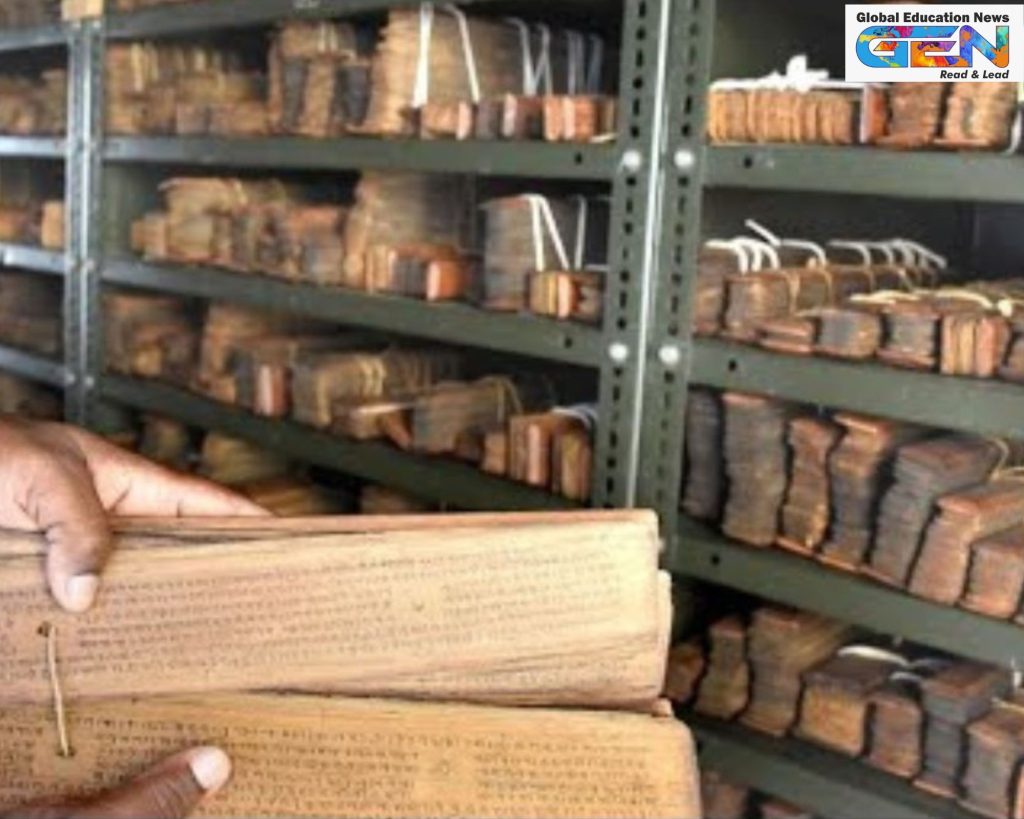
The Gyan Bharatam Mission, a flagship initiative of the Union Ministry of Culture, has taken a significant leap forward by signing Memorandums of Understanding (MoUs) with 20 prestigious institutions on October 25, 2025, to conserve, digitize, and promote India’s vast manuscript heritage. Announced in the Union Budget 2025-26, this mission builds on the National Mission for Manuscripts (NMM) and aims to survey, document, and digitize over 1 crore manuscripts—estimated at 10 million in total—spanning 80 ancient scripts like Sanskrit, Pali, Prakrit, Brahmi, and more. With a budget of ₹482.85 crore from 2024-2031, the mission integrates cutting-edge technologies to create a unified National Digital Repository (NDR), making centuries-old knowledge accessible worldwide. An additional 30 institutions are slated to join soon, amplifying the effort to safeguard what Prime Minister Narendra Modi called “chapters of India’s soul.”
Key Points
- Launch Timeline: Officially unveiled by PM Modi on July 28, 2025, during the 124th episode of Mann Ki Baat; restructured from NMM in March 2025 as a Central Sector Scheme.
- Scale and Scope: Targets digitization of 50 crore manuscript pages; already 3.5 lakh manuscripts (3.5 crore folios) digitized, with 76,000 freely accessible online.
- Funding Boost: Allocation surged from ₹3.5 crore to ₹60 crore in 2025-26, supporting equipment, training, and outreach.
The Gyan Bharatam Mission: Objectives and Framework
Rooted in Article 51A(f) of the Constitution—to value and preserve India’s composite culture—the mission focuses on holistic preservation. It encompasses survey and cataloging, conservation, digitization, translation, research, and public outreach. Institutions are classified as Cluster Centres (overseeing up to 20 partners) or Independent Centres (handling internal collections). Each will establish a dedicated Gyan Bharatam Cell for coordination, with the ministry providing frameworks, funding (70% upfront, 30% post-verification), equipment, and third-party monitoring. The initiative follows a phased rollout: Phase 1 for setup and pilots, Phase 2 for NDR launch, and Phase 3 for global integration.
Key Points
- Core Goals: Identify unknown manuscript reserves at grassroots levels; create multilingual metadata catalogs; ensure scientific conservation using archival materials like plastic imaging and wafer-fiche.
- Technological Edge: Employs AI for transcription, OCR for script recognition, blockchain for provenance tracking, and computer vision for layout analysis—addressing challenges like ink bleeding, worm damage, and fragile palm leaves.
- Phased Implementation: Pilot digitization and training in 2025; full NDR rollout by 2026; outreach via VR/AR experiences, educational modules, and Manuscript Melas.
Participating Institutes: Pillars of Preservation
The 20 inaugural partners represent a diverse network of cultural custodians, from ancient libraries to modern universities. These institutes will lead surveys, conservation, and digitization efforts, fostering collaboration across regions. Early examples include fragile birch bark texts like the Bakhshali manuscript (3rd-4th century AD), showcasing early use of zero, and illustrated works on mathematics, medicine, and philosophy.
Key Points
- Notable Partners: Asiatic Society, Kolkata; University of Kashmir, Srinagar; Hindi Sahitya Sammelan, Prayagraj; Government Oriental Manuscript Library, Chennai; Indira Gandhi National Centre for the Arts (IGNCA); and others like Rampur Raza Library and Bhandarkar Oriental Research Institute.
- Roles Defined: Cluster Centres coordinate multi-institution activities; Independent Centres focus on in-house collections; all commit to voluntary service and annual progress reports.
- Expansion Plans: 30 more institutes, including international collaborators, to join by year-end, enhancing nationwide coverage.
Technological Innovations: Bridging Past and Future
At the mission’s core is a tech-driven approach to handle diverse formats—from palm leaves to birch bark. The NDR will feature APIs for global integration, semantic models for text parsing, and immersive tools like virtual museums. A recent hackathon at the Gyan Bharatam Conference (September 11-13, 2025) awarded top AI solutions for manuscript accessibility, emphasizing usability and sustainability.
Key Points
- Key Tools: High-resolution imaging with standardized protocols; AI-assisted platforms for multilingual transcription; blockchain to verify authenticity and prevent forgeries.
- Challenges Addressed: Handles translucent pages, stains, and visual elements like maps; ensures long-term archival via digital formats.
- Public Access: Free online portal with 1.35 lakh digitized items already uploaded; future integrations with UNESCO archives.
Significance: A Cultural Renaissance in the Digital Age
Gyan Bharatam transcends preservation—it’s a revival of India’s knowledge systems in philosophy, science, and arts, countering historical losses from invasions and time. By democratizing access, it empowers researchers, educators, and youth, fostering global scholarship. Union Culture Minister Gajendra Singh Shekhawat hailed it as a “cultural renaissance,” turning manuscripts into a “mass movement” for national pride.
Key Points
- Heritage Impact: Protects 10 million manuscripts as UNESCO’s “Memory of the World”; bridges ancient wisdom (e.g., Ayurveda texts) with modern applications like AI ethics.
- Broader Ties: Aligns with Digital India, language revitalization, and Fundamental Duties; promotes monetization for custodians via APIs.
- Global Reach: Encourages international partnerships; PM Modi emphasized collective effort to connect past norms with future innovations.