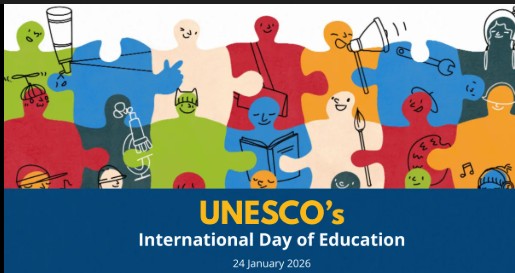
Every January 24, the world pauses to honor the International Day of Education—a vibrant UNESCO-led observance that champions learning as the ultimate force for peace, progress, and human dignity. Proclaimed by the United Nations General Assembly on December 3, 2018, via Resolution 73/25, this day isn’t just a calendar mark; it’s a rallying cry for inclusive, equitable education that empowers every child to dream big. Since its debut in 2019, it has evolved into a hybrid whirlwind of events—from UNESCO’s Paris headquarters to youth-driven webinars and social media storms—uniting students, policymakers, and changemakers to tackle SDG4’s bold promise: quality education for all by 2030. In India, where 250 million schoolgoers navigate diverse challenges, the 2026 theme “The power of youth in co-creating education” hits home, urging young voices to shape systems amid tech leaps and social shifts. As UNESCO Director-General Audrey Azoulay reflects, it’s about turning “beneficiaries into builders”—a timely nudge for a nation racing toward Viksit Bharat.
Key Points:
- Proclamation Pulse: UN Resolution 73/25 (Dec 3, 2018); first celebrated Jan 24, 2019.
- Global Glue: Hybrid events in Paris; youth webinars/social campaigns for SDG4.
- India Impact: 250M learners; theme spotlights co-creation in diverse India.
- Azoulay’s Affirm: “Beneficiaries to builders”; Viksit Bharat nudge.
History: From UN Resolution to a Decade of Global Awakening
The seeds of International Day of Education were sown in the UN General Assembly’s 73rd session, where Resolution 73/25—adopted unanimously—declared January 24 as the annual beacon for education’s role in fostering peace and sustainable development. Inspired by SDG4’s 2015 launch, it addressed stark realities: 258 million children out of school globally, per UNESCO stats. The inaugural 2019 event, themed “What you need to know about the right to education,” kicked off with Paris gatherings and worldwide dialogues, evolving yearly to tackle crises like COVID learning losses (affecting 1.6 billion kids). By 2026, a decade in, it has mobilized millions, from Indian village story circles to African policy huddles—proving education’s ripple from classrooms to corridors of power.
Key Points:
- Resolution Roots: UNGA 73rd session; SDG4-inspired for peace/sustainability.
- Debut Drive: 2019 theme “Right to education”; Paris kickoff amid 258M out-of-school crisis.
- Evolution Echo: COVID (1.6B affected) to 2026 decade; millions mobilized.
- Ripple Reach: Village circles to policy halls worldwide.
Why Celebrated: Education as the Bedrock of Peace and Progress
January 24 isn’t a holiday—it’s a global huddle to spotlight education’s superpowers: dismantling inequality, sparking innovation, and weaving social fabrics. UNESCO champions it to rally commitments for SDG4, urging governments, NGOs, and communities to plug gaps like the 69 million girls denied schooling (UNESCO 2023). From hybrid forums in Paris to youth-led webinars on storytelling and leadership, the day amplifies voices—encouraging social media shares of “good practices” for youth involvement. In India, it resonates amid 20% foundational learning poverty (ASER 2025), pushing for equitable access and lifelong vibes. Simply put: celebrate education, and you celebrate humanity’s upgrade.
Key Points:
- Superpower Spotlight: Inequality bust, innovation spark, social weave; SDG4 rally.
- Gap Plug: 69M girls out (UNESCO 2023); Paris hybrids/youth webinars.
- India Ink: 20% poverty fix (ASER); equitable lifelong push.
- Humanity Hack: Education = upgrade.
Theme for 2026: “The Power of Youth in Co-Creating Education” – Tomorrow’s Builders Today
2026’s theme flips the script: youth aren’t passive pupils but active architects, co-shaping learning amid tech tsunamis and social swells. With over half the world under 30, UNESCO spotlights their genius in designing delivery, governance, and dreams—aligning aspirations with inclusive, future-proof systems. Expect Paris panels on youth policy input, global webinars on leadership, and social storms sharing co-creation wins. For India’s 600 million under-25s, it’s a call to hack curricula for AI ethics or climate action—turning “taught” to “together.”
Key Points:
- Script Flip: Youth as architects; half-world under 30’s genius.
- Design Drive: Delivery/governance/dreams; tech/social alignment.
- Event Energy: Paris panels, webinars, social wins.
- India Ignite: 600M under-25; AI/climate co-hack.
Significance: SDG4’s Lifeline in a Fragmented World
This day isn’t fluff—it’s SDG4’s heartbeat, reaffirming education as a human right that powers peace, eradicates poverty, and ignites equality. In a fractured globe—258M kids sidelined, 69M girls lost—it rallies $100B+ annual commitments for quality, lifelong learning. For India, battling 20% poverty and 10% gender gaps (ASER), it’s a mirror: amplify youth voices to craft equitable systems. UNESCO’s Azoulay nails it: “Education is the most powerful weapon… for peace and development.” Globally, it sparks policy pivots; locally, village vibes.
Key Points:
- Heartbeat Hammer: SDG4 right; poverty/equality igniter.
- Global Grind: 258M kids/69M girls; $100B commitments.
- India Mirror: 20% poverty/10% gaps; youth equity craft.
- Azoulay Arrow: “Powerful weapon for peace/development.”