In May 2025, U.S. President Donald Trump visited Saudi Arabia, securing a historic $600 billion investment commitment and the largest $142 billion defense cooperation agreement in U.S. history. This visit, prioritizing economic ties over security, aligns with Saudi Arabia’s Vision 2030 to diversify its oil-dependent economy. Meanwhile, India’s 2024 displacement crisis, with 5.4 million uprooted by floods and cyclones, underscores the need for accurate weather forecasting, threatened by NOAA’s 25% budget cut. This article connects Trump’s diplomatic triumph, Saudi’s economic ambitions, and India’s climate challenges, weaving in the innovative AI-powered weather balloons as a solution. Packed with SEO keywords and engaging insights, it’s designed to captivate and drive clicks.
Trump’s Saudi Triumph: $600B Investment, $142B Defense Deal
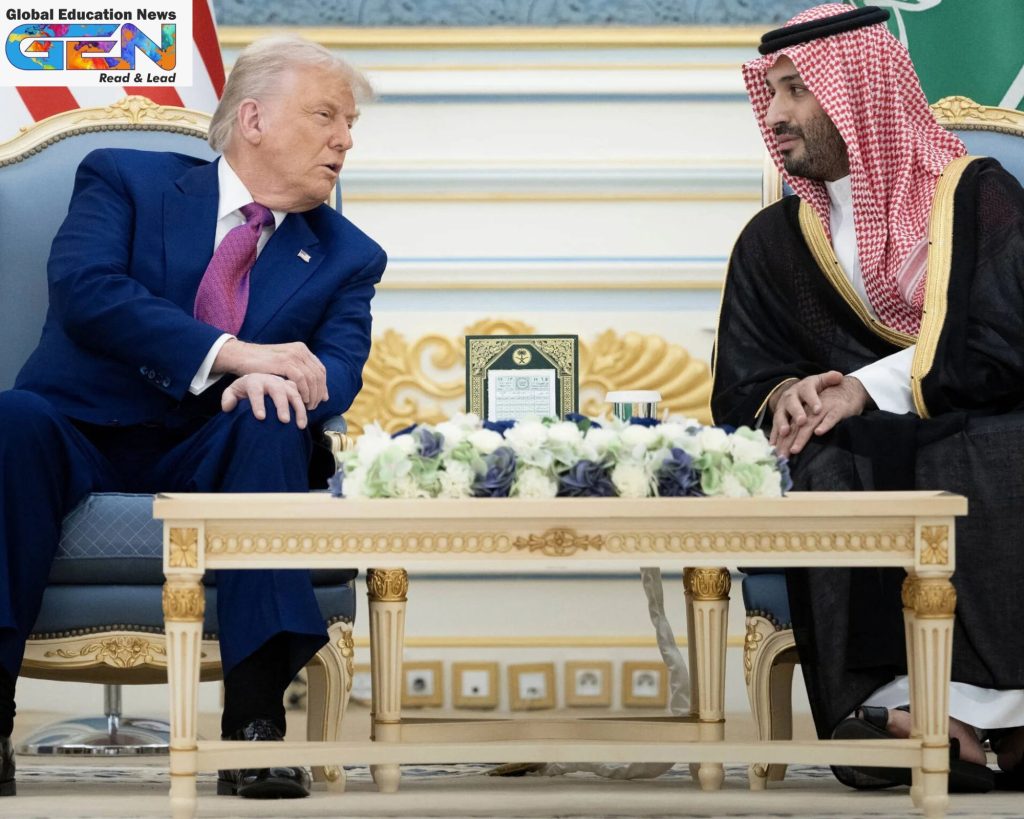
Trump’s visit to Riyadh on May 13, 2025, marked a pivotal moment in U.S.-Saudi relations. Welcomed by Crown Prince Mohammed bin Salman (MbS), Trump signed agreements at the U.S.-Saudi Investment Forum, securing $600 billion in investments, with $300 billion inked during the event and plans to scale to $1 trillion. The $142 billion defense deal, dubbed the largest in U.S. history, involves over a dozen U.S. firms supplying air defense, space tech, and maritime security systems.
- Key Points:
- $600B investment includes $20B for AI data centers, $80B in tech.
- Defense deal covers air force, missile defense, and communications.
- Saudi aims for $1T total investment, per MbS.
Saudi Arabia’s Vision 2030: Beyond Oil
Saudi Arabia’s Vision 2030, led by MbS, seeks to diversify its economy, with oil accounting for 62% of 2024 revenue. Projects like NEOM, a futuristic city the size of Belgium, aim to boost tourism and tech, but low oil prices ($64.77/barrel Brent crude) and high costs strain budgets. The $600B U.S. investment supports AI, energy, and infrastructure, aligning with Vision 2030’s goal to reduce oil reliance.
- Key Points:
- NEOM and Red Sea Global target global tourists.
- Oil’s fiscal break-even price: $96–98/barrel.
- U.S. tech firms like Google, Oracle join Saudi AI push.
India’s 2024 Displacement Crisis: A Climate Emergency
In 2024, India faced 5.4 million displacements, driven by Assam’s 2.5M flood victims, Cyclone Dana’s 1M+ evacuations in Odisha and West Bengal, and Tripura’s 315,000 landslide displacements. Climate change, deforestation, and poor infrastructure worsened these disasters, with 314 extreme weather days killing 3,000 and ruining 2M hectares of crops. Accurate weather forecasting, reliant on global data, is critical to mitigate such crises.
- Key Points:
- Assam’s Brahmaputra floods worst in a decade.
- Cyclone Remal displaced 546,000 across Assam, West Bengal.
- 80% of India’s population in disaster-prone zones.
NOAA Budget Cuts Threaten Global Forecasting
The Trump administration’s 25% NOAA budget cut ($1.6B from $6B) has reduced weather balloon launches, dropping U.S. data by 10% since March 2025. This threatens global models like GFS, used by India to predict cyclones. Fewer launches echo Russia’s 2015 cuts, which slashed forecast accuracy. With India’s 5.4M displacements tied to weather, degraded forecasts could cost lives.
- Key Points:
- NOAA cuts target balloon launches, research.
- 900 global stations, including India’s, launch balloons twice daily.
- Reduced data risks hurricane forecast errors.
AI-Powered Balloons: A Forecasting Lifeline
WindBorne, a Silicon Valley State of the art AI-powered weather balloons, developed by a Silicon Valley startup, offer a solution to NOAA’s cuts. These balloons, with satellite connectivity and motor-controlled ballast, stay aloft for weeks, collecting data at lower costs than NOAA’s latex balloons. Scaling WindBorne’s fleet could restore data, aiding India’s cyclone predictions and supporting Saudi’s tech ambitions under Vision 2030.
- Key Points:
- WindBorne balloons last weeks, unlike NOAA’s one-day balloons.
- Potential NOAA partnership to offset data losses.
- Supports Saudi’s AI infrastructure goals.
Middle East Dynamics: Peace and Tensions
Trump’s visit skipped Israel, raising questions about U.S. priorities amid Gaza’s 19-month war and Lebanon conflicts. Trump hopes Saudi normalizes ties with Israel, but Netanyahu’s opposition to a Palestinian state stalls progress. U.S.-Saudi ties, rooted in oil-for-security, strengthen with the $142B arms deal, but past tensions (e.g., Khashoggi killing) linger. Trump’s Syria sanctions lift and Iran nuclear talks signal broader peace efforts.
- Key Points:
- No Israel stop, despite Gaza ceasefire push.
- $142B deal includes potential F-35 sales.
- Syria’s new leader met Trump in Riyadh.
Why It Matters: Global Impact
Trump’s $600B Saudi deal boosts U.S. jobs and tech, while Vision 2030 transforms Saudi’s economy. India’s 5.4M displacements highlight the stakes of accurate forecasting, threatened by NOAA cuts. AI balloons could bridge gaps, aiding India and Saudi’s tech goals. Middle East peace efforts, though complex, shape global stability, with India’s climate crisis underscoring urgency.
- Key Points:
- U.S. gains jobs; Saudi diversifies economy.
- NOAA cuts risk India’s disaster response.
- AI balloons link climate and tech solutions.
Call to Action
Trump’s Saudi triumph and India’s climate crisis demand action. Share this with #TrumpSaudi2025 and #IndiaClimateCrisis to spark change. Urge leaders to fund IMD, adopt AI balloons, and push Middle East peace. Subscribe for updates on global deals and climate solutions!