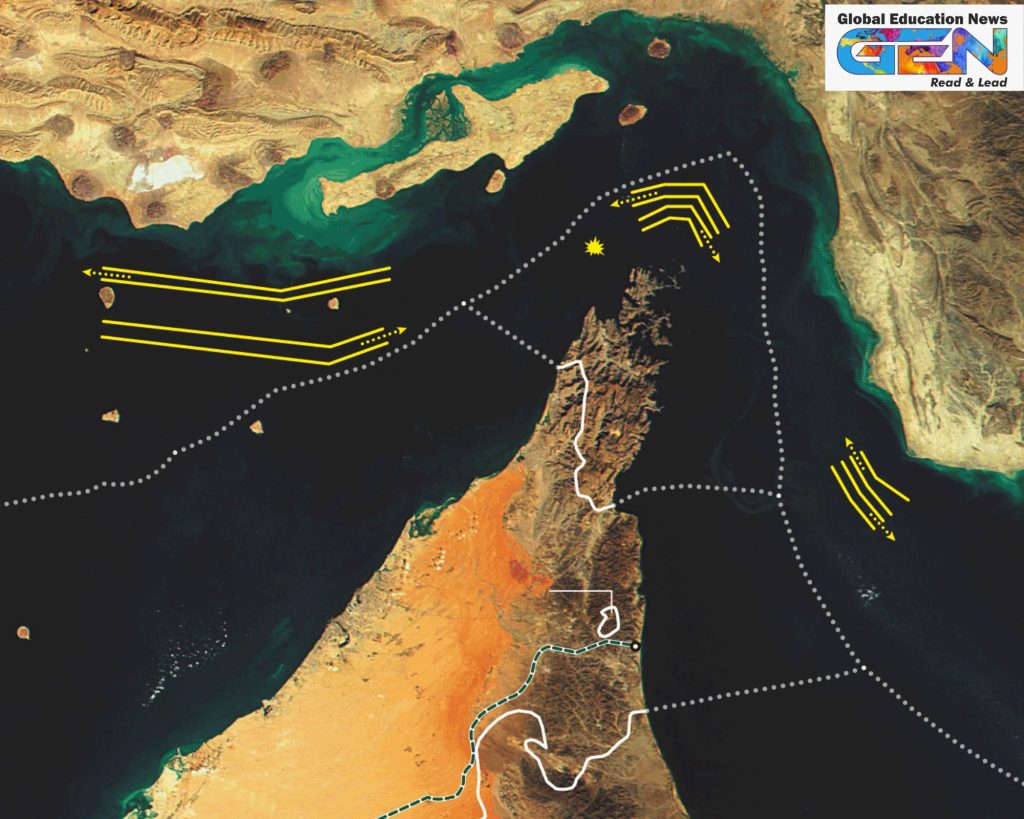
Imagine a narrow waterway that holds the key to the world’s energy supply. That’s the Strait of Hormuz, a 33-km-wide passage linking the Persian Gulf to the Gulf of Oman. Every day, 20 million barrels of oil—more than a quarter of the world’s seaborne oil trade—flow through this vital route, alongside 83% of global LNG trade. Flanked by Iran and Oman, it’s a geopolitical powder keg where tensions could spark global chaos. With Iran and the US at odds, the question looms: could this tiny strait grind the world’s economy to a halt?
- Connects Persian Gulf to Gulf of Oman, only 33 km wide at its narrowest.
- Handles 20 million barrels of oil daily—over 25% of global seaborne trade.
- Bordered by Iran and Oman, a hotspot for strategic control.
What Happens If Iran Blocks the Strait?
Key Points:
- Oil prices could skyrocket, disrupting global markets.
- Shipping costs would surge, hitting energy-dependent nations hard.
- 83% of LNG trade faces delays, per US Energy Information Administration.
A blockade of the Strait of Hormuz would be an economic earthquake. Global oil prices would likely spike as supply chains choke, with 20 million barrels daily at risk. The US Energy Information Administration (EIA) notes that 83% of LNG trade relies on this route, meaning delays could cripple energy markets. Higher shipping costs and supply shortages would hit countries like Japan, South Korea, and India hardest, destabilizing economies worldwide. X posts warn of “oil shock” scenarios, signaling the high stakes of any disruption.
Iran’s High-Stakes Gamble
Key Points:
- Iran has never fully blocked the strait, even during the Iran-Iraq War.
- China buys discounted Iranian oil via the strait, tying Iran’s economy to it.
- A blockade could alienate allies and hurt Iran’s own exports.
Iran talks tough but plays smart. Historically, it avoided fully blocking the strait, even during the Iran-Iraq War when both sides attacked ships but kept traffic flowing. Why? Iran relies on the strait to export oil, especially to China, its top buyer at discounted rates. Closing it would slash Iran’s revenue and risk angering regional allies. Yet, with US sanctions biting, Iran might flex its muscles with partial disruptions, keeping the world on edge. X users speculate Iran’s “bluff” could still rattle markets without a full closure.
The US Military’s Watchful Eye
Key Points:
- US 5th Fleet in Bahrain ensures rapid response to threats.
- Military escalation could disrupt global shipping further.
- Iran’s actions might provoke a US-led coalition response.
The US 5th Fleet, stationed in Bahrain, stands guard over the Strait of Hormuz, ready to counter any Iranian moves. This military presence ensures a swift response but also raises risks. A clash could spiral into chaos, halting global shipping and spiking oil prices. Iran’s arsenal—mines, missiles, and fast boats—could challenge naval patrols, but a full blockade would likely trigger a US-led coalition retaliation. The delicate balance keeps tensions simmering, with X posts highlighting fears of a “hot conflict” in 2025.
India’s Energy Security at Risk
Key Points:
- 84% of India’s crude oil imports pass through the strait in 2024.
- A blockade would spike fuel prices, impacting India’s economy.
- Diversification efforts may soften but not eliminate the blow.
India’s economy hinges on the Strait of Hormuz. In 2024, 84% of its crude oil imports—critical for fuel and industry—flowed through this route. A blockade would send fuel prices soaring, hitting consumers and businesses alike. While India sources oil from Russia, Nigeria, and others, no alternative matches the strait’s volume. Price volatility could strain India’s energy security, with X users urging strategic reserves and diversification to cushion the impact. India’s challenge? Balancing cost and stability in a turbulent region.
Are There Alternatives to the Strait?
Key Points:
- Saudi Arabia’s Red Sea pipeline and UAE’s Gulf of Oman pipeline exist.
- Alternatives can’t match the strait’s 20 million barrel capacity.
- Longer routes mean higher costs and delays for global supply.
If the Strait of Hormuz shuts, are there detours? Yes, but they’re no match. Saudi Arabia runs a pipeline to the Red Sea, and the UAE has one to the Gulf of Oman, bypassing the strait. But these routes handle far less than 20 million barrels daily, and longer paths inflate shipping costs and delay deliveries. The EIA warns that no alternative fully replaces the strait, meaning disruptions would ripple through global oil supply chains. X discussions stress the urgency of new infrastructure to reduce this chokepoint’s grip.
What’s Next for the Strait of Hormuz?
Key Points:
- Diplomacy could ease tensions, but mistrust runs deep.
- Partial disruptions more likely than a full blockade.
- Global markets brace for volatility as 2025 unfolds.
The Strait of Hormuz remains a global flashpoint in 2025. While a full Iranian blockade seems unlikely—given Iran’s own reliance on the strait—partial disruptions or military posturing could still jolt oil and LNG markets. Diplomatic talks, like those hinted at in recent X posts, offer hope, but Iran-US mistrust keeps the region tense. For countries like India, bolstering strategic oil reserves and diversifying imports is critical. The world watches this narrow waterway, knowing its ripples could reshape economies. Stay tuned—this story’s far from over!