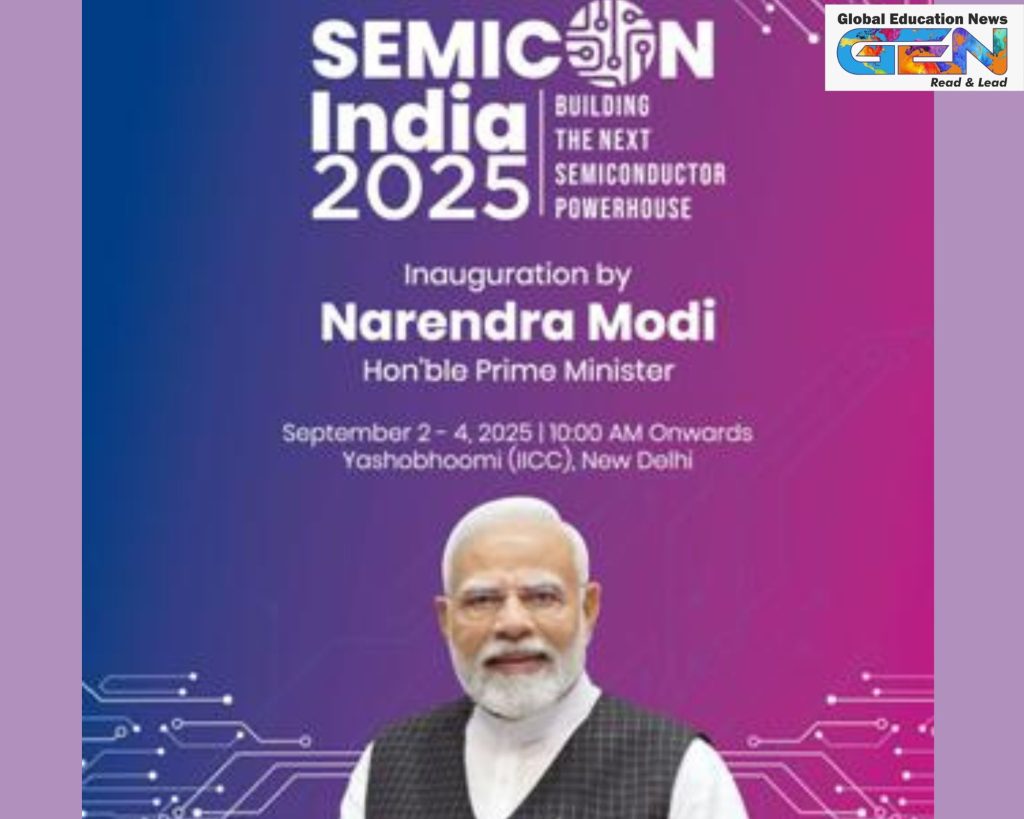
On September 2, 2025, Prime Minister Narendra Modi inaugurated the fourth edition of Semicon India 2025 in New Delhi, delivering a powerful message: “The world trusts India, believes in India, and is ready to build the semiconductor future with India.” Speaking at the Yashobhoomi convention center, Modi emphasized India’s growing role in the global semiconductor ecosystem, backed by significant investments and policy reforms under the India Semiconductor Mission (ISM) launched in 2021. The event, attended by over 2,500 delegates from 48 countries, showcased India’s ambition to become a key player in the projected $1 trillion semiconductor market.
Key Points:
- Global Trust: Delegations from over 40 countries signal international confidence in India’s semiconductor capabilities.
- Economic Impact: Modi highlighted India’s 7.8% GDP growth in Q1 FY 2025-26, showcasing resilience amid global economic challenges.
- Chips as Digital Diamonds: Modi called semiconductors the “digital diamonds” of the 21st century, driving global progress.
Milestones of the India Semiconductor Mission
Since its inception in 2021, the India Semiconductor Mission has driven remarkable progress, with 10 semiconductor projects worth $18 billion approved, including high-volume fabs, advanced packaging, and Outsourced Semiconductor Assembly and Test (OSAT) facilities. A key highlight was the presentation of the Vikram 32-bit processor, India’s first fully indigenous microprocessor, developed by ISRO’s Semi-Conductor Laboratory for space applications, along with test chips from four approved projects.
Key Points:
- Project Approvals:
- 2023: First semiconductor plant approved.
- 2024: Additional plants greenlit.
- 2025: Five more projects cleared, totaling ₹1.5 lakh crore in investments.
- Vikram Processor: Designed for harsh space conditions, marking a milestone in indigenous chip development.
- OSAT Pilot Line: India’s first end-to-end OSAT facility in Sanand, Gujarat, by CG-Semi, set to produce the first “Made in India” chip.
Policy Reforms and Global Competitiveness
Modi announced the upcoming next phase of the India Semiconductor Mission and the Design-Linked Incentive (DLI) scheme, which has sanctioned 23 chip design projects for applications in defense, aerospace, and electric vehicles. The National Single Window System streamlines approvals, reducing paperwork and accelerating project timelines. Modi emphasized, “The less paperwork, the sooner wafer work can start,” signaling investor-friendly reforms.
Key Points:
- DLI Scheme: Supports companies like Vervesemi Microelectronics in developing advanced chips.
- Critical Minerals Mission: Launched to secure rare earths essential for semiconductor manufacturing.
- Workforce Development: India hosts 20% of the world’s chip design engineers, with plans to train 1 million skilled workers by 2030 through SEMI University’s 800+ courses.
India’s Economic Resilience and Global Appeal
Despite global economic uncertainties, Modi highlighted India’s robust 7.8% GDP growth in Q1 FY 2025-26, driven by manufacturing, services, and agriculture. He took a veiled dig at “economic selfishness,” referencing trade tensions with the U.S. over tariffs, and positioned India as a stable destination for investors. The Semicon India 2025 conference, organized by ISM and SEMI, featured 350 exhibitors, 150 speakers, and participation from 9 Indian states, reinforcing India’s global appeal.
Key Points:
- India’s semiconductor consumption is projected to exceed $120 billion by 2030.
- The conference included six country roundtables and four country pavilions, fostering global collaboration.
- Modi’s vision: “Designed in India, Made in India, Trusted by the World.”
Challenges and Competition
While India’s semiconductor journey is gaining momentum, challenges remain. The global chip shortage during the COVID-19 pandemic and geopolitical tensions exposed supply chain vulnerabilities, underscoring the need for self-reliance. Additionally, India faces competition from China, particularly after the U.S. lifted restrictions on Electronic Design Automation (EDA) software exports to Chinese firms. Modi’s focus on a Critical Minerals Mission and state-level policy support aims to counter these challenges.
Key Points:
- India competes with China’s growing semiconductor ecosystem.
- The National Single Window System simplifies approvals to attract global investors.
- State governments are encouraged to compete healthily to build a robust semiconductor ecosystem.
A Vision for a Full-Stack Semiconductor Nation
Modi’s address emphasized India’s transition from a chip-consuming nation to a full-stack semiconductor powerhouse. With advanced facilities like the 3nm chip design centers in Noida and Bengaluru and partnerships with global leaders, India is poised to lead in chip design, manufacturing, and innovation. The Semicon India 2025 conference, running until September 4, 2025, focuses on smart manufacturing, AI integration, and sustainable ecosystems, positioning India as a global semiconductor hub.
Key Points:
- India’s first 3nm chip design facilities launched in May 2025.
- The conference addresses AI, R&D, and state-level policy implementation.
- Modi envisions India capturing a significant share of the $1 trillion global semiconductor market.