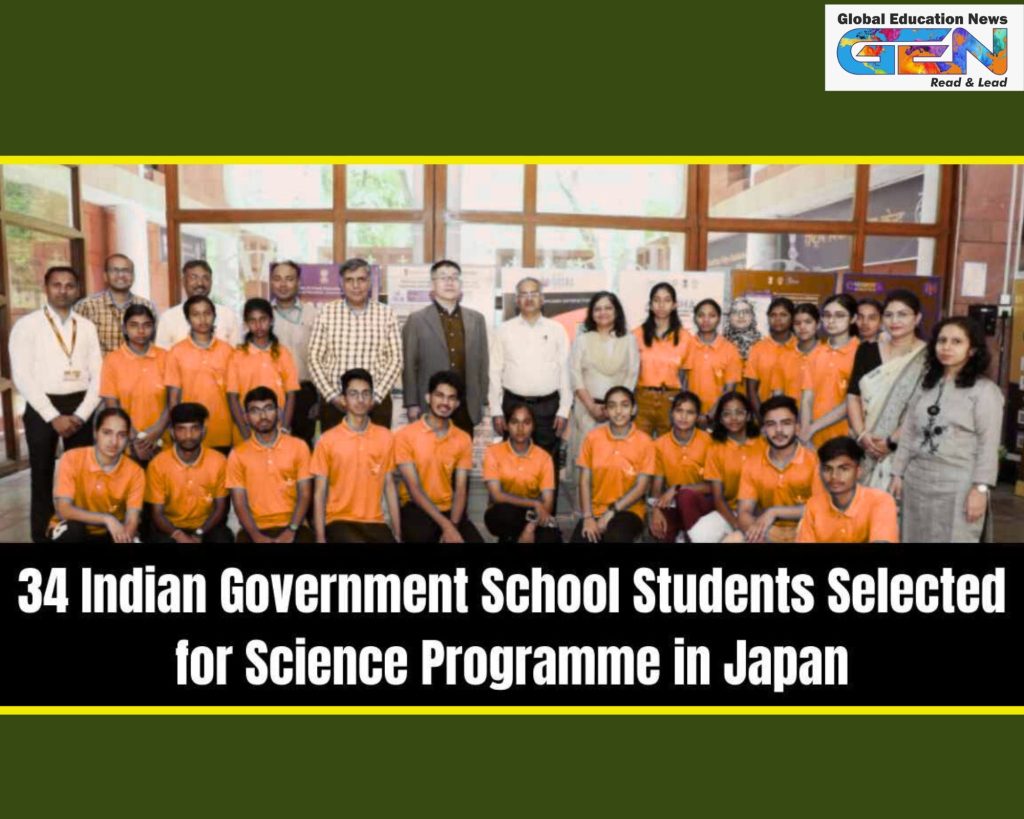
The Sakura Science Programme 2025, organized by the Japan Science and Technology Agency (JST), is set to welcome 34 Indian government school students from August 17 to 23, 2025. This prestigious Japan-Asia Youth Exchange Program in Science offers young learners a unique opportunity to engage with Japan’s advanced scientific innovations while immersing themselves in its rich cultural heritage. Flagged off at a ceremony in NCERT, New Delhi, by the Ministry of Education’s Department of School Education & Literacy (DoSEL), this initiative aligns with the experiential learning vision of India’s National Education Policy (NEP) 2020, inspiring the next generation of innovators.
- Key Points:
- 34 students (13 boys, 21 girls) selected from Indian government schools.
- Program runs from August 17–23, 2025, with participants from seven countries.
- Supports NEP 2020’s focus on holistic and experiential learning.
The Sakura Science Programme: A Global Platform
Launched in 2014 by JST, the Sakura Science Programme aims to foster scientific curiosity and international collaboration among youth. India joined in 2016, with over 639 students and 93 supervisors having participated since. The 2025 edition will include students from India, Egypt, Ghana, Kenya, Nigeria, South Africa, and Zambia, highlighting its global reach. The program offers hands-on exposure to Japan’s cutting-edge technology and cultural traditions, nurturing young minds for global innovation.
- Key Points:
- Initiated in 2014, with India participating since 2016.
- Over 639 Indian students and 93 supervisors have joined to date.
- Combines science, technology, and cultural exchange for holistic learning.
India’s Bright Young Ambassadors
The Indian delegation comprises 34 students from government schools in Andhra Pradesh, Bihar, Delhi, Himachal Pradesh, Lakshadweep, Odisha, Puducherry, West Bengal, and Regional Institute of Education (RIE) demonstration schools in Ajmer, Bhopal, Bhubaneswar, and Mysuru. Accompanied by three supervisors, these students (13 boys and 21 girls) will serve as young ambassadors, showcasing India’s cultural pride while learning from Japan’s advancements.
- Key Points:
- Students represent nine states and Union Territories, plus RIE schools.
- Delegation includes 13 boys and 21 girls, guided by three supervisors.
- Students encouraged to share Indian culture, like “Namaste,” globally.
Flagging-Off Ceremony: A Moment of Pride
The students were celebrated at a ceremonial send-off at NCERT, New Delhi, led by Sanjay Kumar, Secretary of DoSEL, alongside Professor Prakash Chandra Agrawal, Joint Director of NCERT, and Archana Sharma Awasthi, Joint Secretary of DoSEL. Sanjay Kumar called the program a “golden opportunity,” urging students to embrace Japan’s discipline, punctuality, and technological sophistication while sharing India’s rich heritage. He emphasized the program’s role in fostering India-Japan ties and inspiring future innovators.
- Key Points:
- Ceremony hosted by DoSEL at NCERT, New Delhi, on August 16, 2025.
- Sanjay Kumar highlighted Japan’s punctuality and cultural pride as learning points.
- Students urged to act as ambassadors, strengthening bilateral relations.
Learning from Japan: Inspiration for Innovation
The week-long program offers a blend of scientific exploration and cultural immersion. Students will visit leading Japanese institutions, engage in hands-on activities, and deliver presentations, gaining insights into Japan’s technological advancements, such as robotics and green energy. Sanjay Kumar encouraged students to observe Japan’s environmental practices, like cleanliness, and adopt values like punctuality, noting, “Time and tide wait for none.” This experience aligns with NEP 2020’s emphasis on experiential learning and interdisciplinary exploration.
- Key Points:
- Includes visits to schools, universities, and technological sites.
- Students will participate in activities and present their learnings.
- Aligns with NEP 2020’s focus on experiential and global learning.
Strengthening India-Japan Ties
The Sakura Science Programme goes beyond academics, fostering person-to-person connections that strengthen India-Japan relations. By engaging with Japanese culture, from tea ceremonies to cherry blossoms, students will build mutual understanding and lifelong friendships. This initiative supports India’s growing collaboration with Japan in fields like digital technology and innovation, creating a foundation for future partnerships.
- Key Points:
- Promotes cultural exchange and long-term India-Japan collaboration.
- Encourages students to share Indian traditions while learning Japanese values.
- Builds a foundation for future scientific and technological partnerships.
Challenges and Opportunities
Implementing such international exchanges requires robust coordination, including visa processes, travel logistics, and program structuring. However, these challenges offer opportunities to enhance global learning frameworks and align with NEP 2020’s vision. The program’s success depends on ensuring students maximize their exposure while representing India’s diversity and potential.
- Key Points:
- Requires efficient coordination for travel and program execution.
- Aligns with NEP 2020’s goal of fostering global awareness.
- Offers a platform to showcase India’s diversity and talent.