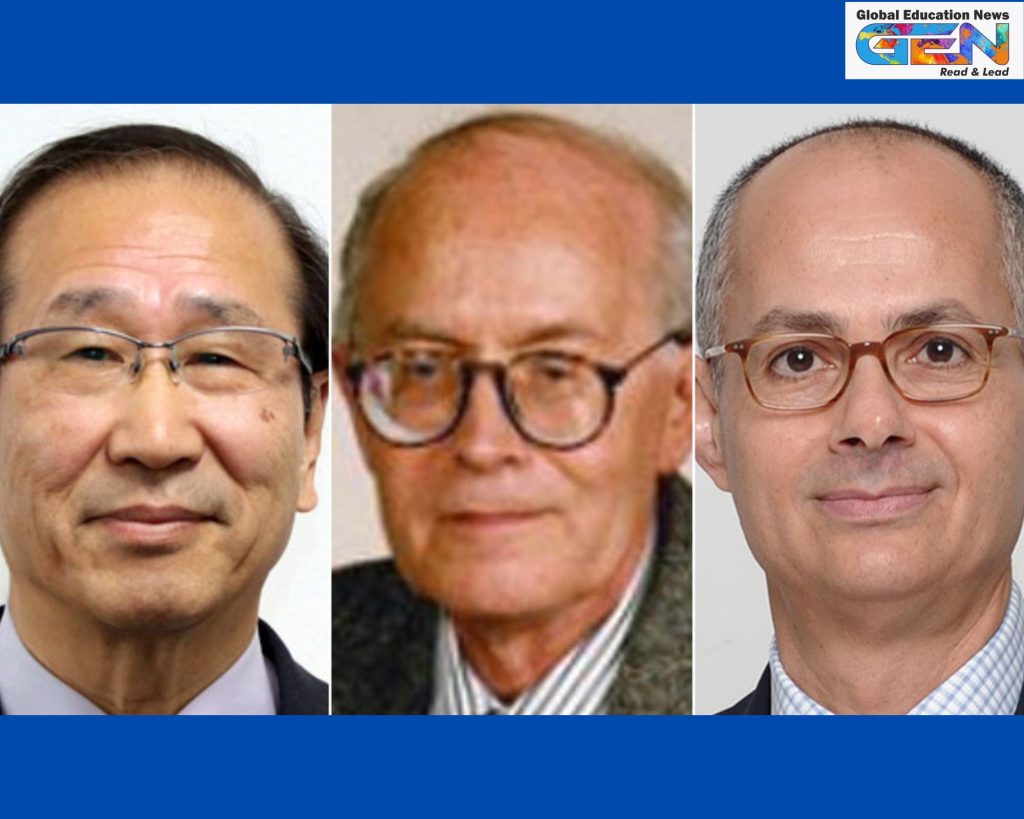
Imagine constructing a skyscraper where every brick is a molecule, and the entire building fits in your pocket—while capturing carbon or purifying water. That’s the wizardry of metal-organic frameworks (MOFs), the porous wonders earning three visionary chemists the 2025 Nobel Prize in Chemistry. Announced today in Stockholm, this award spotlights a “new form of molecular architecture” that’s set to tackle humanity’s toughest challenges, from climate change to clean energy.
The Laureates: Meet the Minds Behind the Magic
These trailblazers, working independently across continents, turned chemistry into an art of precision engineering.
- Susumu Kitagawa (Kyoto University, Japan): The flexibility pioneer who proved MOFs could bend without breaking, allowing gases to flow like rivers through a sponge. Born 1951 in Kyoto; PhD 1979 from Kyoto University.
- Richard Robson (University of Melbourne, Australia): The foundational architect whose 1989 copper-ion experiment birthed the first stable, cavity-filled crystal—though it crumbled like a house of cards until refined. Born 1937 in the UK; PhD 1962 from University of Oxford.
- Omar M. Yaghi (University of California, Berkeley, USA): The stability maestro who designed ultra-durable MOFs with tweakable properties, like customizing a Swiss Army knife at the atomic level. Born 1965 in Jordan; PhD 1990 from University of Illinois.
The Breakthrough: From Fragile Crystals to Framework Revolution
What started as a risky lab hunch in the late 1980s exploded into over 100,000 MOF variants today—each a crystalline lattice of metal ions (the “corners”) linked by organic molecules (the “beams”), creating vast internal voids rivaling a football field in a sugar cube.
- 1989 Spark: Robson’s diamond-like structure showed promise but lacked staying power.
- 1990s Game-Changers: Kitagawa unlocked gas permeability and flexibility; Yaghi engineered rock-solid, modifiable versions between 1992–2003.
- Nobel Motivation: “For the development of metal-organic frameworks,” hailed as tools with “enormous potential for custom-made materials with new functions.”
The Science Simplified: MOFs as Molecular Swiss Army Knives
Think of MOFs as Lego on steroids: infinitely customizable, with pores that trap, release, or transform substances on command. Unlike rigid solids, these frameworks are “alive” with chemistry—conducting reactions, storing energy, or filtering pollutants.
- Core Innovation: Metal ions + organic linkers = endless cavity configurations, enabling selective molecule capture.
- Fun Fact: One gram of MOF can have a surface area of 7,000 square meters—enough to cover two soccer fields!
- Quote from the Committee: “Their molecular architecture contains rooms for chemistry,” turning abstract theory into tangible tools.
World-Changing Applications: MOFs in Action
This isn’t ivory-tower science; MOFs are frontline warriors against global crises, already powering prototypes from labs to real life.
- Climate Hero: Sucks up CO₂ from air or factories, turning greenhouse gas into fuel or stone.
- Water Wizards: Harvests drinkable H₂O from desert humidity; strips toxins like PFAS or pharma residues from wastewater.
- Energy & Health Boost: Stores hydrogen for clean cars; delivers drugs precisely to tumors; catalyzes greener reactions.
- Futuristic Edge: Could revolutionize batteries, sensors, and even space tech—imagine self-healing suits or infinite fuel cells.
Prize Spotlight: Honors, Riches, and Legacy
The Royal Swedish Academy of Sciences dropped this bombshell on October 8, 2025, affirming chemistry’s role in sustainable innovation.
- The Payout: 11 million Swedish kronor (about $1 million USD), split three ways.
- Expert Nod: Heiner Linke, Nobel Committee Chair, praises their work for “bringing previously unforeseen opportunities.”
- Legacy Timeline: From Robson’s 1989 “aha” to today’s MOF boom—proof that patient tinkering yields planetary payoffs.