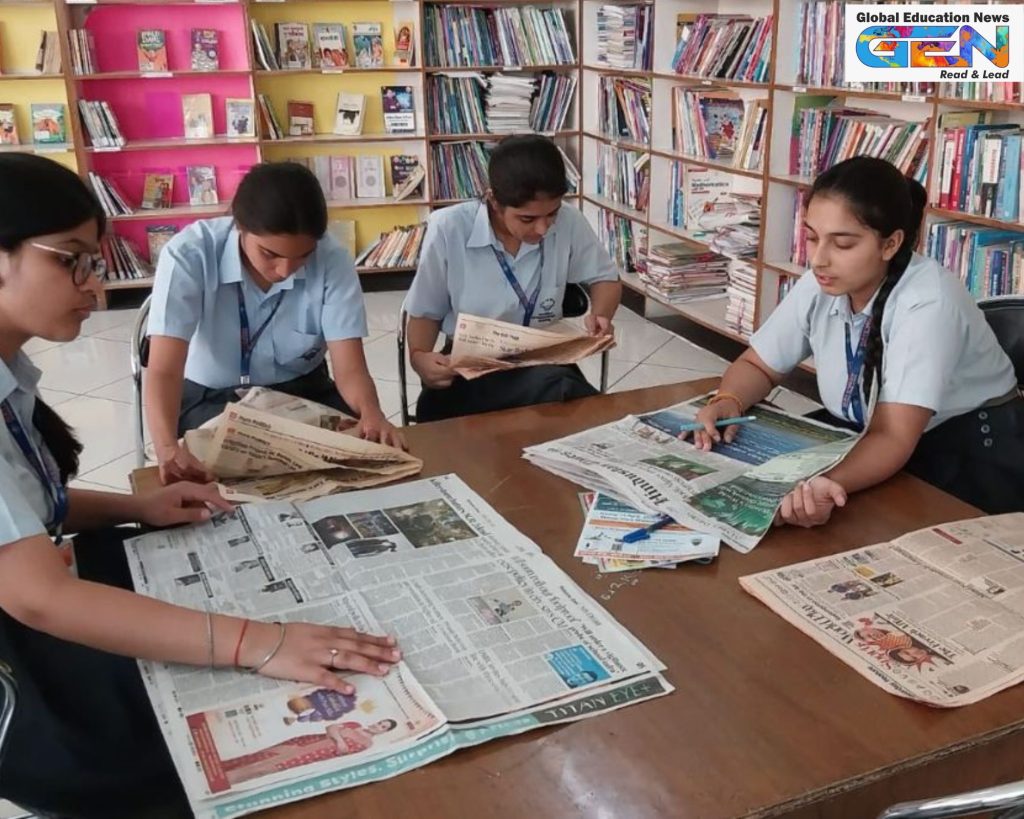
As of December 27, 2025, Uttar Pradesh—the nation’s most populous state and educational powerhouse with over 1.6 lakh schools serving 25 crore students—has ignited a cultural counter-revolution against the tyranny of screens. In a directive issued on December 23 by Additional Chief Secretary Parth Sarathi Sen Sharma, the state’s Secondary and Basic Primary Education departments have ordered daily newspaper reading sessions across all government and aided institutions. This isn’t a nostalgic nod to ink and paper; it’s a calculated intervention to fortify young minds against the perils of social media echo chambers and shrinking attention spans. Complementing a November 2 reading campaign, the policy weaves in the “No Bouquet, Only Book” initiative, swapping event trophies for literary gifts. Amid NEP 2020’s push for holistic literacy, this move addresses a stark reality: Indian students average 7-8 hours daily on devices, per 2025 ASER reports, eroding reading proficiency by 15% since 2020. This analysis dissects the policy’s architecture, evidentiary rationale, execution blueprint, and prospective ripples, evaluating its efficacy in an era where bytes often eclipse books.
Policy Genesis: From Screen Fatigue to Literary Renaissance
Uttar Pradesh’s education machinery, overseeing 2.5 crore learners, has long grappled with the double-edged sword of digital access. While NEP 2020 champions tech-infused pedagogy, it warns of “digital divides” exacerbating inequities—rural UP students lag urban peers in reading comprehension by 25%, per NCERT baselines. The December 23 order builds on the November 2 “Reading Campaign,” which unlocked district libraries and mandated weekly non-syllabus book issues, rewarding voracious readers with certificates.
- Catalyst Factors: Rising fake news vulnerabilities (UP reported 20% youth exposure to misinformation in 2025 surveys) and screen-induced myopia (affecting 30% schoolchildren) prompted the pivot. Officials cite global precedents like Finland’s “literacy hour” for inspiration.
- Holistic Ambition: Beyond rote learning, the policy targets “social awareness” and competitive edge—UP’s JEE/NEET qualifiers rose 12% in 2025, but verbal skills remain a bottleneck.
- Equity Lens: Aimed at basic primary (Classes 1-8) and secondary (9-12) schools, it counters urban-rural gaps, where 40% rural libraries lack newspapers.
This genesis reflects a proactive ethos: Not banning devices, but balancing them with analog anchors.
Core Directives: Mandates and Mechanisms for Daily Engagement
The order’s precision lies in its actionable, low-burden framework, embedding reading into routines without overhauling curricula. Circulated to all divisional education officers, district inspectors, and basic education heads, it demands “strict implementation,” with monitoring via quarterly reports.
Key provisions include:
- Daily Reading Slot: 10 minutes during morning assembly for rotational readings of Hindi/English newspaper editorials, national/international news, and sports highlights—fostering public speaking and peer learning.
- Vocabulary Boost: “Word of the Day” initiative: Five challenging words from papers displayed on notice boards, integrated into classroom quizzes.
- Creative Extensions:
- Juniors (Classes 1-8): Scrapbook-making from news clippings.
- Seniors (9-12): Editorial-based essays, group discussions, crossword/Sudoku contests, and student-led school magazines/newspapers.
- “No Bouquet, Only Book” Campaign: At functions, books replace trophies—symbolizing sustained growth over fleeting wins.
| Directive | Target Group | Activities | Expected Outcome |
|---|---|---|---|
| Assembly Readings | All Classes | Rotational news recaps (10 mins) | Enhanced GK, pronunciation, confidence |
| Word of the Day | All Classes | 5 words on notice board | 20-30% vocabulary gain per semester |
| Scrapbooks/Clippings | Classes 1-8 | News-based collages | Creativity, retention of current affairs |
| Discussions/Essays | Classes 9-12 | Editorial debates, writing | Critical thinking, fake news discernment |
| School Publications | All Classes | Student magazines | Ownership, publishing skills |
These elements, resource-light (₹500-1,000/school annually for papers), prioritize inclusivity—vernacular Hindi editions for non-English speakers.
Rationale and Evidence: Building Minds in a Digital Deluge
The policy’s intellectual scaffolding draws from cognitive science: Reading print enhances empathy and focus (a 2025 UNESCO study links it to 15% better comprehension vs. screens). UP officials underscore preparation for “competitive exams” where verbal sections weigh 30-40%, and “sensitization against fake news” amid 2025’s 25% rise in youth-led hoaxes.
- Screen Time Stats: ASER 2025 reveals 60% students exceed 2-hour daily limits, correlating with 18% literacy dips; the mandate caps assembly “doom-scrolling.”
- Broader Alignment: Echoes NEP’s “joyful learning” via experiential activities, complementing UP’s Digital Saksharta Abhiyan (2024) for balanced tech use.
- Expert Echoes: While no direct quotes, educationists like NCERT’s Dr. R. Venkataraman (in related forums) applaud it as “antidote to algorithmic biases,” potentially lifting UP’s PISA-equivalent scores by 10%.
Critically, it addresses gender nuances—girls in rural UP read 20% less due to chores—via girl-centric library hours.
Implementation Roadmap: From Order to Classroom Reality
Rollout leverages UP’s 1.5 lakh-strong teacher cadre, with training webinars by January 15, 2026, and pilot audits in Lucknow/Varanasi districts.
- Timeline: Immediate (post-Dec 23); full compliance by March 2026 term-end.
- Support Mechanisms: Free newspaper subscriptions via state tenders (₹100 crore budget); app-based tracking for assembly logs.
- Monitoring and Incentives: District Magistrates to verify; top schools earn “Literacy Champions” badges, tied to RTE funding.
Challenges loom: Resource-strapped rural schools (30% lack libraries) may falter; teacher buy-in (overburdened with 50:1 PTRs) requires sensitization. Success metrics: Pre/post surveys on reading hours (target: +30%) and exam verbal scores.
Implications: Literacy Lift or Logistical Hurdle?
This mandate could ripple profoundly: A 2025 World Bank model projects 5-7% NEET qualifier gains from sustained reading. Socially, it inoculates against polarization—UP’s 2025 communal incidents linked 15% to social media. Economically, literate youth fuel UP’s $1 trillion GDP ambition by 2030.
Yet, pitfalls persist: Overemphasis on news risks negativity bias; without diverse papers (e.g., regional dialects), it may alienate minorities. Compared to Kerala’s library networks (90% coverage), UP’s 60% lag demands scaling.