Published on October 7, 2025
Delhi, India
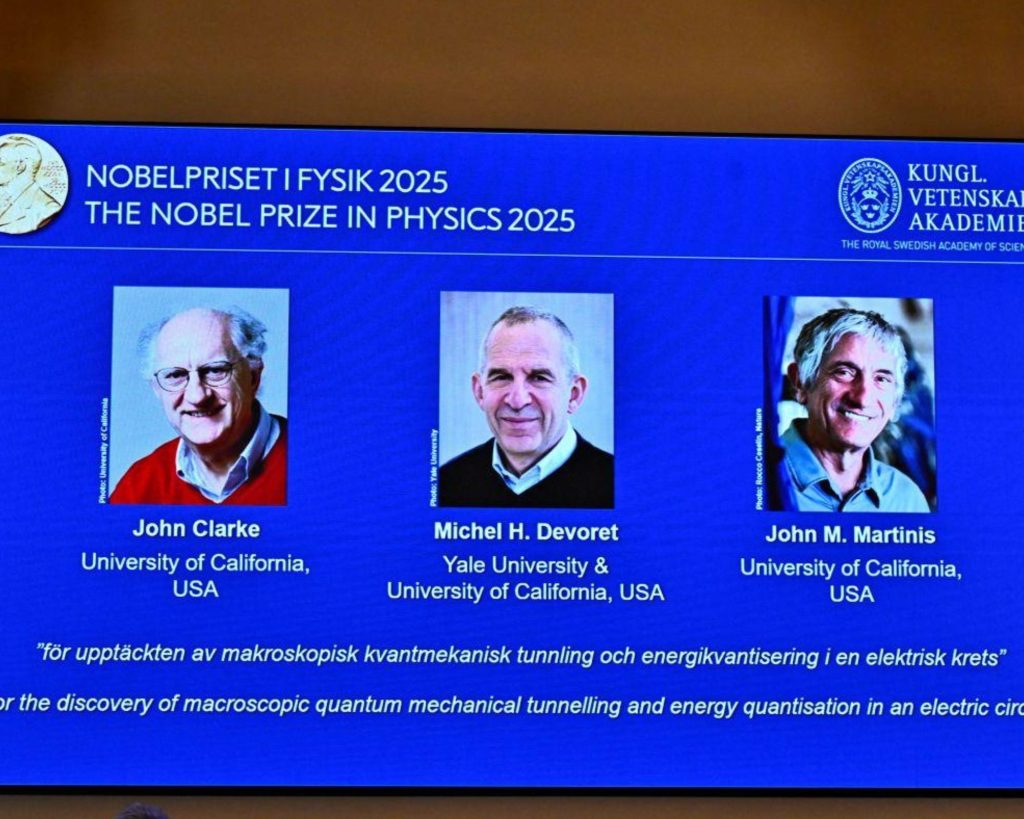
On October 7, 2025, the Nobel Prize in Physics 2025 was bestowed upon University of California, Berkeley emeritus professor John Clarke, Yale’s Michel H. Devoret, and University of California, Santa Barbara’s John M. Martinis for their “discovery of macroscopic quantum mechanical tunnelling and energy quantisation in an electric circuit.” This isn’t abstract theory – it’s the alchemy that turned superconducting circuits into quantum playgrounds, paving the road for tomorrow’s unhackable computers and sensors. As the laureates share the 11 million Swedish kronor purse, let’s quantum-entangle with their story: From fridge-magnet experiments to the qubit revolution.
The Eureka Experiments: How Three Minds Made Quantum Dance at Human Scale
Back in the 1980s, when quantum mechanics was still whispered as particle pixie dust, these pioneers rigged electric circuits to defy classical rules – proving the subatomic strange could scale up big.
- Tunnelling Triumph: Clarke and Devoret’s 1984-85 setups used Josephson junctions (thin insulators between superconductors) to showcase particles “tunnelling” through energy barriers – a macro mimic of atomic leaps, defying Newton’s ironclad walls.
- Quantized Energy Quest: Martinis joined the fray, revealing discrete energy levels in these circuits, like stairs instead of a ramp – echoing atomic spectra but in man-made loops of wire.
- Circuit Symphony: Their SQUID (Superconducting Quantum Interference Device) rigs, cooled to near-absolute zero, measured magnetic fields with insane precision, birthing tools for brain scans and gravitational waves.
These weren’t lab toys; they were the first whispers of quantum tech whispering back, turning “impossible” into “prototype.”
From Fridge Magnets to Qubits: Real-World Ripples of Their Revelation
This Nobel isn’t dusty history – it’s the spark igniting quantum’s golden age, with echoes in everything from AI to astronomy.
- Quantum Computing Catalyst: Their work birthed superconducting qubits, the heart of Google’s Sycamore and IBM’s Eagle – machines juggling probabilities to crack codes in seconds.
- Sensor Superstars: Ultra-sensitive detectors now probe dark matter, map neural fireworks, and hunt exoplanets – all tracing roots to these circuit quirks.
- Global Impact Amp: As academy chair Thors Hans Hansson quipped, their feats “revealed quantum physics in action,” fueling a $30B+ industry and inspiring a new gen of tinkerers.
Picture it: Your next MRI or unbreakable bank vault? Thank these wire whisperers.
Laureate Lowdown: Meet the Minds Behind the Macro Magic
- John Clarke (UC Berkeley): The Scottish trailblazer, now 81, pioneered SQUIDs in the ’70s; his Berkeley lab was quantum’s cradle, blending theory with tinkering grit.
- Michel H. Devoret (Yale): French flair meets American ingenuity – his Yale quantum lab pushes boundaries, mentoring the next qubit wave.
- John M. Martinis (UCSB/Google): The U.S. experimentalist, ex-Google Quantum AI lead, bridged academia to industry, proving quantum scales commercially.
Humble heroes all, with Clarke noting in interviews: “We were just curious – who knew it’d rewrite reality?”
Horizon Hype: What This Nobel Signals for Physics’ Future
As 2025’s prizes roll on (Chemistry and Medicine already buzzed), this nod spotlights quantum’s climb from fringe to forefront – amid U.S.-China tech tussles and Europe’s qubit quests. Expect more Nobels in entanglement and error-correction, but Clarke et al. set the stage: Quantum isn’t weird; it’s wired into our world.
This quantum tunnelling Nobel 2025 is a toast to persistence over probability. What’s your wildest quantum dream? Beam it in the comments – who knows, it might tunnel into tomorrow!