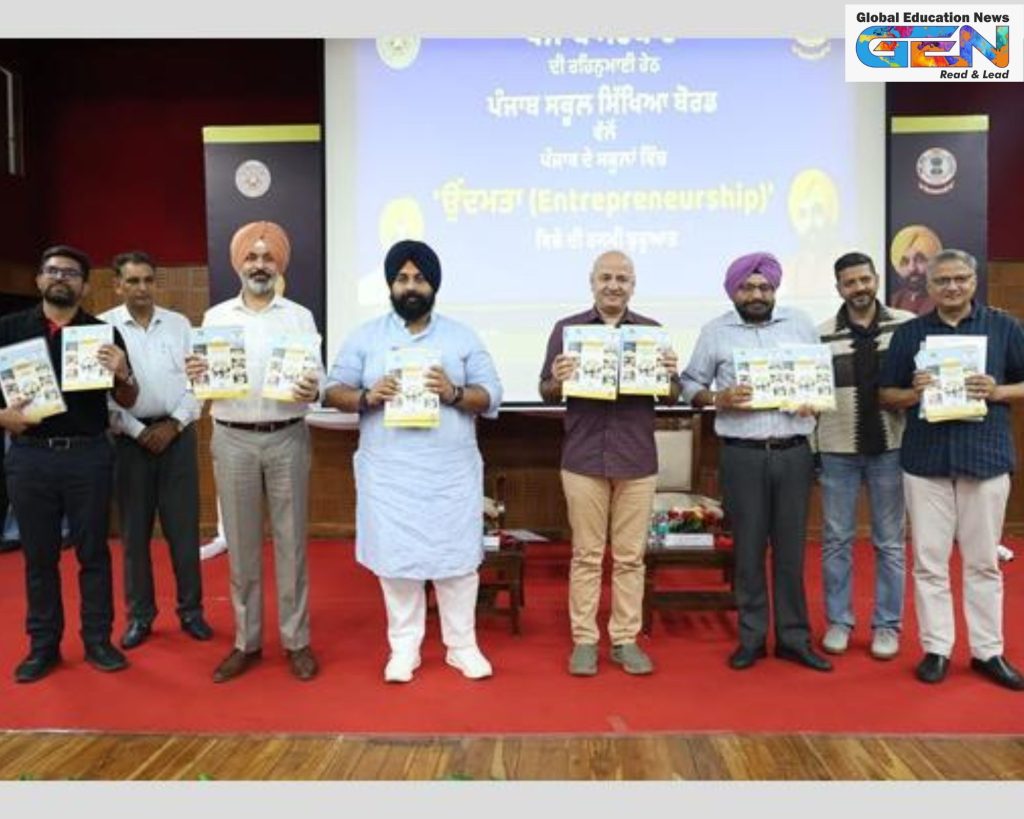
In a strategic bid to redefine career trajectories for Punjab’s youth, the Punjab School Education Board (PSEB) has greenlit an entrepreneurship curriculum for Class 12 students, set to roll out in the 2026-27 academic year. Building on the ‘Business Blaster’ program introduced for Class 11 in 2022-23, this mandatory subject across 3,692 senior secondary schools will reach 5.60 lakh learners, embedding startup savvy into the core syllabus. Announced by Education Minister Harjot Singh Bains, the initiative transcends rote learning, aiming to cultivate innovators who “transform ideas into viable ventures.” This analysis, informed by policy blueprints, educator insights, and national trends, unpacks the curriculum’s architecture, synergies with the National Education Policy (NEP) 2020, projected outcomes, and navigable challenges—heralding Punjab’s pivot toward a self-reliant economy fueled by student-led enterprises.
Background: From ‘Business Blaster’ to Boardroom Blueprints in Punjab’s Reforms
Punjab’s education ecosystem, long critiqued for overemphasis on traditional streams, is evolving through targeted vocational infusions. The Class 12 rollout completes a seamless two-year arc, addressing youth unemployment—pegged at 18-20% for ages 15-29 in the state—by prioritizing entrepreneurial acumen over job-seeking.
- Genesis and Scale: Initiated in 2022-23 with Class 11’s ‘Business Blaster’—a foundational module on ideation and prototyping—the program has already engaged over 2.8 lakh students annually, per state metrics. Now compulsory for seniors, it spans government and aided schools, ensuring equitable access in districts from Amritsar to Bathinda.
- Policy Catalyst: While state-driven, it mirrors NEP 2020’s mandate for 50% curriculum integration of vocational skills by 2025, fostering multidisciplinary exposure. Punjab’s alignment positions it alongside trailblazers like Gujarat and Kerala, where similar modules have spurred 15-20% rises in youth enterprise registrations.
- Economic Imperative: With Punjab’s startup ecosystem nascent (only 1,200 DPIIT-recognized ventures vs. national 1 lakh+), the curriculum targets a 10-15% uptick in student-led innovations, leveraging the state’s agro-industrial base for agri-tech and MSME ideas.
This foundation underscores a shift: From exam-centric to ecosystem-centric education, priming Punjab for a post-agricultural boom.
Core Elements of the Curriculum: Structure, Content, and Rollout Roadmap
The finalized syllabus, developed with input from industry mentors and academics, emphasizes hands-on application over theory, with textbooks ready for seamless distribution. PSEB’s proactive timeline ensures zero academic hiccups.
- Modular Breakdown: Core topics include startup ideation (problem-solving frameworks), legal essentials (company registration, IP basics), financial literacy (budgeting, funding pitches), business modeling (canvas tools, scalability), and sustainability (eco-friendly ventures)—spanning 100-120 instructional hours.
- Pedagogical Tools: Interactive elements like case studies from Punjab unicorns (e.g., local food-tech firms), group simulations, and pitch competitions; assessments blend projects (60% weightage) with MCQs for holistic evaluation.
- Implementation Phasing: Launch in April 2026 for 2026-27; pilot evaluations in Q4 2025 via select schools. Resources include digital portals for mentor matching and e-libraries on venture capital—bolstered by 231 master trainers overseeing 10,382 upskilled educators through 104 workshops.
This robust framework, clocking in at 200+ pages per textbook, equips students with a “startup survival kit,” ready for real-world deployment.
Immediate Impacts: Empowering Students and Revitalizing Classrooms
Early indicators from the Class 11 precursor suggest transformative engagement, with 70% of participants reporting heightened confidence in idea validation. The Class 12 extension amplifies this, potentially halving the “graduation-to-gig” gap.
- Student Gains: Learners master venture blueprints, reducing fear of failure—key as 40% of Indian youth cite “lack of skills” for entrepreneurial hesitance. Testimonials highlight shifts: “From farm chores to fintech pitches,” notes a rural Bhatinda student.
- Educator Enablement: Teacher training has certified 80% of faculty in facilitation techniques, curbing delivery gaps; master trainers ensure consistent quality, with 25% reporting improved classroom dynamism.
- Quantifiable Wins: Projected 20% enrollment in optional electives like digital marketing; initial pilots forecast 5,000 student prototypes by 2027, feeding Punjab’s incubator networks.
These on-ground shifts promise classrooms as incubators, where ideas incubate alongside algebra.
Broader Implications: Synergies with NEP 2020 and Economic Catalysts
PSEB’s move is a microcosm of NEP’s 2025 milestones—vocational credits, flexible streams, and competency-based learning—positioning Punjab as a model for northern states. It dovetails with Atmanirbhar Bharat, channeling youth energy into 50 lakh new MSMEs targeted nationally by 2030.
- NEP Harmonization: Embodies the policy’s 6% GDP education spend goal by embedding 21st-century skills; aligns with revised NCERT frameworks for Grades 9-12, emphasizing experiential learning over silos—potentially boosting Punjab’s ASER innovation scores by 15%.
- Economic Multipliers: Could generate Rs 500-700 crore in youth-led revenue streams via agri-startups and e-commerce, per extrapolated state data; fosters gender equity, with 30% female participation in pilots, countering rural biases.
- National Ripple: As CBSE rolls out similar Class XII modules (e.g., entrepreneurship code 066), Punjab’s scale offers a blueprint, inspiring 10+ states to mandate vocational hours—accelerating India’s $5 trillion economy via grassroots hustles.
Critically, it reframes education as an economic engine, where Punjab’s 5.6 lakh alumni become its venture vanguard.
Challenges Ahead: Scaling Vocational Visions Amid Systemic Strains
While lauded, the rollout grapples with familiar hurdles in resource-scarce settings, demanding adaptive safeguards for longevity.
- Resource Gaps: Rural schools (60% of cohort) face digital divides, with only 40% internet penetration; uneven mentor access risks urban-rural skews.
- Assessment and Adoption: Project-based grading may strain overburdened faculty; student buy-in varies, with 15-20% in surveys citing “theory preference” amid board exam pressures.
- Sustainability Strategies: Integrate AI tools for virtual simulations; forge PPPs with incubators like TiE Punjab for internships; annual audits tied to NEP KPIs ensure 80% outcome tracking. Budget infusions (Rs 50-100 crore projected) will bridge infra voids.
Navigating these with agility could elevate the program from promising to paradigm-shifting.