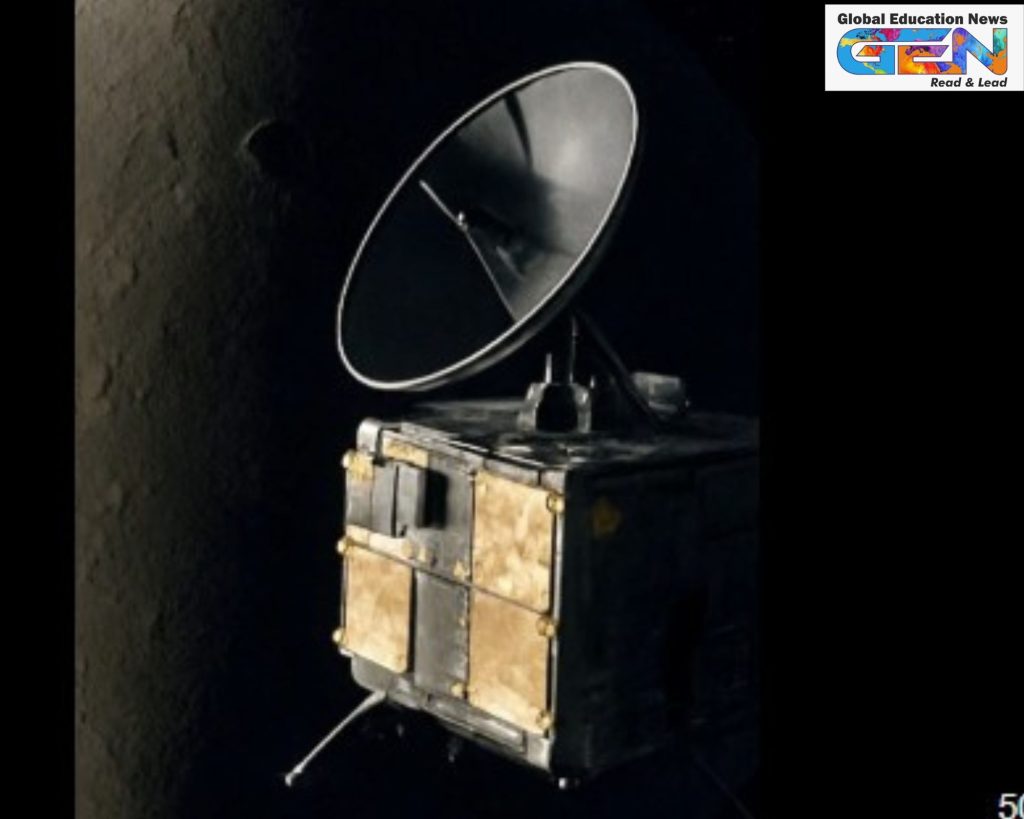
The PRATUSH (Probing ReionizATion of the Universe using Signal from Hydrogen) radiometer is a groundbreaking space payload developed by the Raman Research Institute (RRI) in Bengaluru, in collaboration with the Indian Space Research Organisation (ISRO). Designed to operate in lunar orbit, PRATUSH targets the Cosmic Dawn—the epoch 100 to 900 million years after the Big Bang when the first stars and galaxies formed. By detecting the faint 21-cm hydrogen signal, PRATUSH aims to unravel mysteries about the Universe’s infancy, leveraging a compact single-board computer (SBC) to achieve high-precision measurements in a radio-quiet environment.
Key Points:
- PRATUSH is a proposed cosmology experiment to study the Cosmic Dawn and Epoch of Reionization (CD/EoR).
- It operates in the 55–110 MHz frequency range, with a broader capability of 40–200 MHz.
- The mission will initially conduct observations in low Earth orbit, followed by lunar orbit for optimal data collection.
The Cosmic Dawn: A Window to the Universe’s Past
The Cosmic Dawn marks the transition from the Dark Ages—a period devoid of stars—to the formation of the first luminous objects. During this era, ultraviolet radiation from early stars reionized neutral hydrogen, fundamentally shaping the Universe’s evolution. The 21-cm signal, emitted by neutral hydrogen atoms at a rest frequency of 1420 MHz, carries imprints of these events but is redshifted to lower frequencies (40–200 MHz) due to cosmic expansion. Detecting this faint signal is challenging on Earth due to radio-frequency interference (RFI), ionospheric distortions, and ground effects. PRATUSH’s lunar orbit, particularly on the far side of the Moon, offers a pristine, radio-quiet environment ideal for capturing this cosmic whisper.
Key Points:
- The Cosmic Dawn spans 100–900 million years post-Big Bang, when the first stars formed.
- The 21-cm signal is a critical probe for studying the thermal state and reionization of early hydrogen gas.
- Lunar orbit eliminates terrestrial RFI and ionospheric effects, enabling precise measurements.
PRATUSH’s Innovative Design
PRATUSH’s radiometer is a marvel of compact engineering, designed to maximize sensitivity while minimizing size, weight, and power consumption. Its key components include:
- Wideband Frequency-Independent Antenna: Operates over 30–250 MHz, capturing redshifted 21-cm signals.
- Self-Calibrating Analog Receiver: Amplifies faint signals with minimal noise.
- Digital Correlation Spectrometer: Features 10-bit analog-to-digital converters (ADCs) and a Virtex-6 Field Programmable Gate Array (FPGA) for high-resolution spectral analysis.
- Single-Board Computer (SBC): A Raspberry Pi 4 Model B serves as the master controller, real-time processor, and data recorder in the laboratory model, to be replaced by a space-grade equivalent in flight models.
The SBC, roughly the size of a credit card, coordinates data acquisition, processing, and storage, ensuring data integrity with low power usage (approximately 5.45 W for the spectrometer). Laboratory tests demonstrated noise levels reduced to a few millikelvins after 352 hours of data collection, confirming PRATUSH’s sensitivity to detect the faint Cosmic Dawn signal.
Key Points:
- The minimalist design reduces mass, power, and complexity, critical for space missions.
- The SBC optimizes data handling, replacing bulkier traditional systems.
- Enhanced software and next-generation hardware promise even greater performance.
Why the Moon’s Far Side?
The far side of the Moon is the most radio-quiet location in the inner Solar System, free from Earth’s RFI, FM transmissions, and ionospheric distortions. PRATUSH will conduct scientific observations in the prime cone region (behind the Moon) and transmit data to Earth when on the near side. This setup ensures uncontaminated measurements of the 21-cm signal, which is millions of times weaker than terrestrial noise. The mission’s two-phase approach includes initial testing in low Earth orbit and final observations in lunar orbit, with a planned mission lifetime of two years.
Key Points:
- The lunar far side eliminates RFI and ionospheric effects, critical for detecting faint signals.
- PRATUSH will operate in a circumlunar orbit, with data downlinked when Earth is in view.
- The mission aligns with global efforts like LuSEE-Night and CosmoCube to study the Cosmic Dawn from lunar orbit.
Scientific Significance
PRATUSH aims to answer fundamental questions about the Cosmic Dawn and Epoch of Reionization:
- When did the first stars form? Pinpointing the timeline of star formation.
- What were the first stars like? Determining if they were hydrogen-based, black holes, or exotic objects.
- How did reionization occur? Understanding the radiation and ionization processes that shaped the early Universe.
By detecting the sky-averaged 21-cm signal, PRATUSH will provide insights into the thermal state of primordial gas, the radiation background, and the nature of early cosmic structures. Its data could validate or challenge existing models of galaxy formation and potentially reveal new physics, such as dark matter interactions.
Key Points:
- PRATUSH will probe the redshift range z ~ 13–150, covering 80–420 million years post-Big Bang.
- It complements ground-based experiments like SARAS, which face RFI limitations.
- The mission could inform future lunar telescopes, enhancing exoplanet and cosmological research.
Challenges and Global Context
Detecting the 21-cm signal is a formidable challenge due to its faintness and interference from brighter foregrounds. PRATUSH’s lunar orbit mitigates these issues, but the mission requires precise calibration and robust hardware to operate in harsh space conditions. Globally, PRATUSH joins other lunar-based projects like NASA’s LuSEE-Night, China’s DSL, and the Dark Ages Radio Explorer (DARE), all aiming to probe the Cosmic Dawn and Dark Ages. India’s leadership in this field, backed by ISRO’s expertise, positions PRATUSH as a pioneering effort in low-frequency cosmology.
Key Points:
- PRATUSH faces challenges in signal detection due to foreground noise millions of times stronger.
- Its lunar orbit design aligns with global trends in radio-quiet astronomical observations.
- The mission, proposed in 2018, is in the pre-project studies phase, with a concept model under development.