On June 18, 2025, India launched Operation Sindhu to evacuate its nationals from Iran as the Israel-Iran conflict escalated into open warfare, starting June 13, 2025. The first phase successfully brought 110 Indian students, mostly from Jammu and Kashmir, back to New Delhi on June 19, 2025, via Armenia. With over 4,000 Indian nationals in Iran, including 1,500–2,000 students, the Ministry of External Affairs (MEA) is working tirelessly to ensure their safety amid Israeli airstrikes and Iranian retaliatory attacks. Here’s your guide to Operation Sindhu, the evacuation process, and how Indian citizens can stay safe.
- Key Point: Operation Sindhu evacuated 110 students from northern Iran via Armenia, landing in Delhi on June 19, 2025.
- Key Point: Israel’s Operation Rising Lion and Iran’s Operation True Promise III have killed over 600, with 224 in Iran alone.
- Key Point: Indian Embassy in Tehran and a 24/7 MEA Control Room are coordinating further evacuations.
Why Operation Sindhu? The Israel-Iran Conflict Context
The Israel-Iran conflict erupted on June 13, 2025, when Israel launched Operation Rising Lion, targeting Iran’s nuclear sites (Natanz, Arak), military facilities, and residential areas, killing 224 civilians and several military leaders. Iran retaliated with Operation True Promise III, firing Fattah-1 hypersonic missiles and drones, causing 24 deaths and 1,300 injuries in Israel. The conflict, now in its sixth day, has closed Iranian airspace, disrupted internet access, and stranded thousands, including Indian students.
India, with 4,000+ nationals in Iran (half students, many in medical courses), faced urgent calls for evacuation, especially after five Indian students were injured in a strike on a Tehran dormitory on Keshavarz Street. The Jammu and Kashmir Students Association appealed to External Affairs Minister S Jaishankar for swift action, prompting Operation Sindhu.
- Key Point: Israel targeted Iran’s nuclear and missile infrastructure; Iran fired ballistic missiles at Tel Aviv.
- Key Point: Indian students in Tehran, especially from Kashmir, faced safety risks near strategic sites.
- Key Point: Iran’s internet restrictions and airspace closure complicate evacuations.
Evacuation Process: How 110 Students Returned Home
The first phase of Operation Sindhu focused on 110 students, primarily from Urmia Medical University in northern Iran. Here’s how India executed the evacuation:
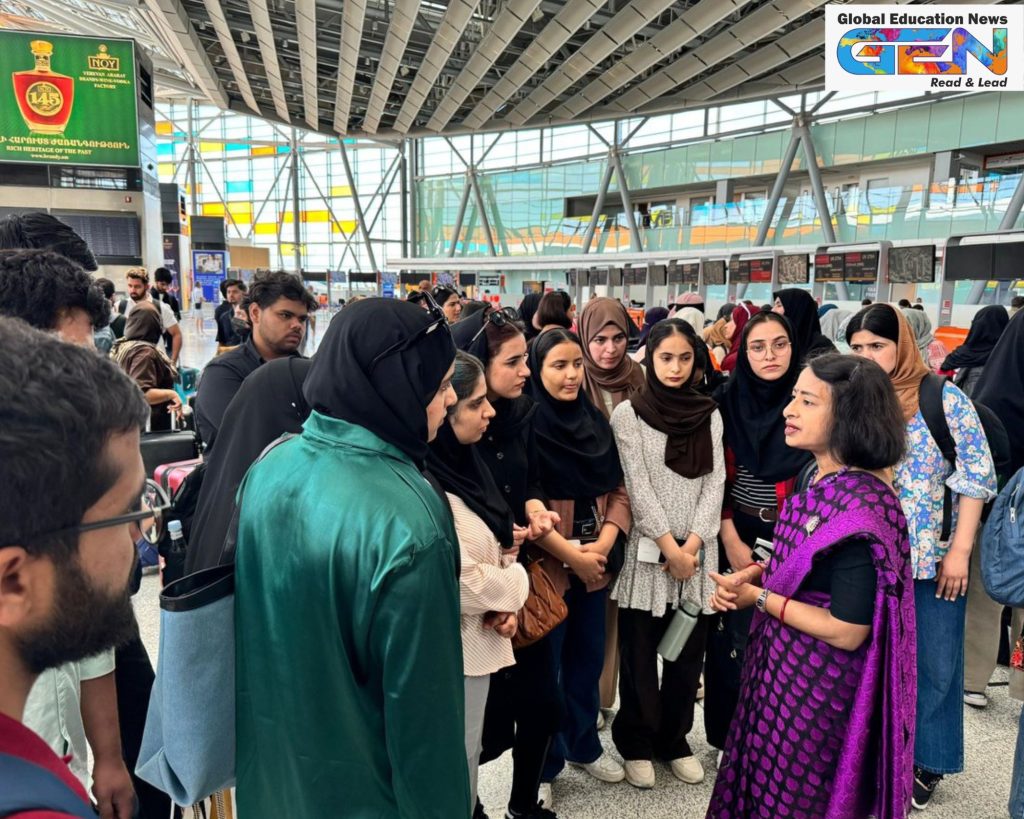
- Relocation from Iran: On June 17, 2025, the Indian Embassy in Tehran facilitated the students’ safe crossing by road from Urmia to Armenia, supervised by Indian missions in both countries.
- Transit via Yerevan: The students reached Armenia’s capital, Yerevan, and boarded a special flight at 14:55 IST on June 18, 2025.
- Arrival in Delhi: The flight, transiting through Doha, landed at Indira Gandhi International Airport around 2:00 AM on June 19, 2025, delayed by three hours. MoS Kirti Vardhan Singh welcomed them.
The MEA also relocated 600 students from Tehran to Qom, a safer city 150 km south, and is coordinating further evacuations via Armenia, Turkmenistan, and Persian Gulf routes.
- Key Point: Students praised the Indian Embassy’s 24/7 support via emergency helplines.
- Key Point: Evacuation flight transited via Doha, Qatar, before reaching Delhi.
- Key Point: More flights are planned from Turkmenistan to evacuate additional nationals.
Role of Iranian and Armenian Authorities
The evacuation succeeded due to strong cooperation from Iranian and Armenian governments:
- Iran’s Support: The Iranian Foreign Ministry worked closely with the Indian Embassy, ensuring safe passage despite airstrikes. The Deputy Ambassador of Iran in Delhi confirmed Iran’s commitment to protecting foreign nationals, including evacuating injured students from a Tehran dormitory.
- Armenia’s Role: Armenia facilitated the students’ border crossing and provided logistical support in Yerevan, enabling the special flight. The MEA expressed gratitude to both nations for their “smooth facilitation.”
- Key Point: Iran evacuated international students, including Indians, from a struck dormitory on June 15.
- Key Point: Armenia’s diplomatic ties with India eased the evacuation process.
Challenges Faced by Indian Students
The Israel-Iran conflict created dire conditions for Indian students in Iran:
- Injuries: Five Indian students were injured in an Israeli airstrike on a medical students’ dormitory in Tehran on June 15, 2025. They were evacuated by the university, with the Indian Embassy in the loop.
- Communication Barriers: Internet restrictions in Iran limited access to Embassy advisories, leaving some students stranded.
- Safety Risks: Students in Tehran, near nuclear and military sites, faced constant bombing threats. One student, Varta from Kashmir, described the situation as “terrifying.”
- Logistical Issues: Unlike Operation Ganga (Ukraine, 2022), Iran’s closed airspace and unreliable road/rail networks made evacuation complex.
- Key Point: Students in Urmia faced less intense conflict than those in Tehran.
- Key Point: Lack of bomb shelters in Tehran forced residents into underground parking lots.
Diplomatic Challenges and Regional Dynamics
India faced a complex diplomatic landscape to execute Operation Sindhu:
- Friendly Nations: India leveraged ties with Armenia, Turkmenistan, and Iraq for evacuation routes. The Persian Gulf (via Saudi Arabia or Kuwait) offers a potential maritime option.
- Strained Relations: Ties with Turkey, Azerbaijan, and Pakistan are less amicable, limiting border options. India lacks formal diplomatic relations with Afghanistan.
- Neutral Stance: India called for peace, with PM Modi discussing de-escalation with Israel’s PM Netanyahu. The G7 Summit (June 16, 2025) urged restraint, but India balances ties with both Israel and Iran.
- Key Point: India’s neutral diplomacy ensures cooperation from Iran while maintaining Israel ties.
- Key Point: Airspace closures across the Middle East disrupted evacuation logistics.
How to Stay Safe: MEA Helplines and Advisories
The Indian Embassy in Tehran and MEA are prioritizing citizen safety:
- Emergency Helplines:
- MEA Control Room (New Delhi): 1800-118-797 (toll-free), +91-11-23012113, +91-11-23014104, +91-11-23017905, +91-9968291988 (WhatsApp).
- Embassy in Tehran: Numbers shared via X on June 14, 2025.
- Advisories: Avoid unnecessary movement, stay in touch with the Embassy, and follow updates on X (@MEAIndia). Relocate to safer cities like Qom if possible.
- 24/7 Support: The MEA’s Control Room monitors the situation and assists nationals.
- Key Point: Register with the Embassy for real-time evacuation updates.
- Key Point: Follow @MEAIndia on X for live advisories.
Tips for Indian Nationals in Iran
For the 4,000+ Indians still in Iran, here’s how to stay safe and prepare for evacuation:
- Contact the Embassy: Use emergency helplines or email situationroom@mea.gov.in to register for evacuation.
- Move to Safer Areas: Relocate to Qom, Mashhad, or other less-targeted cities as advised.
- Monitor Updates: Check @MEAIndia on X and mea.gov.in for real-time guidance.
- Prepare Documents: Keep passports, IDs, and academic records ready for quick evacuation.
- Stay Low-Profile: Avoid conflict zones and limit travel due to airspace closures.
- Key Point: Students in Tehran should prioritize relocation to safer cities.
- Key Point: Save helpline numbers offline due to internet restrictions.
What’s Next for Operation Sindhu?
The MEA is planning further evacuations:
- Additional Flights: More planes are ready, with evacuations planned via Turkmenistan and possibly the Persian Gulf.
- Tehran Focus: Efforts are intensifying to evacuate students stranded in Tehran, where conditions are worsening.
- Ongoing Monitoring: The 24/7 Control Room will guide nationals as the conflict evolves.
- Diplomatic Push: India continues to coordinate with Iran, Armenia, and other nations for safe routes.
- Key Point: Over 600–700 Indians already relocated to Qom; more evacuations imminent.
- Key Point: Conflict’s sixth day (June 18) saw no de-escalation, urging faster evacuations.
India’s Commitment Shines Through
Operation Sindhu showcases India’s dedication to its citizens abroad, mirroring past successes like Operation Ganga (Ukraine, 2022) and Operation Ajay (Israel, 2023). The evacuation of 110 students from Iran, despite airspace closures and diplomatic challenges, is a testament to India’s swift action. With 4,000+ nationals still in Iran, the MEA and Indian Embassy are working round-the-clock to bring them home. Stay safe, stay connected, and let’s support Operation Sindhu!