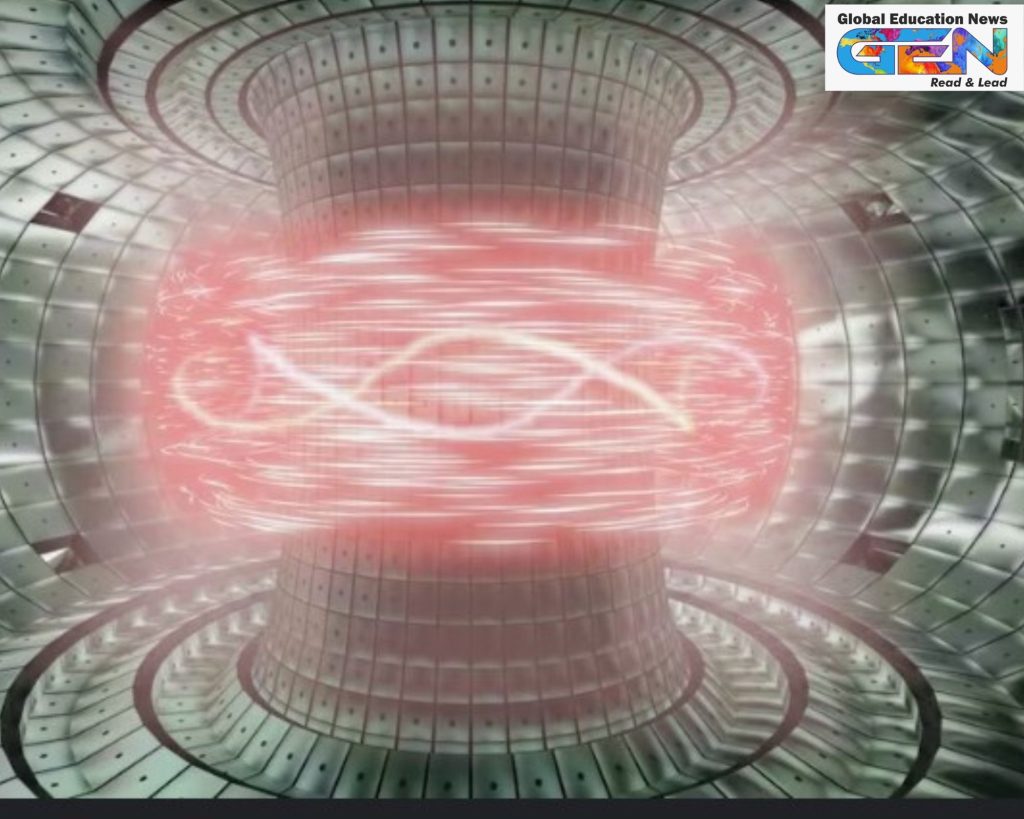
On June 10, 2025, Germany’s Wendelstein 7-X stellarator in Greifswald made headlines by sustaining a fusion plasma for 43 seconds at temperatures soaring to 30 million°C. This breakthrough, achieved by the Max Planck Institute for Plasma Physics, marks a historic step toward harnessing nuclear fusion—the process that powers the Sun—as a clean, limitless energy source. With a record-breaking triple product, this achievement rivals top tokamaks and fuels hope for a sustainable energy future. Let’s dive into what this means and why it’s a game-changer!
- Key Points:
- Sustained plasma for 43 seconds at 30 million°C.
- Achieved record triple product, a key fusion efficiency metric.
- Positions stellarators as viable rivals to tokamaks.
What Is Nuclear Fusion? The Power of the Stars
Nuclear fusion fuses light atomic nuclei, like hydrogen, to form heavier ones, releasing massive energy. Unlike fission, which splits atoms and produces long-lived radioactive waste, fusion offers clean energy with minimal environmental impact. It’s the Sun’s secret sauce, and replicating it on Earth could solve the global energy crisis. The Wendelstein 7-X brings us closer by proving fusion can be sustained under extreme conditions.
- Key Points:
- Fusion combines light nuclei, releasing vast energy.
- Produces no greenhouse gases and minimal waste.
- Promises limitless, clean power for Earth.
Inside Wendelstein 7-X: The Stellarator Powerhouse
The Wendelstein 7-X, the world’s largest operational stellarator, uses 50 powerful magnets to confine superheated plasma in a twisted magnetic field. Unlike tokamaks, which use simpler toroidal shapes, stellarators offer better plasma stability, reducing disruptions. In its latest run, it hit 20–30 million°C, sustaining plasma for 43 seconds—a leap from its previous 8-minute record in 2022. This performance showcases stellarators’ potential in the fusion race.
- Key Points:
- World’s largest stellarator with advanced magnetic design.
- Achieved 30 million°C and 43-second plasma duration.
- Offers stable plasma compared to tokamaks.
Triple Product: The Fusion Success Metric
The triple product—combining plasma temperature, density, and confinement time—is the gold standard for fusion efficiency. Higher values mean closer to net energy gain, where fusion produces more energy than it consumes. Wendelstein 7-X’s recent triple product matches top tokamaks like China’s EAST, which held plasma for 1,000 seconds in 2021. This milestone shows stellarators are catching up, paving the way for practical fusion power.
- Key Points:
- Triple product measures temperature, density, confinement time.
- Wendelstein 7-X’s results rival tokamak performance.
- Critical for achieving net energy gain in fusion.
The Challenges: Why Fusion Isn’t Here Yet
Despite the excitement, fusion remains a tough nut to crack. Current reactors, including Wendelstein 7-X, consume more energy than they produce. Maintaining extreme temperatures (over 20 million°C) and stable plasma for long durations requires cutting-edge tech. Costly infrastructure and complex engineering—like the €1.06 billion Wendelstein 7-X—add hurdles. Scientists aim for ignition, where fusion sustains itself, but that’s still years away.
- Key Points:
- Reactors use more energy than they generate.
- Requires extreme conditions and advanced tech.
- Ignition remains the ultimate fusion goal.
Global Race for Fusion: Where Germany Stands
The global fusion race is heating up. China’s EAST set a 1,000-second plasma record, while the ITER project in France targets 500 MW output by 2035. The UK’s JET achieved 59 megajoules in 2022, and private firms like Commonwealth Fusion Systems aim for commercial fusion by 2030. Germany’s Wendelstein 7-X strengthens Europe’s position, with its stellarator design offering a unique path to stable fusion.
- Key Points:
- China’s EAST leads with long plasma duration.
- ITER and private firms push for commercial fusion.
- Wendelstein 7-X bolsters stellarator research.
Safety and Green Benefits: Fusion’s Promise
Fusion is a clean energy dream. Unlike fission, it poses low accident risks and produces no long-lived radioactive waste. Its fuel—hydrogen isotopes like deuterium and tritium—is abundant, with deuterium in seawater. Fusion emits no greenhouse gases, making it a weapon against climate change. The Wendelstein 7-X’s success brings this eco-friendly future closer, with no meltdown risks like fission reactors.
- Key Points:
- No greenhouse gases or long-lived waste.
- Abundant fuel from seawater and lithium.
- Safer than fission with minimal risks.
Beyond Earth: Fusion’s Role in Space Exploration
Fusion’s potential isn’t just Earth-bound. Its high energy density could power deep-space missions, enabling travel beyond our solar system. Imagine spacecraft with fusion reactors supporting long-term missions to Mars or beyond. The Wendelstein 7-X experiments, like those planned for Axiom-4’s microgravity research, lay the groundwork for space applications, aligning with India’s Gaganyaan and NASA’s goals.
- Key Points:
- Fusion could power deep-space missions.
- Supports long-term space exploration.
- Aligns with microgravity research advancements.
Tips to Stay Engaged with Fusion Progress
Want to follow the fusion revolution? Here’s how:
- Track Updates: Follow @MaxPlanckPress on X for Wendelstein 7-X news.
- Explore Resources: Visit ipp.mpg.de for detailed research updates.
- Learn Basics: Check Khan Academy or OpenStax for free fusion science courses.
- Join the Buzz: Use #FusionEnergy to share excitement and learn from global experts.
- Key Points:
- Stay updated via Max Planck Institute channels.
- Access free OERs for fusion education.
- Engage with #FusionEnergy online.
The Future of Fusion: A Bright Horizon
The Wendelstein 7-X’s 43-second plasma record is a beacon of hope in the quest for clean, limitless energy. As Germany pushes stellarator technology, the global race to fusion power intensifies. With no emissions, abundant fuel, and space exploration potential, fusion could transform our world. Stay tuned to ipp.mpg.de for updates on the next launch window, and join the conversation with #FusionEnergy. The future of energy is closer than ever—let’s ignite it!
- Key Points:
- Wendelstein 7-X sets stellarator benchmark for fusion.
- Fuels clean energy and space exploration dreams.
- Follow ipp.mpg.de for the latest fusion breakthroughs.