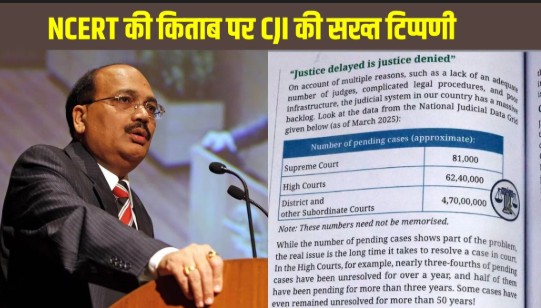
A routine textbook update by the National Council of Educational Research and Training (NCERT) has erupted into a major controversy involving the Supreme Court of India, the Ministry of Education, and the nationwide academic community. At the centre of the dispute is a chapter in the Class 8 Social Science book that references judicial corruption and systemic challenges within India’s judiciary — language that prompted strong judicial objection and an unprecedented ban.
1. What Sparked the Controversy?
The chapter titled “The Role of Judiciary in Our Society” included sections noting:
- Corruption within the judiciary,
- Backlogs of cases across courts,
- Shortage of judges in the system.
Although these issues are part of public discourse and acknowledged by legal scholars and practitioners, the inclusion of such content in a textbooks for 13-14-year-old students triggered judicial concern that the material might convey a negative portrayal of the judiciary without sufficient contextual balance.
2. Supreme Court’s Reaction: Strong and Unambiguous
The Supreme Court, led by Chief Justice Surya Kant, took suo motu cognisance of the matter, stating:
- “No one on earth would be permitted to defame the judiciary.”
- The court described the inclusion as a “deep-rooted, well-planned conspiracy to defame the judiciary.”
- A complete blanket ban was ordered on the book’s publication, distribution, and usage in classrooms.
The apex court also issued show-cause notices to senior officials, including the NCERT Director and Secretary of School Education, signalling potential legal consequences under the Contempt of Courts Act if compliance is not demonstrated.
3. Government Response: Respect for Judiciary and Action Promised
Union Education Minister Dharmendra Pradhan addressed the backlash in a press briefing, expressing:
- Regret over the incident,
- Respect for the judiciary,
- No intention to insult or undermine judicial authority.
- An inquiry will be conducted to fix accountability and appropriate action taken against those responsible.
Pradhan confirmed the Ministry’s full compliance with the Supreme Court’s directives and stated that distribution of the textbook was immediately halted once the issue came to light.
4. NCERT’s Position and Textbook Status
NCERT issued an official statement acknowledging that “inappropriate material and an error of judgement” had crept into the chapter. It clarified:
- There was “no intent to question or diminish the authority of any constitutional body.”
- The chapter will be rewritten with consultation of appropriate authorities before future publication.
Only a negligible number of the printed copies (38 out of 2.25 lakh) had been sold before the distribution recall was ordered.
5. Public Debate and Educational Implications
The episode has reinvigorated broader debates on:
- Academic freedom versus institutional respect
- How sensitive civic and constitutional topics should be taught in school curricula
- The role of transparency in textbooks without compromising respect for democratic institutions
- Whether discussing systemic challenges (including corruption and case backlogs) is educationally valid or irresponsible in early schooling
While some argue that students deserve factual awareness of real challenges, critics counter that textbooks must frame such issues responsibly to avoid undermining trust in constitutional pillars.