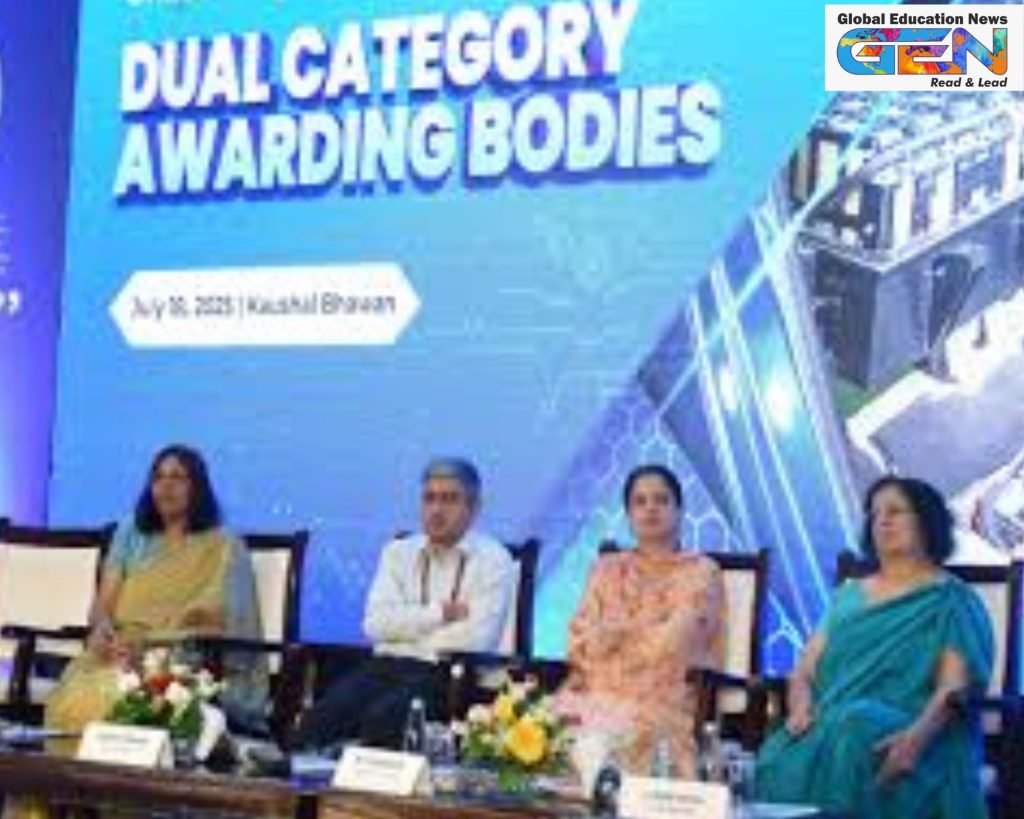
On July 18, 2025, Kaushal Bhawan, New Delhi, buzzed with excitement as over 150 delegates from 24 State and UT Education Boards gathered for a National Workshop on Onboarding State/UT Education Boards as Dual Category Awarding Bodies under the National Council for Vocational Education and Training (NCVET). Organized by the Department of School Education & Literacy (DoSE&L), Ministry of Skill Development and Entrepreneurship (MSDE), and NCVET, this landmark event marked a bold step toward integrating vocational education with formal schooling, aligning with the National Education Policy (NEP) 2020. The goal? To create seamless, skill-focused learning pathways for India’s youth
- Key Points:
- 24 State/UT Boards engaged to become Dual Category Awarding Bodies.
- Aligns vocational training with NEP 2020’s vision for holistic education.
- Over 150 delegates, including senior officers, attended the workshop.
What Are Dual Category Awarding Bodies?
Imagine State Education Boards not just conducting exams but shaping industry-ready professionals! Unlike standard Awarding Bodies (ABs) that focus solely on training and certification, Dual Category ABs take it up a notch. They handle end-to-end vocational education, from designing courses to assessing learners, all aligned with the National Skills Qualification Framework (NSQF) up to Level 4. This empowers boards to deliver job-ready skills directly within schools, making them central to India’s skilling ecosystem.
- Key Points:
- Dual Category ABs manage both training and assessment.
- Courses align with NSQF for industry-relevant skills.
- Enhances employability and higher education recognition.
Why This Matters for India’s Youth
This initiative is a game-changer for millions of students! By embedding vocational training in schools, State Boards can offer courses in fields like IT, agriculture, tourism, and healthcare, ensuring students graduate with marketable skills. The National Credit Framework (NCrF) and Academic Bank of Credits make these qualifications stackable, allowing seamless transitions to higher education or jobs. As Shri Rajit Punhani, MSDE Secretary, said, “This is a moment to redefine our collective identity—to make every training course and certificate stand for excellence.”
- Key Points:
- Equips youth with skills for jobs in high-demand sectors.
- Supports flexible learning via NCrF and Academic Bank of Credits.
- Boosts employability with globally recognized certifications.
Highlights from the Workshop
Held at Kaushal Bhawan, the workshop was a powerhouse of collaboration. Structured sessions introduced NCVET regulations, while hands-on segments with consultants helped boards complete their NCVET recognition applications on the spot. 24 States kicked off the process, with Goa, Maharashtra, Himachal Pradesh, Assam, Madhya Pradesh, and Nagaland submitting theirs—a huge win! The Goa Board of Secondary and Higher Secondary Education (GBSHSE) shared its journey as a case study, offering practical tips for others.
- Key Points:
- 24 States initiated NCVET recognition; 6 submitted applications.
- GBSHSE’s case study provided real-world onboarding insights.
- Hands-on support ensured practical application progress.
Star-Studded Leadership
The event shone with high-profile leaders like Ms. Sonal Mishra (Additional Secretary, MSDE), Ms. Prachi Pandey (Joint Secretary, DoSE&L), Dr. Vinita Agarwal, and Dr. Neena Pahuja (Executive Members, NCVET). Their presence underscored the government’s whole-of-government approach to skilling, as emphasized by X posts from @MSDESkillIndia and @jayantrld. This wasn’t just a workshop—it was the culmination of weeks of virtual consultations and state-specific discussions.
- Key Points:
- Led by top MSDE and DoSE&L officials for maximum impact.
- Built on extensive pre-workshop consultations.
- Social media buzz highlighted the event’s significance.
Benefits of the Dual Category Model
Why go dual? The Dual Category AB model is a win-win:
- Government Endorsement: Boards gain credibility in the national vocational education and training (VET) ecosystem.
- Industry Alignment: Access to NCVET-aligned qualifications ensures employer trust.
- Expanded Offerings: Boards can design and assess courses up to NSQF Level 4, covering grassroots skills like carpentry or IT.
- Global Recognition: Certifications meet international benchmarks, boosting job prospects.
- Key Points:
- Enhances board credibility with NCVET recognition.
- Aligns courses with industry needs for better jobs.
- Supports global-standard certifications for youth.
Challenges and the Road Ahead
Transitioning to Dual Category status isn’t a walk in the park. Boards face challenges like:
- Capacity Building: Training teachers for vocational pedagogy.
- Infrastructure: Scaling facilities for hands-on courses.
- Compliance: Meeting NCVET’s rigorous quality standards.
Yet, the workshop’s hands-on support and GBSHSE’s success story show it’s doable. With NCVET’s KaushalVerse launching on July 22, 2025, and frameworks like the National Curriculum Framework, boards are poised to transform education by 2026.
- Key Points:
- Boards need training and infrastructure upgrades.
- NCVET’s support ensures compliance and quality.
- KaushalVerse launch to boost digital skilling access.
Tips for Students and Educators
For students eyeing vocational courses:
- Explore Options: Check with your State Board for new NSQF-aligned courses in 2026.
- Leverage Credits: Use the Academic Bank of Credits to stack qualifications.
- Stay Updated: Follow NCVET’s portal (ncvet.gov.in) for course details.
For educators and boards:
- Complete Applications: Use NCVET’s guidelines to finalize Dual Category status.
- Train Staff: Invest in pedagogy training for vocational subjects.
- Engage Industry: Partner with local employers for relevant curricula.
- Key Points:
- Students can access new vocational courses via State Boards.
- Boards should prioritize staff training and industry ties.
- NCVET portal offers resources for course verification.
A Bright Future for Skilling in India!
The National Workshop at Kaushal Bhawan is a bold step toward a skill-ready India. By empowering State Boards as Dual Category Awarding Bodies, NCVET is weaving vocational education into the fabric of schooling, fulfilling NEP 2020’s vision. With 24 States on board and leaders like Shri Rajit Punhani championing quality, India’s youth are set to shine in fields from IT to healthcare. As @PIBodisha tweeted, “This is a landmark initiative for seamless learning pathways!” Join the revolution—India’s skilling future starts now!