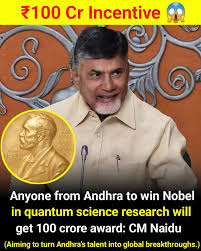
As Andhra Pradesh CM N. Chandrababu Naidu unveiled his vision for a tech utopia in the Swarna Andhra 2047 blueprint, one promise stole the spotlight: A whopping ₹100 crore reward for any researcher clinching a Nobel in quantum computing. Announced on December 23, 2025, during a student interaction in Amaravati, this audacious incentive aims to catapult the state into the global quantum race, positioning it among five future “quantum valleys.” It’s a classic Naidu move—bold, futuristic, and reminiscent of his 1990s IT boom that birthed HITEC City. Yet, as 2026 dawns, experts caution that such starry-eyed goals risk fading into footnotes without addressing stark capacity constraints: Meager budgets, faculty voids, and infra lags that hobble even basic research. Drawing from the 232-page Swarna Andhra document and Naidu’s track record, this analysis dissects the Nobel carrot’s allure, the systemic sticks holding it back, and whether Andhra can truly engineer a Nobel-worthy leap—or if it’s another aspirational echo of unkept promises like Vision 2020’s literacy dreams.
The Swarna Andhra Vision: From Literacy to Laureates
Naidu’s Swarna Andhra 2047, dropped in November 2024, is a 22-year roadmap to a $2.5 trillion economy, with education as the fourth pillar—a far cry from the rote rote of yesteryears. It envisions universal vocational training for the 15-59 age group (up from 1%), 100% literacy for seven-plus, and a School Education Quality Index (SEQI) jump from 50 to 100. The crown jewels? Three “knowledge cities” in Amaravati, Visakhapatnam, and Tirupati; an AI University; a National Centre for AI; and 3-5 world-class multidisciplinary universities. And the Nobel kicker: Up to two homegrown laureates, starting with quantum computing.
- Historical Echo: This mirrors Naidu’s 1999 Vision 2020, which ballooned engineering colleges from 35 to 236 by 2004, spiking intake but skimping on quality—literacy hit 72.6% in 2023-24 (PLFS), last among states.
- Budget Bite: FY26 allocates ₹31,800 crore for schools, ₹2,500 crore for higher ed, and ₹1,200 crore for skills—12.1% of expenditure, below the 15% state average and Vision 2020’s 17-20% target.
Naidu’s pitch: “Produce quantum computers in Amaravati within two years.” Ambitious? Absolutely. Achievable? That’s the quantum question.
The ₹100 Crore Nobel Bait: Incentive or Illusion?
The December 23 reveal—during a PowerPoint pep talk with students—dangled ₹100 crore for a quantum Nobel, framing it as fuel for Amaravati’s “quantum valley” dreams. Nobel Prizes, awarded December 10 in six fields, honor breakthroughs; quantum computing’s frontier status makes it a fitting frontier for Naidu’s tech tilt.
- Incentive Mechanics: Cash for the winner; part of broader R&D pushes like the Andhra Pradesh Quantum Computing Policy (2025–2030), capping academic grants at ₹30 lakh/project (134 proposals pending).
- Global Benchmark: Echoes Singapore’s $1M awards, but India’s National Quantum Mission (NQM) budgets $0.735B (2023-31)—a drop against China’s $15.3B.
- Naidu’s Nobel Nod: Positions AP as a “knowledge hub,” but experts dub it “aspirational”—Nobels demand ecosystems, not endowments.
Quote from Naidu: “Aim for a big vision… the next breakthrough will be quantum’s speed.” Bold words, but as one analyst quips, “Daydream without infrastructure.”
Capacity Constraints: The Infra and Talent Tangle
Andhra’s ambitions crash against capacity walls: Research infra is threadbare, faculty thin, and funding fickle.
- Budget Blues: FY26’s 12.1% education spend trails peers; higher ed gets ₹2,500 crore, skills ₹1,200 crore—meager for Nobel-scale labs.
- Infra Ills: Lacks ultra-high-precision optics, millikelvin facilities, high-end magnetometers, and nanoscale fabs; India imports even X-ray diffractometers for crystal analysis.
- Talent Crunch: Andhra University Physics has 3-4 professors for 200 students; statewide, 60% teaching posts vacant (contractual fills 14%). 20 courses ran faculty-free in June 2025.
- Systemic Snags: Inequitable funding, erratic cycles, referee shortages in agencies.
Expert Dinesh Shukla (UGC-DAE): “Large cash rewards are aspirational… but a daydream without infrastructural needs.” Anonymous AP prof: “Hopeful for quantum BTech, but proposals await approval.”
| Constraint | AP Reality | Global Gap |
|---|---|---|
| Quantum Budget | NQM: $0.735B (India) | China: $15.3B |
| Faculty Vacancies | 60% statewide | IITs: 20-30% |
| Lab Facilities | No millikelvin/X-ray lasers | US/EU: 100+ hubs |
| Project Grants | ₹30L cap | Singapore: $1M+ |
These chasms cast shadows on Naidu’s shine.
Expert Echoes: Aspirations vs. Execution
Voices from academia temper the hype with hard truths.
- Dinesh Shukla: “Nobel for genuine breakthroughs… requires specialized infra scarce in India.”
- Anonymous Prof: “AP University’s quantum BTech is a start; research awaits NQM nod.”
- A. Mathew (NIEPA): “Naidu’s tenure exploded colleges (35 to 236 engineering), but quality lagged—history may repeat.”
These insights frame the incentive as motivational, not magical.
Implications: Can Andhra Quantum-Leap to Nobel Glory?
Naidu’s ₹100 crore is a spark, but sustaining it demands systemic fire. Vision 2020’s literacy flop (44% to 72.6%) warns of overpromise; Swarna Andhra’s 95% vocational goal hinges on execution. Positives: Quantum policy could seed startups; knowledge cities attract FDI. Risks: Brain drain (30% IIT grads emigrate); funding flux.