On July 11, 2025, UNESCO inscribed three haunting remnants of Cambodia’s Khmer Rouge era—Tuol Sleng Genocide Museum, Choeung Ek Killing Fields, and M-13 prison—onto its prestigious World Heritage List. Announced during the 47th Session of the World Heritage Committee in Paris, this landmark decision marks the 50th anniversary of the Khmer Rouge’s rise to power in 1975. These sites, tied to the genocide that claimed an estimated 1.7 million lives from 1975 to 1979, now stand alongside global treasures like the Great Wall of China and Cambodia’s Angkor Wat, symbolizing a commitment to remembrance and education.
- Key Points:
- First modern, non-classical sites from Cambodia on UNESCO’s list.
- Recognized for their role in preserving the memory of genocide.
- A global call to defend peace and learn from history’s darkest chapters.
Tuol Sleng: The Notorious S-21 Prison
Once a high school in Phnom Penh, Tuol Sleng, or S-21, became a chilling symbol of Khmer Rouge brutality. Approximately 15,000 men, women, and children were tortured and interrogated here, their black-and-white mugshots now lining the walls of the Tuol Sleng Genocide Museum. Today, it serves as a space for reflection, housing preserved torture equipment and victim portraits that draw thousands of visitors annually. Its UNESCO listing underscores its role in educating about the horrors of the regime.
- Key Points:
- Former high school turned torture center for 15,000 victims.
- Now a museum preserving victim stories and artifacts.
- A focal point for global education on genocide prevention.
Choeung Ek: The Killing Fields’ Grim Legacy
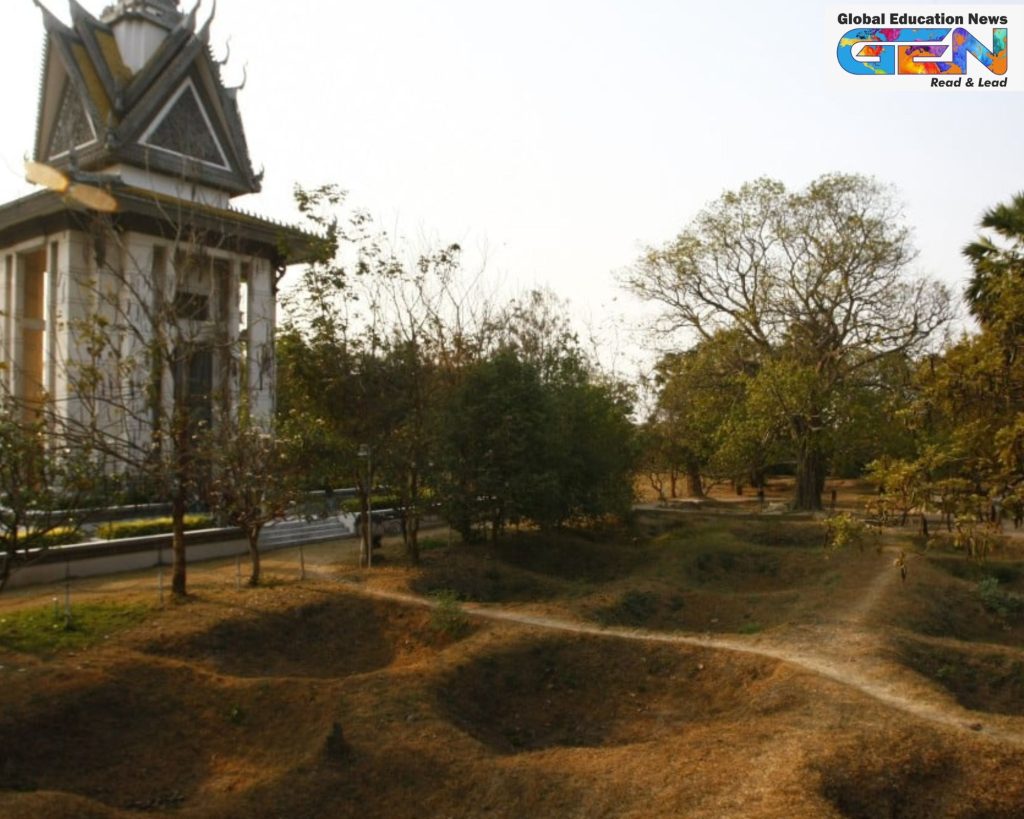
Located 15 kilometers south of Phnom Penh, Choeung Ek is infamous as a Killing Field where S-21 prisoners faced nightly executions. Over 6,000 bodies were exhumed from more than 100 mass graves in the early 1980s, with a memorial stupa now displaying victims’ skulls. Immortalized in the 1984 film The Killing Fields, this site hosts annual remembrance prayers and student reenactments, making its UNESCO recognition a powerful step toward healing.
- Key Points:
- Execution site with over 6,000 bodies uncovered from mass graves.
- Memorial stupa and annual ceremonies honor victims.
- Featured in the Oscar-nominated film The Killing Fields.
M-13: The Early Crucible of Khmer Rouge Cruelty
In rural Kampong Chhnang province, the M-13 prison stands as a lesser-known but equally harrowing site. Used in the early Khmer Rouge years, it was a testing ground for interrogation and torture methods, with prisoners held in pits still faintly visible today. Now a derelict patch of land, its inclusion in the UNESCO list highlights its historical significance as a precursor to the regime’s widespread atrocities.
- Key Points:
- Early Khmer Rouge prison in rural Cambodia.
- Site where torture and interrogation techniques were developed.
- Preserved as a testament to the regime’s early brutality.
A Global Call for Peace and Education
The UNESCO inscription, Cambodia’s first for modern conflict sites, is a bold step in confronting the painful legacy of the Khmer Rouge, which killed nearly a quarter of the population through starvation, forced labor, and mass executions. Cambodian Prime Minister Hun Manet marked the occasion with a nationwide drum-beating ceremony on July 13, 2025, urging citizens to reflect on peace. “From the darkest chapters of history, we can draw strength to build a better future,” he said in a video message.
- Key Points:
- Nationwide drum-beating ceremony to commemorate the listing.
- Hun Manet emphasizes peace and resilience through remembrance.
- UNESCO listing aims to educate global youth on genocide.
Healing Through Remembrance
Youk Chhang, a Khmer Rouge survivor and director of the Documentation Center of Cambodia, called the sites “the landscape of our shared memory.” He believes their UNESCO status will amplify efforts to teach younger generations about the genocide, fostering healing and awareness worldwide. This recognition comes after the Khmer Rouge tribunal, which convicted only three leaders at a cost of $337 million, underscoring the need for alternative paths to justice and remembrance.
- Key Points:
- Youk Chhang highlights the sites’ role in education and healing.
- Khmer Rouge tribunal convicted just three men over 16 years.
- UNESCO listing offers a new avenue for preserving history.
Cambodia’s Growing UNESCO Legacy
These three sites join Cambodia’s four existing UNESCO World Heritage Sites—Angkor, Preah Vihear, Sambo Prei Kuk, and Koh Ker—marking the nation’s first nomination for modern, conflict-related sites. The decision, celebrated across social media, reflects Cambodia’s commitment to confronting its past while educating the world. As one X post noted, these sites “preserve history, promote peace, and educate future generations.”
- Key Points:
- Cambodia’s first UNESCO listing for modern conflict sites.
- Joins four existing cultural heritage sites, including Angkor Wat.
- Social media buzz highlights global support for the decision.
A Step Toward a Hopeful Future
The UNESCO listing of Tuol Sleng, Choeung Ek, and M-13 is more than a historical marker—it’s a call to action. By preserving these sites, Cambodia ensures that the atrocities of the Khmer Rouge are neither forgotten nor repeated. For visitors, students, and survivors, these places offer a chance to reflect, learn, and build a future rooted in peace. As the world watches, Cambodia’s story of resilience continues to inspire.
- Key Points:
- Sites serve as a global reminder to prevent future atrocities.
- Encourage reflection and education for visitors and students.
- Cambodia’s resilience shines through its commitment to remembrance.