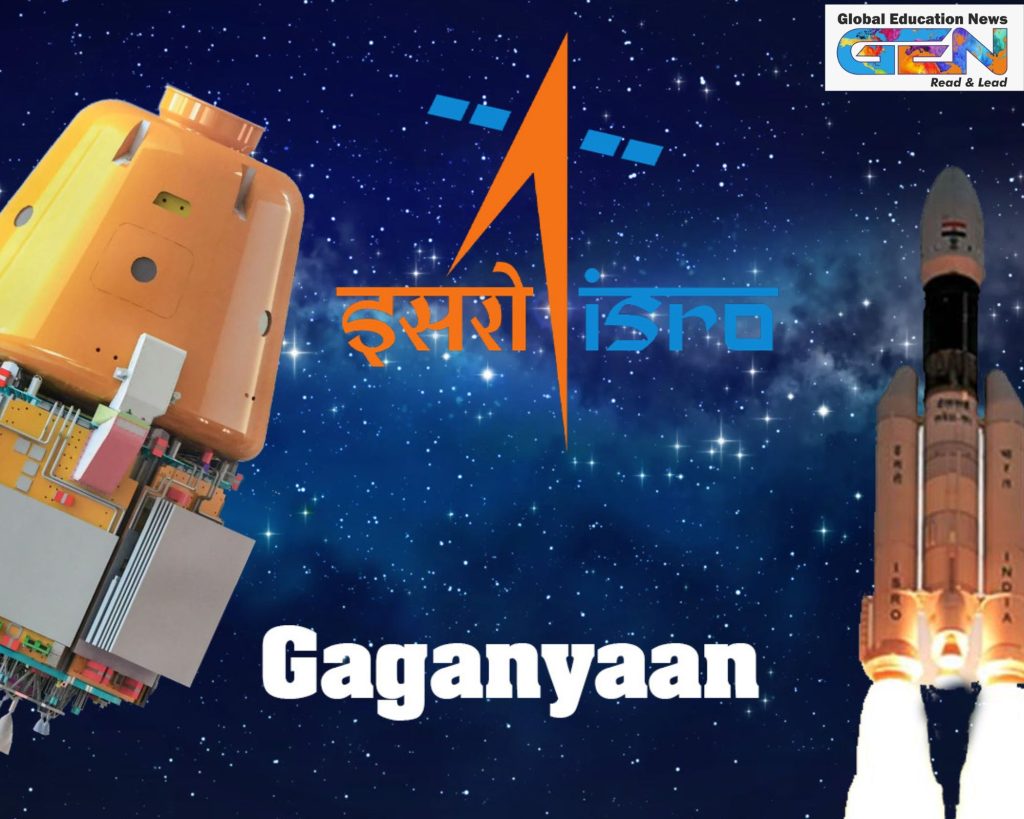
The Indian Space Research Organisation (ISRO) is rocketing toward history with its Gaganyaan mission, India’s bold leap into human spaceflight. On July 3, 2025, ISRO lit up the skies—figuratively and literally—with two successful hot tests of the Gaganyaan Service Module Propulsion System (SMPS) at its Propulsion Complex in Mahendragiri, Tamil Nadu. These tests aren’t just about firing engines; they’re about igniting India’s dream of sending astronauts into orbit by 2027. Here’s why this milestone has the nation buzzing and how it’s propelling India closer to the stars.
Blasting Off: The Heart of Gaganyaan’s Success
- Key Points:
- Two hot tests (30 and 100 seconds) validated the SMPS’s performance.
- SMPS ensures orbital maneuvering and emergency abort capabilities.
- Tests confirmed flawless operation of Liquid Apogee Motor (LAM) and Reaction Control System (RCS) thrusters.
Imagine a spacecraft dancing gracefully in orbit, adjusting its path with pinpoint precision. That’s the job of the Service Module Propulsion System, the powerhouse behind Gaganyaan’s ability to navigate space. The recent tests, conducted with surgical accuracy, saw five 440-Newton LAM engines and 16 100-Newton RCS thrusters roar to life. The 100-second test was a showstopper, with all thrusters firing in sync—some in steady bursts, others in rapid pulses—proving the system’s readiness for the real deal. This isn’t just engineering; it’s a symphony of fire and precision, choreographed to keep astronauts safe and on course.
Building the Rocket, Step by Fiery Step
- Key Points:
- Builds on Phase-1 and Phase-2 tests from 2023, with thousands of seconds of firing time.
- Incorporates upgrades from lessons learned, nearing flight-ready hardware.
- Led by ISRO’s Liquid Propulsion Systems Centre (LPSC) in Bengaluru and Valiamala.
ISRO’s journey to this point reads like a sci-fi thriller. The Gaganyaan program has been a marathon of innovation, with earlier tests in 2023 laying the groundwork for today’s triumphs. Those trials, including a marathon 700-second burn, fine-tuned the SMPS to perfection. Now, with lessons learned and upgrades in place, ISRO is crafting a propulsion system that’s not just reliable but revolutionary. The LPSC team, working across Bengaluru and Valiamala, is the unsung hero, turning complex math and fiery engines into a ticket to orbit.
Green Fuel, Big Dreams
- Key Points:
- Uses eco-friendly propellants like ISROSENE and hydroxylammonium nitrate (HAN).
- Moves away from toxic hydrazine for safer, sustainable missions.
- Aligns with global trends in environmentally conscious space tech.
In true ISRO style, Gaganyaan isn’t just about reaching the stars—it’s about doing it responsibly. The mission swaps out old-school hydrazine for greener alternatives like ISROSENE (rocket-grade kerosene) and innovative blends like HAN and methanol. This shift isn’t just about safety for astronauts; it’s about protecting Earth’s future while exploring space’s frontiers. It’s ISRO saying, “We’re going to the stars, and we’re doing it with a conscience.”
A Team Effort That Spans the Nation
- Key Points:
- Collaborates with Indian industries like Larsen & Toubro for the HS200 booster.
- Involves testing facilities from Sriharikota to Mahendragiri.
- Astronaut-designate Shubhanshu Shukla conducts experiments on the ISS.
Gaganyaan is more than an ISRO project—it’s a national mission. From Larsen & Toubro’s HS200 booster, tested in 2022, to facilities across India, the program unites the best of Indian ingenuity. Add to that Group Captain Shubhanshu Shukla, one of four astronaut-designates, already making waves with experiments on the International Space Station. This is India’s brain trust at work, turning a bold vision into reality, one test at a time.
What’s Next? The Road to 2027
- Key Points:
- Full-duration hot test planned to simulate flight conditions.
- Second test vehicle and uncrewed mission set for 2025.
- Mission aims for a 400 km orbit, three-day stay, and safe splashdown.
The hot tests are just the beginning. ISRO is gearing up for a full-duration test to mimic the chaos of a real mission. By 2025, expect a second test vehicle and an uncrewed flight to fine-tune systems for crew safety. The goal? A three-day adventure in a 400 km orbit, culminating in a splashdown off India’s coast. Despite hurdles like pandemic-related delays, ISRO’s on track to make 2027 a year India soars into history.
Why Gaganyaan Is India’s Cosmic Calling Card
- Key Points:
- Joins elite nations like the US, Russia, and China in human spaceflight.
- Includes experiments in microgravity for biology and physical sciences.
- Inspires a generation to dream beyond the horizon.
Gaganyaan isn’t just a mission; it’s a statement. It’s India saying, “We belong among the stars.” With experiments planned in biology and physics, the mission will unlock new knowledge in microgravity. More than that, it’s a spark for young dreamers, showing them that the sky isn’t the limit—it’s just the beginning.