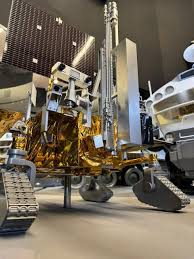
The Indian Space Research Organisation (ISRO) has taken a decisive step in its next lunar frontier by selecting a landing site near the Moon’s south pole for the Chandrayaan-4 mission, which is slated for launch around 2028. This important milestone reflects India’s steady progression in space science and deepens its contributions to global lunar exploration.
Mission Overview: Chandrayaan-4’s Ambitious Goals
Chandrayaan-4 is designed to be India’s first lunar sample-return mission — a highly complex endeavour that aims to collect lunar soil and rock samples and bring them back to Earth for analysis. If successful, it would place India among a select group of nations capable of executing such advanced space missions.
The mission architecture includes multiple modules — such as propulsion, descender, ascender, transfer, and re-entry modules — that will work in concert to land softly, collect samples, and return them through lunar orbit to Earth.
Why the South Polar Region Matters
The lunar south pole has emerged as one of the most scientifically compelling regions on the Moon due to its:
- Potential presence of water ice in permanently shadowed areas.
- Unique geology that could reveal early Solar System history.
- Long periods of sunlight useful for sustainable power during operations.
ISRO’s earlier missions, such as Chandrayaan-1 and Chandrayaan-3, also focused on the lunar south polar region, highlighting the area’s importance.
Selecting the Landing Site: Mons Mouton and MM-4
ISRO scientists conducted a detailed terrain assessment using high-resolution data from the Chandrayaan-2 orbiter’s Orbiter High Resolution Camera (OHRC) and other datasets. They evaluated multiple candidate sites in the Mons Mouton region — a rugged area near the Moon’s south pole — with careful emphasis on:
- Terrain safety and slope characteristics
- Hazard density and terrain roughness
- Sunlight availability and landing stability
Among the four shortlisted sites — MM-1, MM-3, MM-4, and MM-5 — the site designated MM-4 was selected for its optimal terrain profile, including a lower hazard percentage, a mean slope of about five degrees, and a large number of hazard-free grid areas ideal for a soft landing.
This one-square-kilometer area offers a relatively smooth and safe surface, which is critical for ensuring the mission’s precision landing, sample collection, and ascent operations.
Scientific and Strategic Significance
Enhancing Lunar Geology Research
Landing near the south pole provides access to ancient polar terrain with potentially preserved volatile compounds such as water ice — a major objective for scientific study. The samples returned by Chandrayaan-4 may help researchers better understand the Moon’s formation history and volatile inventory.
Building on Past Success
ISRO’s previous success with Chandrayaan-3’s soft landing near the lunar south pole validated the agency’s landing capabilities on challenging terrain. Chandrayaan-4 now builds on this achievement with a more complex mission profile requiring precise landing and ascent sequence planning.
Global Leadership in Space Exploration
With a lunar sample-return mission, India enters a rarified league of spacefaring nations that have accomplished similar feats, strengthening its scientific reputation and space technology expertise.
Mission Timeline and Future Expectations
While Chandrayaan-4 is still undergoing design and development phases, ISRO Chairman V. Narayanan has reaffirmed the agency’s target for a 2028 launch, allowing ample lead time for engineering, testing, and mission refinement.
The early selection of the landing site — years in advance of launch — enables mission planners to integrate precise descent trajectories, communication pathways, and lander-related systems that maximize mission success and safety.