Published on November 02 , 2025
Contents
Delhi, India
Overview of the LVM3-M5 Mission Launch
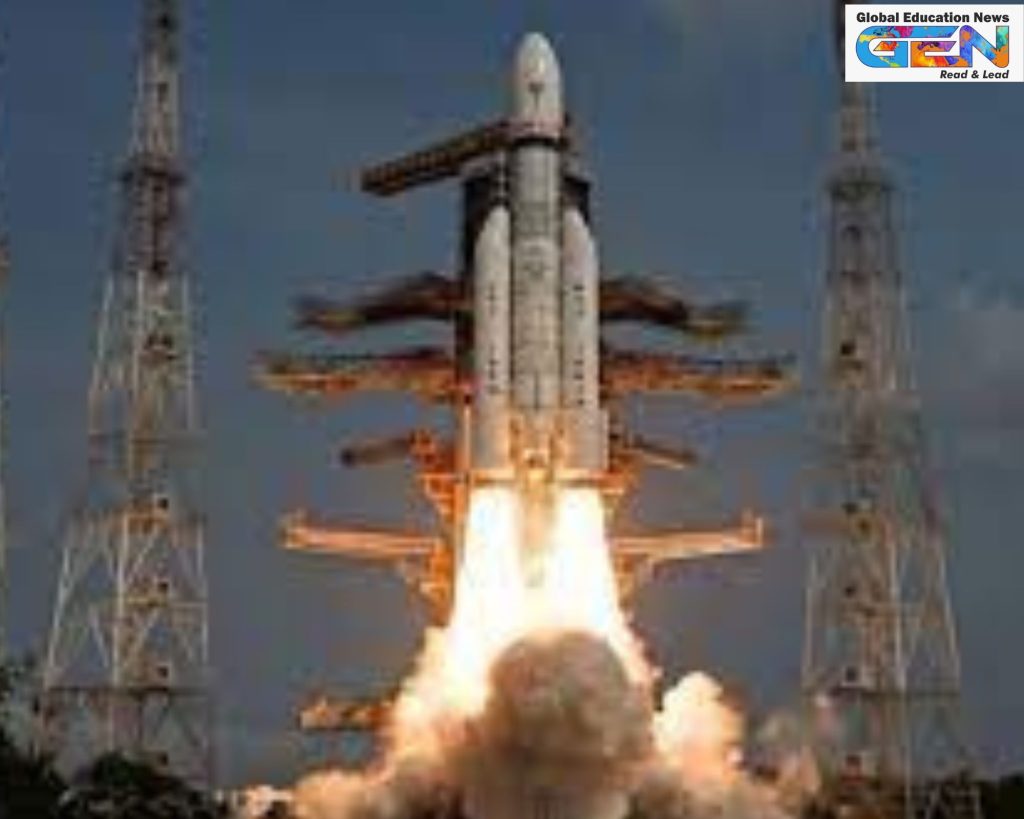
- The LVM3-M5 mission lifted off successfully on November 2, 2025, at 5:10 PM IST from the Satish Dhawan Space Centre in Sriharikota, Andhra Pradesh, despite challenging weather conditions.
- This marked the fifth operational flight of the LVM3 rocket, also dubbed “Bahubali” for its heavy-lift prowess, injecting the CMS-03 satellite precisely into Geosynchronous Transfer Orbit (GTO) within 20 minutes.
- Mission objective: Deploy India’s heaviest homegrown communication satellite to enhance secure, multi-band connectivity over Indian oceans and landmass, replacing aging GSAT-7 series launched in 2013.
- ISRO’s 100% success rate across all eight LVM3 flights underscores its reliability, building on triumphs like Chandrayaan-3 in 2023 and the Crew module Atmospheric Re-entry Experiment in 2014.
Technical Specifications of the LVM3-M5 Rocket
- Three-stage architecture: Two S200 solid motor strap-ons for initial thrust, L110 liquid core stage with twin Vikas engines, and indigenous C25 cryogenic upper stage for precise orbital insertion.
- Payload capacity: Up to 4,000 kg to GTO and 8,000 kg to Low Earth Orbit (LEO), with a height of 43.5 meters—taller than a 14-storey building.
- Fully indigenous development: S200 boosters from Vikram Sarabhai Space Centre and Vikas engines from Liquid Propulsion Systems Centre, eliminating foreign dependencies for heavy payloads.
- Performance highlights: Achieved flawless separation sequences, with CMS-03 deployed at 179 km altitude, demonstrating superior accuracy in adverse weather.
CMS-03 Satellite: Features and Strategic Role
- Weighing 4,410 kg, CMS-03 is ISRO’s heaviest communication satellite launched from Indian soil, designed for a 15-year operational lifespan in multi-band frequencies.
- Capabilities: Provides advanced secure communications for defense, including naval and army networks, covering vast oceanic regions for real-time data relay and surveillance.
- Technological edge: Equipped with high-throughput transponders for broadband services, enabling encrypted voice, video, and data links critical for military operations.
- Strategic importance: Enhances India’s maritime domain awareness, supporting operations in the Indian Ocean Region and reducing reliance on foreign satellites for defense connectivity.
Mission Execution and Key Milestones
- Launch sequence: Eight critical events unfolded seamlessly, from strap-on ignition to cryogenic stage burnout, culminating in satellite separation and solar panel deployment confirmation.
- Weather resilience: Despite uncooperative conditions, ground teams at Sriharikota ensured zero deviations, with real-time telemetry from Mission Control validating every parameter.
- Post-injection phase: CMS-03’s health parameters nominal, with upcoming orbit-raising maneuvers using onboard thrusters to reach final geostationary slot.
- Comparative success: Surpasses previous LVM3 payloads like Chandrayaan-3’s 3,841 kg lander, affirming ISRO’s evolution from foreign launches (e.g., GSAT-11’s 5,854 kg via Ariane-5 in 2018).
Insights from ISRO Leadership and Team
- ISRO Chairman V. Narayanan hailed the mission as a “shining example of Atmanirbhar Bharat,” praising the team’s diligence in overcoming weather hurdles.
- Narayanan described LVM3 as “Bahubali” for its unmatched heavy-lift capability, injecting CMS-03 with pinpoint precision into the targeted orbit.
- Team acknowledgments: Over 1,000 scientists and engineers contributed, with special nods to cryogenic stage developers for enabling self-reliant GTO insertions.
- Broader pride: Officials linked the success to national milestones like Chandrayaan-3, boosting morale ahead of human spaceflight ambitions.
Broader Implications for India’s Space Program
- Self-reliance milestone: Ends dependence on foreign providers like Arianespace for satellites up to 4,000 kg, saving costs and accelerating deployment timelines.
- Defense and commercial boost: Strengthens secure comms for armed forces while opening doors for ISRO’s launch services to international clients since 1999.
- Pathway to Gaganyaan: Validates human-rated LVM3 (HRLV) for India’s crewed mission, with enhanced safety features tested in this flight.
- Future horizon: Positions ISRO’s versatile fleet—PSLV for LEO, GSLV/LVM3 for GTO, SSLV for small sats—as a global competitor, targeting 20+ launches in 2026.