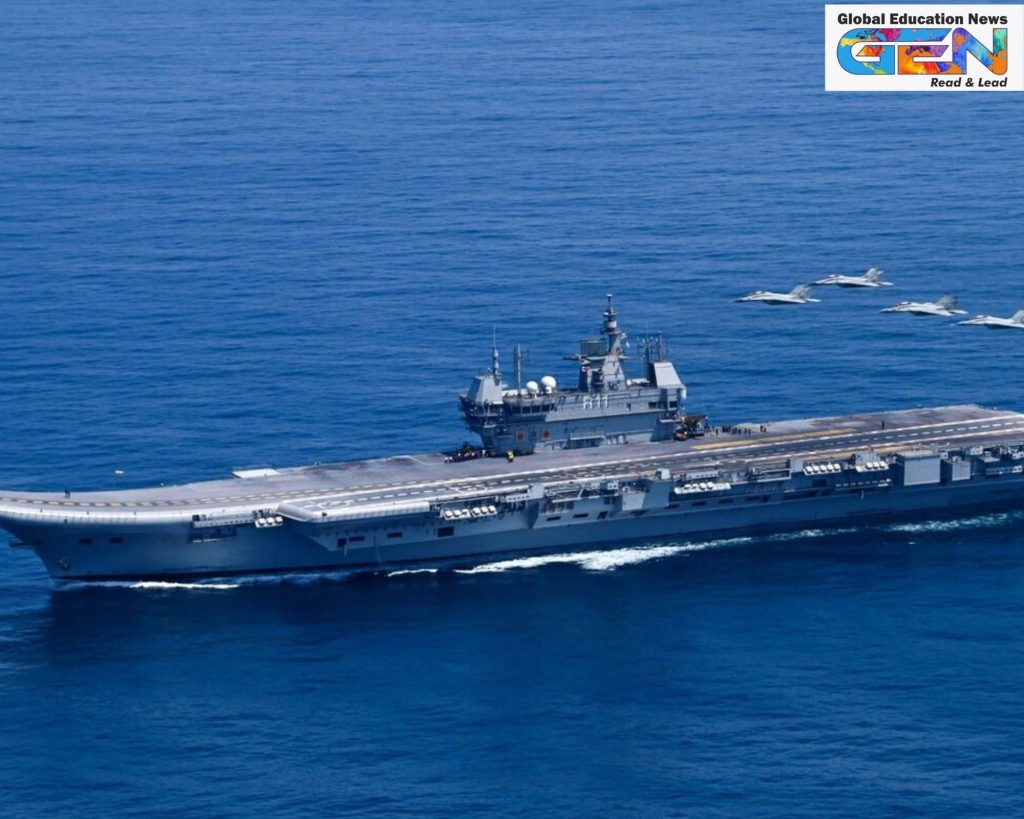
In a powerful address aboard the INS Vikrant, Defence Minister Rajnath Singh underscored the pivotal role of aircraft carriers in modern naval warfare, calling them “floating fortresses” that embody India’s maritime strength. Launched as India’s first indigenously-built aircraft carrier, INS Vikrant, alongside its counterpart INS Vikramaditya, is redefining the Indian Navy’s reach in 2025. These colossal warships are not just tools of war but symbols of national power and technological prowess. Ready to dive into why aircraft carriers are the backbone of India’s blue-water navy? Let’s explore their significance, capabilities, and future in shaping maritime dominance!
Key Points:
- Rajnath Singh highlights INS Vikrant as a critical naval asset.
- Aircraft carriers symbolize India’s growing maritime influence.
- INS Vikrant and Vikramaditya anchor India’s blue-water ambitions.
What Makes an Aircraft Carrier a Naval Powerhouse?
An aircraft carrier is a seagoing airbase, a mighty warship designed to project air power across vast oceans. Equipped with a flight deck for take-offs and landings and a hangar for aircraft storage, carriers bring unmatched versatility to naval operations. Their primary strength lies in fighter aircraft, which deliver air superiority, precision strikes, and reconnaissance far from home shores.
Key Points:
- Functions as a mobile airbase with a flight deck and hangar.
- Fighter jets provide long-range offensive and defensive capabilities.
- Essential for projecting power in modern naval warfare.
Why Aircraft Carriers Are Central to Naval Strategy
Aircraft carriers are the cornerstone of a blue-water navy, enabling nations to project power thousands of miles away. Their significance was cemented during World War II, when carriers like those of the U.S. and Japan dominated battles with precise, long-range strikes, outclassing traditional naval guns. Today, carriers remain vital for:
- Power Projection: Conducting operations far from home waters.
- Strategic Flexibility: Supporting air strikes, surveillance, and disaster response.
- Maritime Dominance: Controlling key sea lanes and deterring adversaries.
Defence Minister Singh emphasized that carriers like INS Vikrant ensure India’s ability to safeguard its maritime interests in an evolving geopolitical landscape.
Key Points:
- Enable power projection beyond territorial waters.
- Outperform traditional naval weapons with air capabilities.
- Critical for India’s maritime security in 2025.
The Strength of Carrier Strike Groups: A Floating Fortress
Aircraft carriers never sail alone—they lead carrier strike groups (CSGs), a formidable fleet of warships working in tandem. A typical CSG includes:
- Destroyers and Missile Cruisers: For air and missile defense.
- Frigates: For anti-submarine warfare.
- Submarines: For stealth operations and protection.
- Supply Ships: To sustain long missions.
This multi-layered defense system shields the carrier from threats, while its aircraft extend offensive reach, making CSGs a force multiplier in naval operations.
Key Points:
- CSGs combine destroyers, frigates, submarines, and supply ships.
- Provide robust defense against air, surface, and underwater threats.
- Enhance the carrier’s offensive and strategic capabilities.
INS Vikrant: India’s Pride, Built at Home
Commissioned in 2022, INS Vikrant is a testament to India’s growing defense manufacturing prowess. As the first indigenously-built aircraft carrier, it boasts impressive specs:
- Displacement: 45,000 tonnes, the largest warship built in India.
- Indigenous Content: ~76% of components made in India.
- Aircraft Capacity: Up to 34 aircraft, primarily MiG-29K fighter jets.
- Crew: 1,600 personnel, functioning like a self-sustaining town at sea.
With advanced automation and cutting-edge technology, INS Vikrant is a symbol of Atmanirbhar Bharat (self-reliant India).
Key Points:
- India’s first home-built carrier, showcasing engineering excellence.
- Hosts 34 aircraft, including Russian-made MiG-29K jets.
- Operates with a 1,600-strong crew for extended missions.
Inside INS Vikrant: Features That Power Missions
Beyond its combat capabilities, INS Vikrant is equipped to support its crew during long deployments:
- Medical Facilities: A hospital with two operating theatres and an ICU.
- Workshop: Onboard mechanical repair facilities for operational readiness.
- Galleys: Three kitchens capable of feeding 600 personnel at once.
- Living Quarters: Comfortable accommodations for the 1,600-strong crew.
These features ensure that INS Vikrant can operate independently for months, supporting both crew welfare and mission success.
Key Points:
- Advanced hospital with ICU for crew healthcare.
- Workshops ensure real-time repairs at sea.
- Galleys support large-scale meal preparation.
The Future: Expanding India’s Carrier Fleet
The Indian Navy is not stopping at INS Vikrant and INS Vikramaditya. Plans are underway for a third aircraft carrier within the next decade, reinforcing India’s commitment to maritime security. As geopolitical tensions rise in the Indo-Pacific, carriers will play a pivotal role in:
- Securing critical sea lanes, like the Indian Ocean Region.
- Countering regional challenges from adversaries.
- Supporting India’s vision of a Viksit Bharat with global influence.
Rajnath Singh’s address aboard INS Vikrant signals the government’s focus on strengthening naval capabilities to meet 21st-century challenges.
Key Points:
- Third carrier planned to bolster India’s naval strength.
- Carriers critical for Indo-Pacific maritime security.
- Aligns with India’s goal of global strategic influence.