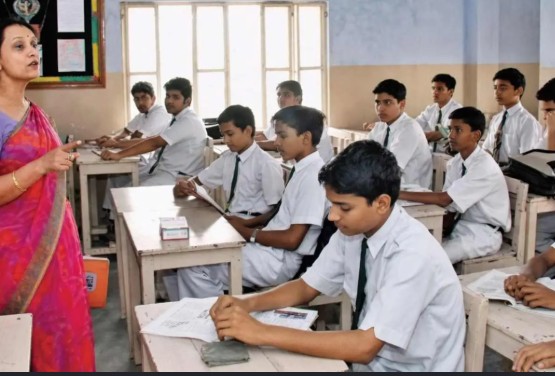
India’s school education system has witnessed significant improvements in access, infrastructure, inclusion, and digital learning over the past decade, according to a new report released by NITI Aayog.
The report, titled “School Education System in India: Temporal Analysis and Policy Roadmap for Quality Enhancement,” provides a detailed assessment of the country’s evolving education landscape and outlines key reforms needed to improve learning quality nationwide.
India Operates the World’s Largest School Education Network
According to the report, India currently has:
- More than 14.71 lakh schools
- Around 24.69 crore students enrolled
This makes India one of the world’s largest and most complex school education systems.
The assessment is based on data from:
- UDISE+ 2024-25
- PARAKH Rashtriya Sarvekshan 2024
- NAS surveys
- ASER reports
Major Improvements in School Infrastructure
The report highlights substantial growth in school infrastructure and digital access over the past decade.
Key Infrastructure Improvements
- Increased availability of electricity in schools
- Better sanitation and girls’ toilet facilities
- Expansion of computer and internet access
- Rise in smart classrooms and digital learning tools
- Improved accessibility infrastructure for children with special needs
The availability of ramps for Children with Special Needs (CwSN) reportedly increased from nearly 60% in 2014-15 to over 79% in 2024-25.
Digital Learning Ecosystem Expanding Rapidly
The report notes that India’s digital learning ecosystem has expanded significantly under initiatives such as:
- DIKSHA platform
- Samagra Shiksha
- National Education Policy (NEP) 2020
- NIPUN Bharat Mission
Schools across many states have seen improved access to:
- Computers
- Internet connectivity
- Smart learning technologies
However, the report also notes that interstate disparities still exist in digital infrastructure.
Girls’ Enrolment and Inclusion See Positive Growth
One of the report’s major highlights is the improvement in inclusion and equity across educational stages.
Positive Trends Identified
- Higher enrolment of girls across levels
- Increased participation of Scheduled Caste (SC) and Scheduled Tribe (ST) students
- Improved transition rates from primary to upper primary levels
The report states that girls’ Gross Enrolment Ratio (GER) at the higher secondary level increased significantly over the last decade.
Foundational Literacy and Numeracy Recovering After Pandemic
The report also observed signs of recovery in:
- Foundational literacy
- Numeracy skills
following learning disruptions caused by the COVID-19 pandemic.
Initiatives like NIPUN Bharat Mission were credited with helping improve early-grade learning outcomes.
Challenges Still Remain in Secondary Education
Despite improvements, the report highlighted several ongoing concerns.
Major Challenges
- High dropout rates at secondary level
- Uneven learning outcomes across states
- Rural-urban learning gaps
- Weak performance in mathematics and higher-order reasoning skills
The report noted that while primary-level retention has improved significantly, secondary education remains a critical challenge area.
NITI Aayog Recommends AI and Systemic Reforms
To improve school quality further, NITI Aayog proposed:
- Integration of AI in classrooms
- State and district-level education task forces
- Stronger teacher training systems
- Better school governance and accountability
- Improved monitoring of learning outcomes
The report includes 13 policy recommendations focused on long-term education quality enhancement.
Why This Report Is Important
Education experts believe the report provides one of the most comprehensive analyses of India’s school education system in recent years.
The findings are expected to:
- Influence future education policies
- Guide state-level reforms
- Improve quality and equity in schooling
- Support implementation of NEP 2020 goals
The roadmap could play a crucial role in shaping India’s future workforce and human capital development.