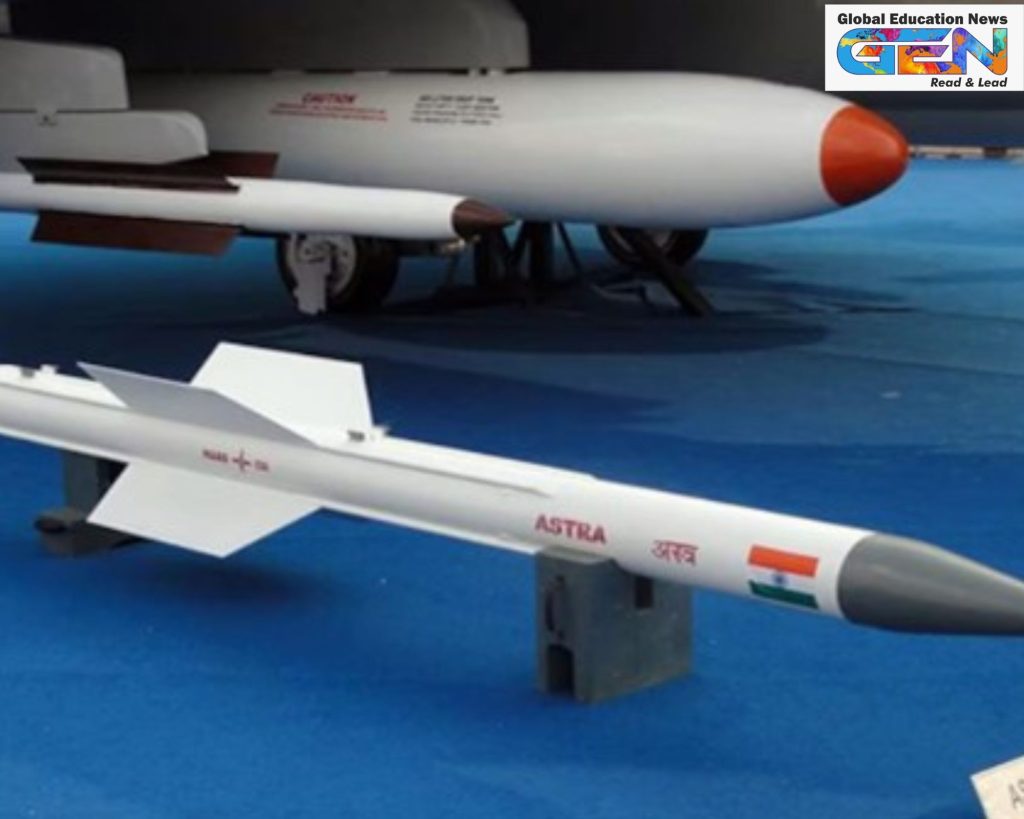
On July 11, 2025, India’s Astra Beyond Visual Range Air-to-Air Missile (BVRAAM) marked a historic leap in self-reliant defense technology. Launched from a Su-30 MKI fighter jet off the Odisha coast, the missile, equipped with a fully indigenous Radio Frequency (RF) seeker, obliterated high-speed unmanned aerial targets with pinpoint accuracy in twin tests. Conducted by the Defence Research and Development Organisation (DRDO) and the Indian Air Force (IAF), this success at the Integrated Test Range in Chandipur underscores India’s growing expertise in cutting-edge missile systems.
- Key Points:
- Twin tests on July 11, 2025, hit targets with flawless precision.
- Indigenous RF seeker designed by DRDO’s Research Centre Imarat.
- Validates India’s push for self-reliance in defense technology.
The Power of Astra: A Game-Changing Missile
The Astra Mk-1, a 3.8-meter, 154 kg missile, boasts a range exceeding 100 km, capable of striking targets at Mach 4.5 and altitudes up to 20 km. Its Ku-band active radar seeker, now fully indigenous, locks onto targets with a radar cross-section of 5 square meters from 15 km, even under enemy jamming attempts, thanks to advanced electronic counter-countermeasures (ECCM). With a 15 kg high-explosive warhead and smokeless solid-fuel motor, Astra is a force multiplier, integrated with the IAF’s Su-30 MKI and Tejas fleets, with plans for MiG-29 and Rafale integration.
- Key Points:
- Range over 100 km, speed of Mach 4.5, and 20 km altitude capability.
- Indigenous Ku-band seeker resists enemy electronic jamming.
- Integrated with Su-30 MKI and Tejas, with broader fleet plans.
A Collaborative Triumph for Aatmanirbhar Bharat
The Astra program, initiated in 2004 with a ₹995 crore budget, is a shining example of India’s Aatmanirbhar Bharat initiative. Over 50 public and private industries, including Hindustan Aeronautics Limited (HAL), contributed to its development. The indigenous RF seeker, replacing earlier Russian variants, was developed by DRDO’s Research Centre Imarat (RCI), ensuring technological sovereignty. Defence Minister Rajnath Singh hailed the tests as a “major milestone,” while DRDO Chairman Dr. Samir V. Kamat praised the collaborative effort, noting the missile’s flawless performance validated by Chandipur’s range tracking instruments.
- Key Points:
- Over 50 industries, including HAL, supported Astra’s development.
- Indigenous seeker marks a shift from Russian technology.
- Rajnath Singh and DRDO chief laud the milestone for self-reliance.
Strategic Edge in Modern Warfare
The Astra’s success comes amid regional tensions, with adversaries like China’s PL-15 (200-300 km range) and Pakistan’s PL-15E posing challenges along the Line of Actual Control (LAC). The Astra Mk-1’s 100+ km range and 30g maneuverability make it a formidable counter, while the upcoming Astra Mk-2 (160 km) and Astra Mk-3 (340 km), with advanced dual-pulse rocket motors and AESA seekers, promise to outmatch global competitors like the AIM-120D AMRAAM. The missile’s ability to engage high-value targets like AWACS and refuelers enhances the IAF’s combat edge.
- Key Points:
- Counters regional threats like China’s PL-15 and Pakistan’s PL-15E.
- Astra Mk-2 and Mk-3 to extend ranges to 160 km and 340 km.
- Capable of targeting high-value assets like AWACS and refuelers.
A Legacy of Rigorous Testing
The Astra’s journey began with ground tests from 2003 to 2012, followed by carriage trials on Su-30 MKI in 2009 and 2013. Its first air launch in 2014 and a 30g maneuver test in 2015 proved its lethality. The 2017–2018 trials validated the indigenous seeker, with seven successful tests against pilotless targets. The July 2025 tests, conducted under varied combat conditions, reaffirmed Astra’s reliability, paving the way for its integration with the Tejas Mk-1A by August 2025 and full production by Bharat Dynamics Limited (BDL).
- Key Points:
- Extensive testing since 2003, with key milestones in 2014 and 2017.
- Seven successful trials in 2017 validated the indigenous seeker.
- Set for Tejas Mk-1A integration and full production in 2025.
Why Astra’s Success Resonates
The Astra missile’s triumph is more than a technological feat—it’s a symbol of India’s growing defense autonomy. By replacing foreign seekers with indigenous technology, India reduces reliance on imports, ensuring supply chain security. Former Odisha CM Naveen Patnaik and social media posts on X celebrated the achievement, with users calling it a “proud moment for DRDO and IAF.” As India advances toward Astra Mk-2 and Mk-3, the missile family strengthens the IAF’s firepower, aligning with the Make in India vision and positioning India among elite missile-producing nations.
- Key Points:
- Reduces India’s dependence on foreign defense technology.
- Celebrated by leaders and X users as a national pride moment.
- Sets the stage for advanced Astra Mk-2 and Mk-3 variants.
A Call to Celebrate India’s Defense Leap
The successful test of the Astra missile with its indigenous RF seeker is a clarion call for Indians to take pride in their nation’s defense innovations. From the shores of Odisha to the skies of future battlefields, Astra embodies India’s resolve to secure its airspace with homegrown technology. Whether you’re a defense enthusiast or a proud citizen, this milestone invites you to celebrate India’s journey toward self-reliance and global defense leadership.
- Key Points:
- A symbol of India’s growing defense innovation and autonomy.
- Enhances IAF’s readiness for future aerial challenges.
- Invites all to celebrate India’s self-reliant defense milestone.