Published on October 11, 2025
Contents
Introduction to AI Integration in Indian SchoolsKey Announcements and ObjectivesCurriculum Structure and Age-Appropriate LearningImplementation Timeline and Rollout StrategyTeacher Training: Building the AI-Savvy Educator WorkforcePotential Challenges and Mitigation StrategiesFuture Impact: Shaping India’s AI Ecosystem
Delhi, India
Introduction to AI Integration in Indian Schools
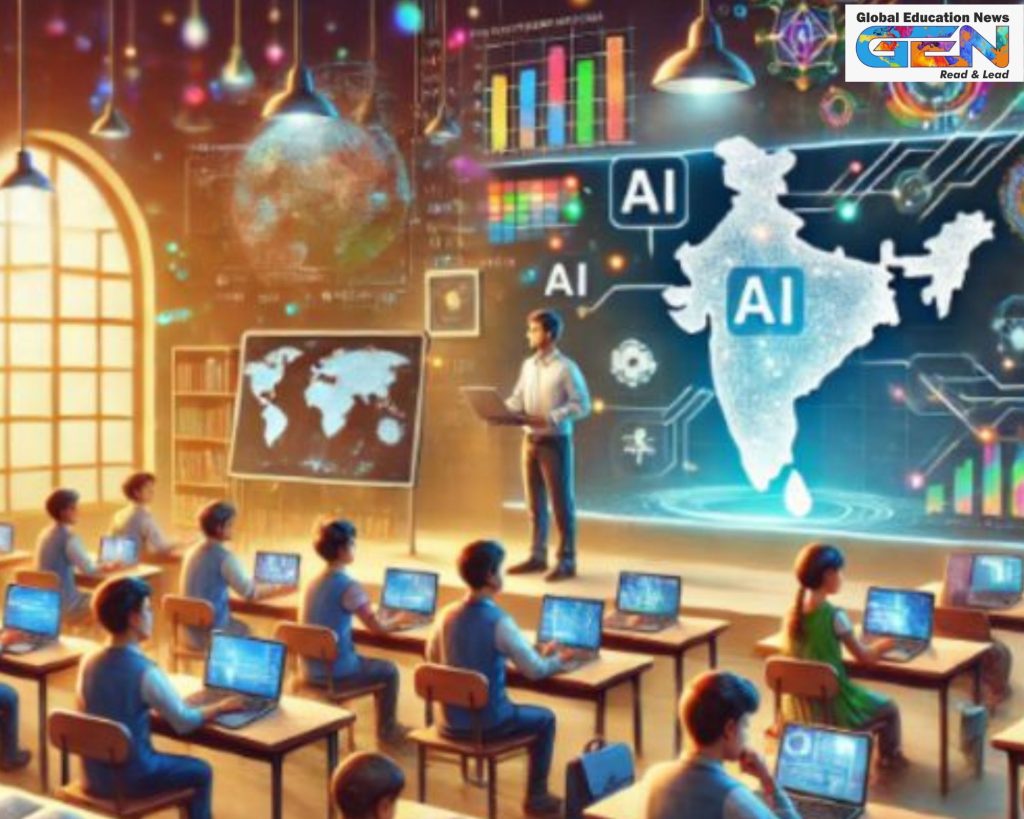
- The Ministry of Education (MoE) announces mandatory AI education for all students from Class 3, starting the 2026-27 academic year, aligning with the National Education Policy (NEP) 2020 to foster foundational AI literacy.
- This initiative aims to prepare over 250 million students for a digital economy, positioning India as a global AI leader by blending technology with core subjects like math and environmental studies.
- Current landscape: Over 18,000 CBSE-affiliated schools already offer AI as a 15-hour skill module from Class 6, with optional courses in Classes 9-12, seeing enrollment surge to nearly 800,000 students since 2019.
Key Announcements and Objectives
- School Education Secretary Sanjay Kumar revealed the plan during the launch of a NITI Aayog report on AI and jobs, emphasizing collaboration between the India AI Talent Mission and India AI Mission.
- Core goal: Equip learners and educators for AI-driven disruptions, with the report projecting 2 million traditional jobs displaced but 8-10 million new opportunities in IT and beyond by 2030.
- Quote from Sanjay Kumar: “Our objective is to prepare both the learner and the teacher for the digital economy.”
Curriculum Structure and Age-Appropriate Learning
- Early Years (Class 3-5): Introductory modules integrated into existing subjects, focusing on basics like pattern recognition, simple algorithms, and ethical AI discussions through games and real-world examples.
- Middle School (Class 6-8): 15-hour foundational module on AI fundamentals, including hands-on activities like building basic chatbots and data analysis.
- High School (Class 9-12): Optional advanced electives in machine learning, AI ethics, and project-based learning to encourage innovation and problem-solving.
- Framework development: CBSE is crafting a comprehensive, inclusive structure to ensure accessibility across urban and rural divides, with pilots already showing improved critical thinking skills.
Implementation Timeline and Rollout Strategy
- Launch: Academic session 2026-27, with rapid scaling over the next 2-3 years to align students and teachers with emerging tech.
- Pilot programs: Ongoing in select schools for curriculum testing; nationwide rollout to cover all boards beyond CBSE.
- Infrastructure push: Partnerships with industry for devices, software, and connectivity to bridge the digital gap, especially in underserved areas.
Teacher Training: Building the AI-Savvy Educator Workforce
- Scale: Training over 1 crore teachers nationwide, starting with a pilot using AI tools for lesson planning, quiz generation, and personalized content creation.
- Approach: Workshops, online modules, and collaborations with tech firms like Google and Microsoft to upskill on AI ethics, integration, and practical applications.
- Timeline: Intensive orientation within 2-3 years, with initial focus on CBSE educators to model success for other boards.
- Challenges addressed: Resource allocation and continuous professional development to ensure equitable training.
Potential Challenges and Mitigation Strategies
- Teacher Capacity: Reaching 1 crore educators poses logistical hurdles; solution includes phased regional programs and AI-assisted training platforms.
- Equity and Access: Rural-urban divide in tech infrastructure; countered by government subsidies for devices and inclusive content design for diverse learners, including girls and underprivileged groups.
- Job Market Shifts: AI’s dual impact (displacement vs. creation); mitigated through ecosystem building via academia-industry-government ties for skill-aligned job pathways.
- Ethical Concerns: Embedding bias detection and responsible AI in curriculum to promote fair tech use.
Future Impact: Shaping India’s AI Ecosystem
- Long-term vision: By 2035, AI proficiency as essential as literacy, driving innovation in sectors like healthcare, agriculture, and climate solutions.
- Global Context: Mirrors trends in Singapore and Europe with adaptive learning tools, but India’s scale could set a benchmark for emerging economies.
- Call to Action: Parents and educators urged to engage early through home AI activities, fostering a nationwide culture of curiosity and creation.