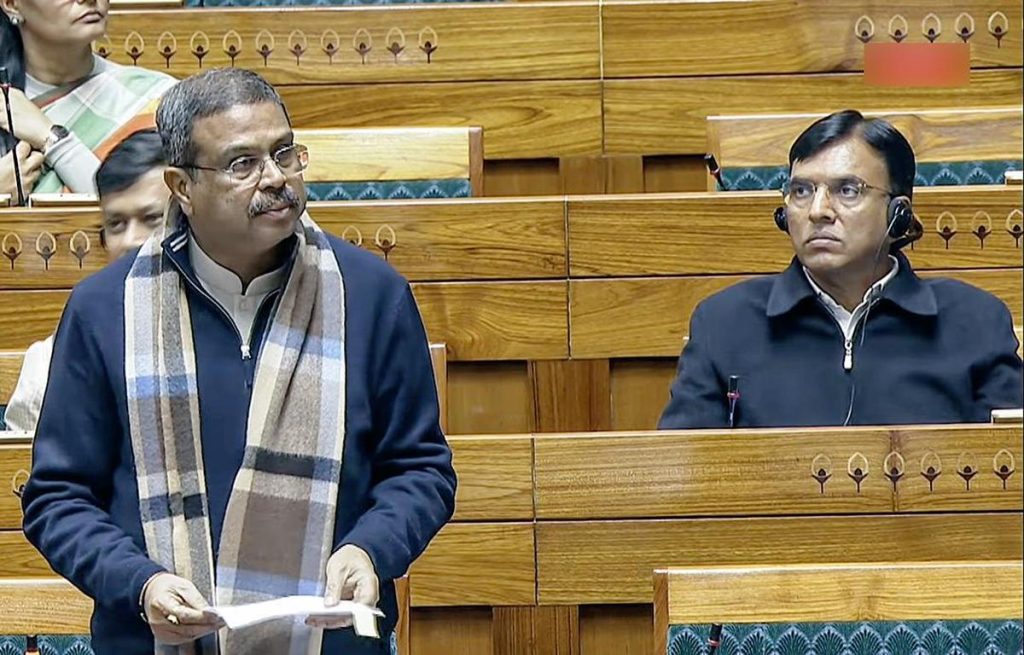
In a significant development for India’s higher education sector, the Parliament of India has constituted a Joint Parliamentary Committee (JPC) to review the Viksit Bharat Shiksha Adhishthan (VBSA) Bill, 2025. The panel will scrutinise the proposed legislation before making recommendations, marking a crucial step in the debate over restructuring the nation’s higher education regulatory framework.
1. What the JPC Decision Entails
A 31-member Joint Parliamentary Committee comprising representatives from both the Lok Sabha and the Rajya Sabha has been formed to examine the VBSA Bill. The panel is chaired by BJP MP Daggubati Purandeswari, reflecting cross-party involvement in reviewing the proposed reform.
The committee’s main responsibility is to scrutinise the provisions of the Bill in detail, solicit inputs from key stakeholders — including state governments, academic bodies, and experts — and submit a report with findings and recommendations to Parliament.
2. Overview of the Viksit Bharat Shiksha Adhishthan Bill
The VBSA Bill, 2025 represents one of the most comprehensive attempts to revamp higher education governance in India, aligning reforms with the National Education Policy (NEP) 2020.
Key Proposals Under the Bill
- Unified Higher Education Regulator: The Bill proposes replacing existing regulators such as the UGC (University Grants Commission), AICTE (All India Council for Technical Education), and NCTE (National Council for Teacher Education) with a single apex body supported by three independent councils responsible for standards, regulation, and accreditation.
- Clear Functional Separation: A core design feature is separating accreditation, funding, and standard-setting functions — a shift from the current overlapping regulatory model.
- Modern Governance Architecture: The Bill envisions a technology-enabled, transparent, and single-window regulatory ecosystem to reduce duplication and simplify compliance for institutions.
This overhaul aims to make regulation more efficient, aligned with global standards, and supportive of institutional autonomy and excellence. However, it has sparked debate nationwide over the extent of centralisation.
3. Why It’s Being Reviewed by a Parliamentary Panel
Though introduced during the Winter Session of Parliament, the VBSA Bill was referred to the JPC to ensure broader consultation and deliberation across political and academic stakeholders before being tabled for final legislative consideration.
Opposition parties had raised concerns about federalism and the autonomy of institutions, arguing the Bill could centralise control and interfere with state governance of education. The referral to a JPC aims to address these concerns and incorporate comprehensive feedback.
4. Key Issues Under Debate
a. Centralisation vs. Autonomy
Critics contend the Bill may concentrate too much power in the Centre’s hands by limiting independent academic representation and decision-making authority, potentially diminishing the autonomy of universities and colleges.
b. Simplification vs. Federal Balance
Proponents argue that a unified regulator will reduce overlapping mandates, improve quality assurance, and allow institutions to thrive with less bureaucratic red-tape. Opponents warn it could undercut state roles and impose uniform standards without accommodating regional diversity.
c. Transparency and Stakeholder Involvement
The JPC will invite inputs from states, institutional bodies, students, and experts — a process seen as crucial for balancing efficiency with democratic consultation and ensuring the reforms reflect the sector’s needs.