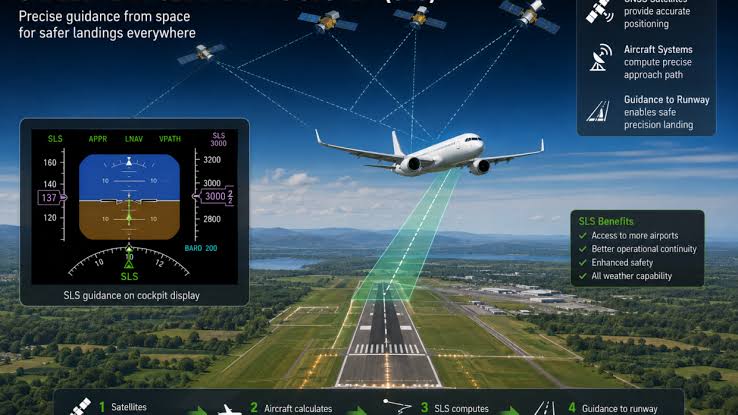
India has achieved a significant breakthrough in aviation by successfully conducting its first satellite-based landing of a commercial jet aircraft using the indigenous GAGAN navigation system. The milestone demonstrates the country’s growing technological capabilities in satellite-enabled air navigation and reinforces its commitment to modernising aviation infrastructure through indigenous innovation.
The historic operation was carried out under the supervision of the Directorate General of Civil Aviation (DGCA) at Udaipur Airport, where an IndiGo Airbus A320 successfully completed a Localiser Performance with Vertical Guidance (LPV) approach using GPS Aided GEO Augmented Navigation (GAGAN).
While GAGAN-enabled approaches have previously been used on ATR turboprop aircraft, this is the first successful implementation on a jet aircraft in India, opening a new chapter for satellite-based precision landings.
What is GAGAN?
GAGAN (GPS Aided GEO Augmented Navigation) is India’s satellite-based navigation augmentation system designed specifically for civil aviation. It enhances the accuracy, integrity, continuity, and availability of standard Global Navigation Satellite System (GNSS) signals.
Developed jointly by the Indian Space Research Organisation (ISRO) and the Airports Authority of India (AAI), GAGAN uses geostationary satellites and a nationwide network of ground reference stations to broadcast correction signals to aircraft.
These corrections allow aircraft to determine their exact position with significantly greater precision than conventional GPS alone.
Understanding the LPV Approach
The successful landing used an LPV (Localiser Performance with Vertical Guidance) approach.
Unlike conventional GPS approaches, LPV provides:
Horizontal Guidance
Keeps the aircraft precisely aligned with the runway centreline.
Vertical Guidance
Provides a stable descent path similar to high-end Instrument Landing Systems.
Improved Precision
Enables safer approaches during poor weather or reduced visibility.
This makes LPV particularly valuable for airports where installing expensive ground-based landing infrastructure is not economically viable.
Why This Achievement is Significant
India’s aviation sector is among the fastest-growing in the world, with increasing passenger traffic and expanding regional connectivity.
As more airports become operational under regional development programmes, advanced navigation systems are becoming essential.
The successful jet aircraft landing demonstrates that satellite-based navigation can now support commercial jet operations with high precision.
The milestone delivers multiple advantages:
- Safer landings during challenging weather.
- Reduced dependence on costly ground navigation equipment.
- Lower infrastructure costs for airports.
- Greater operational flexibility for airlines.
- Improved fuel efficiency through optimized flight paths.
- Enhanced passenger safety and flight reliability.
How GAGAN Differs from Traditional Landing Systems
Conventional aircraft landings often depend on the Instrument Landing System (ILS) installed at airports.
Although highly accurate, ILS infrastructure is expensive to install and maintain, making it unavailable at many smaller airports.
GAGAN changes this model by providing navigation corrections directly through satellites.
| Instrument Landing System (ILS) | GAGAN Satellite Navigation |
|---|---|
| Ground-based infrastructure | Satellite-based system |
| High installation cost | Lower infrastructure cost |
| Airport-specific coverage | Wider regional coverage |
| Requires runway equipment | Minimal ground infrastructure |
| Limited deployment | Scalable across more airports |
Years of Development Reach Commercial Success
India’s journey with GAGAN has been gradual and carefully validated.
The technology was initially tested on smaller ATR aircraft before aviation authorities expanded trials to commercial jet aircraft.
In 2022, IndiGo became the first Indian airline to operate GAGAN-enabled landings using ATR aircraft. The latest successful Airbus A320 demonstration confirms that the technology is now mature enough for wider deployment across India’s commercial aviation fleet.
This progression reflects years of technical development, regulatory certification, pilot training, and operational testing.
Supporting India’s Vision of Technological Self-Reliance
The successful demonstration aligns closely with India’s broader vision of strengthening indigenous technology across strategic sectors.
Instead of relying entirely on imported aviation navigation systems, India now possesses one of the world’s few operational indigenous Satellite-Based Augmentation Systems.
Only a limited number of countries operate their own SBAS platforms, placing India among an exclusive group with advanced aviation navigation capabilities.
Beyond aviation safety, GAGAN also strengthens India’s position in aerospace technology and satellite applications.
Benefits for Regional Airports
Many regional airports lack sophisticated precision landing systems due to high installation and maintenance costs.
GAGAN offers a practical solution by enabling precision approaches without requiring expensive ground-based equipment.
This could benefit airports located in:
- Remote regions
- Mountainous terrain
- Smaller cities
- Newly developed aviation hubs
As India continues expanding regional air connectivity, satellite-guided navigation can significantly improve accessibility while reducing operational costs.
Challenges Before Nationwide Adoption
Although the milestone is historic, nationwide implementation will require:
- Certification of additional airports for LPV approaches.
- Upgrading aircraft avionics where necessary.
- Pilot training on satellite-based precision procedures.
- Development of additional satellite-enabled flight procedures.
- Coordination among airlines, regulators, and airport operators.
These steps are expected to be implemented progressively as India’s aviation ecosystem embraces next-generation navigation technologies.
The Road Ahead
The successful jet aircraft landing using GAGAN is more than a technological demonstration—it marks the beginning of a new phase in India’s civil aviation evolution.
As satellite-based navigation becomes increasingly integrated into commercial operations, India is poised to make air travel safer, more efficient, and more accessible across its expanding airport network.
With indigenous innovation driving the future of aviation, GAGAN stands as a powerful example of how space technology can directly enhance everyday transportation while strengthening India’s position as a global leader in aerospace innovation.