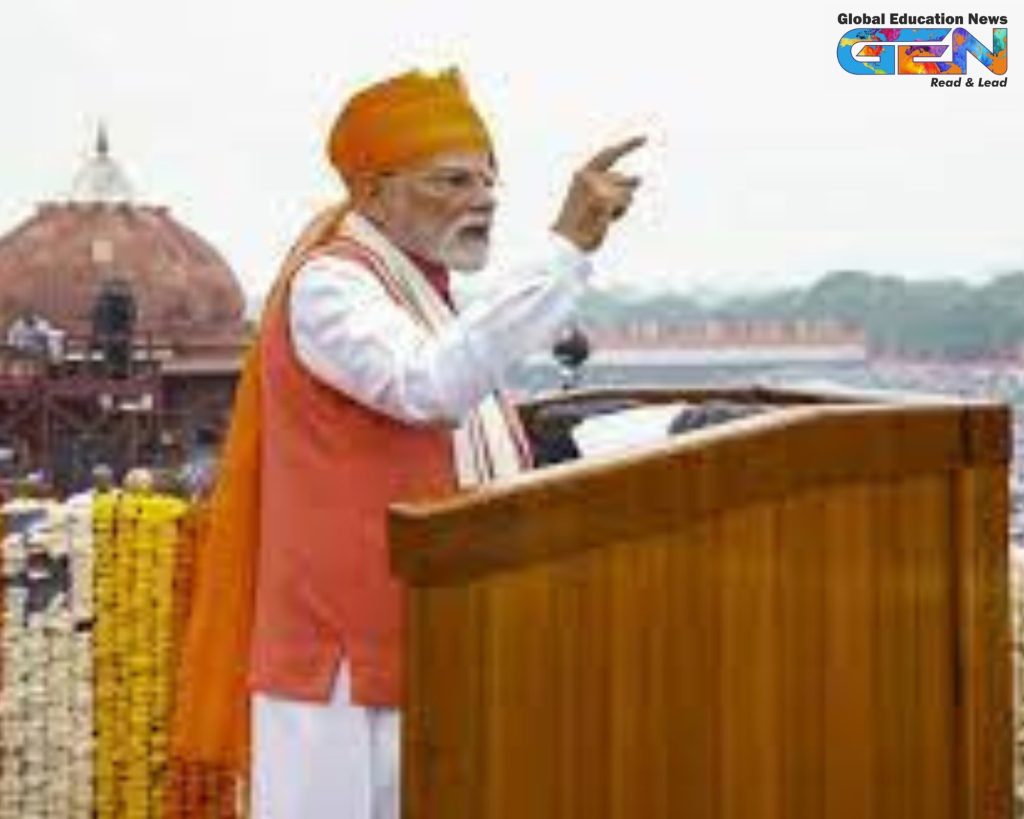
On August 15, 2025, Prime Minister Narendra Modi delivered a record-breaking 103-minute speech from the Red Fort, marking his 12th consecutive Independence Day address and surpassing Indira Gandhi’s record. Celebrating India’s 79th Independence Day, Modi outlined a bold roadmap for Viksit Bharat (Developed India) by 2047, blending economic reforms, technological advancements, and a strong stance on national security. The speech introduced transformative initiatives, including the Pradhan Mantri Viksit Bharat Rozgar Yojana, aimed at empowering youth and driving economic growth. Prime Minister Narendra Modi delivered a record-breaking 103-minute speech on India’s 79th Independence Day, marking the longest ever from the Red Fort.
Here are the key highlights and the new programs launched during this historic speech.
1. Pradhan Mantri Viksit Bharat Rozgar Yojana: Empowering Youth with Jobs
The centerpiece of Modi’s speech was the launch of the Pradhan Mantri Viksit Bharat Rozgar Yojana, a Rs 99,446 crore scheme to create 3.5 crore jobs by July 31, 2027, including 1.92 crore for first-time job seekers. This initiative supports young Indians entering the private sector and incentivizes employers to boost hiring, particularly in manufacturing.
Key Points:
- Employee Benefits: First-time private sector employees (earning up to Rs 1 lakh/month) registered with EPFO will receive Rs 15,000 in two instalments via Direct Benefit Transfer (DBT).
- First instalment: After 6 months of service.
- Second instalment: After 12 months and completing a financial literacy program.
- Employer Incentives: Up to Rs 3,000/month per new hire for two years, with extended benefits for manufacturing firms.
- Eligibility: Jobs created between August 1, 2025, and July 31, 2027; employers must hire at least 2–5 extra staff based on company size.
- Impact: Expected to benefit 3.5 crore youth, bridging Swatantra Bharat to Samriddha Bharat.
How to Apply:
- Employees: Register with EPFO via the UMANG app using Aadhaar-based authentication.
- Employers: Use the Shram Suvidha Portal to register and file monthly returns for incentives.
2. GST Reforms: A Diwali Gift for Citizens
Modi announced next-generation GST reforms to be rolled out by Diwali 2025, aimed at reducing taxes on essential goods and supporting MSMEs, local vendors, and consumers. A Reform Task Force will streamline regulations to prepare India for a USD 10 trillion economy by 2047.
Key Points:
- Tax Relief: Lower rates on daily-use items to ease household budgets.
- MSME Support: Simplified compliance to boost small businesses.
- Economic Growth: Aims to cut red-tapism and modernize governance.
- Timeline: Reforms to be implemented by October 2025, offering a “Diwali bonanza” for citizens.
3. Mission Sudarshan Chakra: Strengthening National Security
Drawing inspiration from Lord Krishna’s Sudarshan Chakra, Modi launched Mission Sudarshan Chakra, a decade-long defense initiative to protect strategic, civilian, and religious sites by 2035 using indigenous technology.
Key Points:
- Develops an Iron Dome-like defense system to counter terrorist attacks.
- Focus on Made in India weapons to neutralize and strike back at threats.
- Integrates AI and advanced tech for a nationwide security shield.
- Complements the success of Operation Sindoor, a cross-border anti-terror strike.
4. Made-in-India Semiconductors: A Tech Leap Forward
Modi announced that Made-in-India semiconductor chips will hit the market by the end of 2025, marking a milestone in India’s self-reliance journey. This follows decades of stalled efforts, with six semiconductor units now operational and four more approved.
Key Points:
- Launch Timeline: First chips by December 2025.
- Impact: Reduces reliance on imports, boosts electronics manufacturing.
- Youth Appeal: Modi urged young innovators to drive tech advancements.
- Global Edge: Positions India as a leader in the tech-driven 21st century.
5. Nuclear Energy Expansion: A Tenfold Increase by 2047
To achieve energy self-reliance, Modi revealed plans to build 10 new nuclear reactors, aiming for a tenfold increase in nuclear energy capacity by 2047. This aligns with India’s early achievement of 50% non-fossil fuel electricity ahead of the 2030 target.
Key Points:
- New Reactors: 10 under construction to reduce dependence on imported fuels.
- Clean Energy: Expands solar, hydrogen, hydro, and nuclear initiatives.
- Economic Benefit: Cuts India’s massive petroleum import bill.
- Private Sector: Opens nuclear energy to private companies for innovation.
6. Indus Water Treaty Suspension: Prioritizing Indian Farmers
Modi took a firm stand on the Indus Water Treaty, suspending it to prioritize Indian farmers’ water needs. He criticized the treaty for favoring “hostile neighbors” while leaving Indian fields thirsty.
Key Points:
- Suspension: India will not tolerate the “unjust” treaty.
- Farmer Focus: Ensures water from Indian rivers benefits local agriculture.
- Security Stance: Rejects Pakistan’s nuclear blackmail and terror support.
- Global Message: Signals India’s resolve to protect national interests.
7. High-Powered Demography Mission: Addressing Migration
Modi launched a High-Powered Demography Mission to tackle demographic imbalances caused by illegal migration in border areas, linking it to national security and citizens’ rights.
Key Points:
- Addresses infiltration impacting unity and resource allocation.
- Ensures fair policies to safeguard India’s cultural and demographic integrity.
- Strengthens border security with a focus on long-term stability.
8. Other Key Initiatives: Space, Jet Engines, and More
Modi highlighted India’s strides in technology and innovation, urging youth to lead the charge:
Key Points:
- Space Sector: Congratulated Group Captain Shubhanshu Shukla for his ISS mission; India aims for its own space station and Gaganyaan launch.
- Jet Engines: Called for indigenous jet engine development for fighter aircraft.
- Samudra Manthan: Launched a National Deepwater Exploration Mission to harness ocean resources.
- Women Empowerment: Over 80% of MUDRA loans to women; 5,000 new Women Empowerment Clusters by 2030.
Why This Speech Matters
Modi’s 103-minute address was a policy-heavy blueprint for Viksit Bharat 2047, blending economic reforms, technological leaps, and a zero-tolerance stance on security threats. The Pradhan Mantri Viksit Bharat Rozgar Yojana stands out as a transformative program, offering Rs 15,000 to first-time job seekers and incentivizing employers to create millions of jobs. With GST reforms, semiconductor production, and nuclear energy expansion, Modi positioned India as a self-reliant, tech-driven global power.
Key Points:
- Historic Milestone: Longest Independence Day speech at 103 minutes, surpassing Modi’s 2024 record of 98 minutes.
- Youth Focus: Empowers young Indians through jobs, tech, and innovation.
- Global Stance: Signals India’s resolve against terrorism and unfair trade policies.
- Cultural Pride: Celebrates India’s diversity and freedom fighters’ legacy.
How to Engage with These Initiatives
- For Job Seekers: Register with EPFO via the UMANG app to claim Rs 15,000 under PM-VBRY. Check sarkariyojana.com for updates.
- For Innovators: Explore opportunities in semiconductors, AI, and space via government portals like startupindia.gov.in.
- For Citizens: Stay informed about GST reforms and other schemes on mygov.in or trusted platforms like sarkariresult.com.
A Roadmap for Viksit Bharat
PM Modi’s 79th Independence Day speech was a clarion call for a self-reliant, prosperous India. From launching the Pradhan Mantri Viksit Bharat Rozgar Yojana to unveiling Mission Sudarshan Chakra and pushing for Made-in-India semiconductors, the address set a bold agenda for 2047. As India celebrates its freedom, these initiatives promise to transform the nation into a global powerhouse.