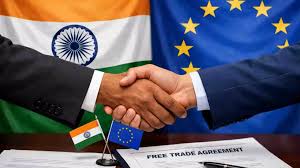
The recently concluded India-European Union Free Trade Agreement (India-EU FTA) — often dubbed the “mother of all deals” — is not just about tariff elimination and market access. It also integrates education, skills, mobility and research cooperation as an essential part of a future-oriented strategic partnership between India and the EU. Unlike traditional FTAs focused narrowly on goods and services, both sides recognised that human capital mobility, academic exchange and skills alignment are crucial for long-term economic growth.
1. Education as a Strategic Lever in the FTA
While the FTA primarily covers goods, services, and trade liberalisation, education and people-to-people links are highlighted as key enablers of deeper cooperation. Leaders from India and the European Union explicitly acknowledged that education plays a central role in unlocking the full potential of bilateral relations.
Why Education Matters in the Deal
- Positioning education and mobility as strategic partnership enablers, not just ancillary issues.
- Recognition that knowledge flows and skills exchange fuel innovation, talent development and competitiveness in both regions.
This reflects an evolved trade agenda where human capital and institutional cooperation complement commercial interests.
2. Student Mobility and Academic Exchanges
One of the most visible education components in the India-EU FTA framework is student mobility and exchange facilitation:
✔ Expanded mobility pathways for Indian students — enabling smoother access to European higher education.
✔ Initiatives aiming to regularise post-study work options, reducing uncertainty for graduates looking to gain experience in EU countries.
✔ Agreements building on existing programs like Erasmus+ and SPARC, boosting academic and research exchanges.
These provisions aim to create structured routes for learning abroad, research collaboration and longer-term career opportunities for Indian students.
3. Education & Skills Dialogue
To make cooperation more substantive, India and the EU agreed to launch a formal Education and Skills Dialogue.
Goals of the Dialogue:
- Stakeholder engagement across policymakers, quality assurance bodies, universities, vocational trainers, and employers.
- Promotion of recognition frameworks for qualifications and learning outcomes across borders.
- Development of joint programs, dual degrees and satellite campuses, including vocational excellence linkages.
This initiative aims to reduce technical barriers to student and workforce mobility and enhance education system compatibility between India and EU member states.
4. Qualifications Recognition & Institutional Links
A major challenge for international education cooperation historically has been the mutual recognition of degrees and learning outcomes. The India-EU framework addresses this by:
🔹 Enabling recognition of qualifications and learning periods abroad, which supports smoother academic transfers.
🔹 Encouraging Indian institutions to join Erasmus+ Centres of Vocational Excellence as partners.
🔹 Creating important legal and structural pathways to connect Indian and European education standards.
Together, these measures reduce friction for students, researchers, and professionals navigating cross-continental academic and career paths.
5. Research, Innovation & Knowledge Exchange
Education cooperation under the India-EU FTA extends to research and innovation ecosystems:
- Joint collaboration through Horizon Europe and similar research programs.
- Expanded access for Indian participation in EU-led research initiatives.
- Innovation hubs aimed at connecting universities, startups and industry for knowledge exchange.
This integration reflects a shift toward knowledge economies where collaborative research and innovation capacity are key drivers of competitiveness.
6. Skills, Jobs and the Future Workforce
Education provisions are linked with broader mobility and employment frameworks:
📍 Structured migration pathways cover students, researchers, and skilled professionals.
📍 Facilitation of temporary work and skill recognition across sectors including ICT and professional services.
📍 Aligning education to market demands in both regions, enhancing employability and bilateral talent flows.
This holistic approach promotes stronger linkages between education, skill development, and jobs on both sides.