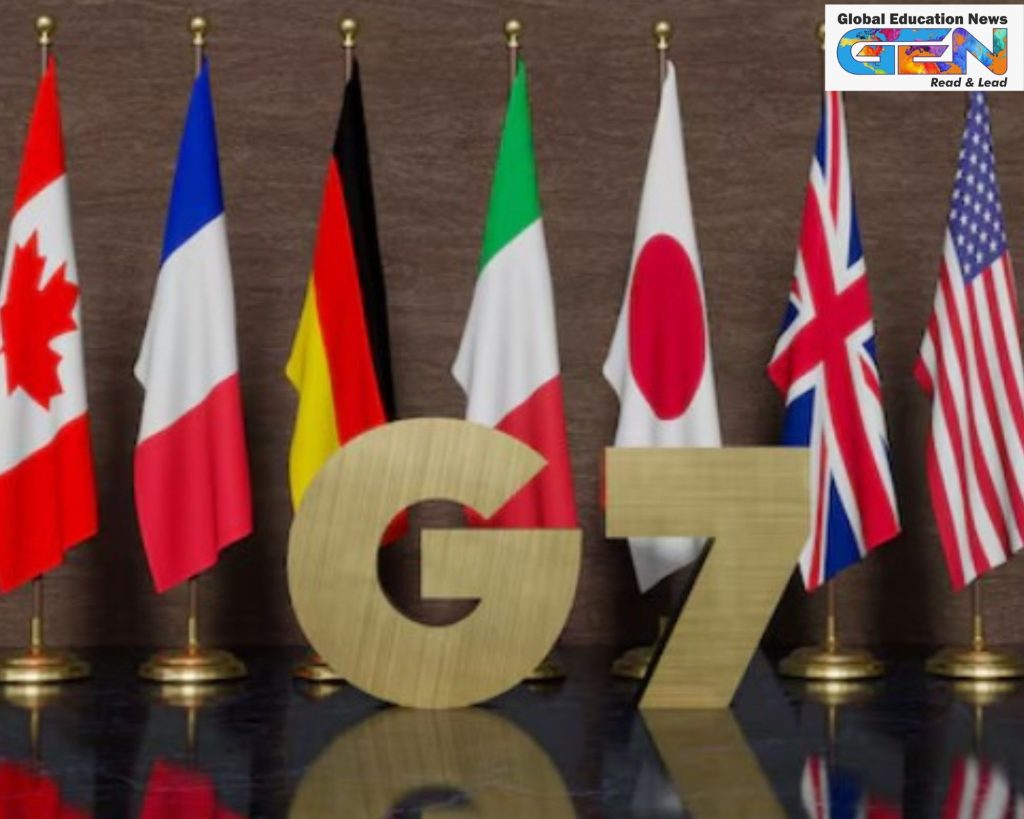
The 50th anniversary of the Group of 7 (G7) will be celebrated at the G7 Leaders’ Summit 2025, hosted by Canada from June 15 to 17 in the scenic Kananaskis, Alberta. As Canada’s seventh time hosting, this summit brings together leaders from the United States, Canada, France, Germany, Italy, Japan, and the United Kingdom to address pressing global challenges. Representing 40% of global GDP and 10% of the world’s population, the G7’s decisions shape international policy. Notably, India, a regular guest since 2019, has not yet received an invitation, potentially marking its first absence in years. With Ukraine and Australia confirmed as guests, the summit promises high-stakes discussions on economy, security, and governance.
Key Points:
- Hosted by Canada in Kananaskis, Alberta, June 15-17, 2025.
- Marks the 50th anniversary of the G7, founded in 1975.
- India’s participation uncertain; Ukraine and Australia invited as guests.
What is the G7?
The G7 is an informal intergovernmental group of seven major economies with no legal status or permanent secretariat. Decisions require independent ratification by member states, making it a platform for dialogue rather than binding agreements. The group focuses on shared democratic values and collective action on global issues.
Key Points:
- Members: USA, Canada, France, Germany, Italy, Japan, UK.
- Represents 40% of global GDP, 10% of world population.
- Operates through annual summits and ministerial meetings.
Historical Roots of the G7
The G7 traces its origins to a 1973 Paris meeting of finance ministers and central bank governors from six nations, convened to tackle the 1973 oil crisis and global inflation. The first official summit occurred in Rambouillet, France, in 1975, with Canada joining in 1976 to form the G7. The European Economic Community (now EU) began participating in 1977, and Russia joined in 1998, creating the G8. Russia’s expulsion in 2014 after the Crimea annexation reverted the group to the G7.
Key Points:
- Founded in 1975; Canada joined in 1976.
- Evolved from G6 to G8 (1998-2014), then back to G7.
- Initially focused on economic crises like the oil shock.
Canada’s Role and Summit Agenda
As the 2025 G7 presidency, Canada sets the summit’s agenda, focusing on economic resilience, climate change, global security, and democratic values. Held in Kananaskis, a venue known for hosting the 2002 G7 Summit, the event will leverage Alberta’s natural beauty to foster candid discussions. Canada’s leadership comes at a critical time, with global tensions, including the Russia-Ukraine conflict and economic recovery post-COVID, dominating talks. Posts on X, like those from @CBCNews, highlight Canada’s push for inclusivity by inviting non-members like Ukraine.
Key Points:
- Canada’s seventh time hosting, with Kananaskis as the venue.
- Agenda includes economy, climate, security, and democracy.
- Emphasis on collaborative solutions to global crises.
Guest Countries: Ukraine, Australia, and India’s Uncertainty
Canada has invited Ukraine and Australia as guest countries, reflecting strategic priorities. Ukraine’s inclusion underscores G7 support amid its conflict with Russia, while Australia strengthens Indo-Pacific ties. India, a consistent guest since 2019 under Prime Minister Narendra Modi, has attended every summit except the canceled 2020 meeting. Its potential absence in 2025, as noted by sources like The Hindu and Reuters, could signal shifting G7 dynamics or logistical constraints, though Canada has not ruled out a late invite.
Key Points:
- Ukraine and Australia confirmed as guest nations.
- India awaits invitation, risking first absence since 2019.
- Guest list still evolving, per Canadian government statements.
Focus Areas and Global Influence
Originally centered on international economic policy, the G7 now addresses foreign policy, security, climate change, and global health. The 2025 summit is expected to tackle:
- Economic Stability: Addressing inflation and trade disruptions.
- Ukraine Support: Coordinating aid and sanctions against Russia.
- Climate Action: Advancing renewable energy and net-zero goals.
- Indo-Pacific Strategy: Countering China’s influence, with Australia’s presence.
The G7’s outcomes, though non-binding, influence global governance, as seen in past commitments like the Paris Climate Accord and COVID-19 vaccine distribution.
Key Points:
- Broadened scope from economy to security and climate.
- Influences global policies like climate agreements.
- 2025 focus: Ukraine, economic recovery, and Indo-Pacific.
How to Stay Updated
Follow the G7 Summit 2025 developments through official and reliable channels:
Key Points:
- Visit Canada’s official G7 website (to be launched at canada.ca) for summit details.
- Check g7.org for agendas and outcomes.
- Follow X accounts like @G7 and @CanadianPM for real-time updates.
- Monitor news outlets like Reuters and The Hindu for India’s invite status.
Tips for Stakeholders
For students, policymakers, and global observers:
Key Points:
- Track Guest Invites: India’s status could impact Indo-Pacific discussions.
- Study Past Summits: Understand G7’s influence using resources like EnviStats India 2025 for context on climate data.
- Engage on X: Join discussions via hashtags like #G72025 for insights.
- Prepare for Outcomes: Anticipate policy shifts in trade or climate post-summit.
A Defining Moment for Global Leadership
The G7 Summit 2025 in Kananaskis, Alberta, from June 15-17, marks a historic 50th anniversary for the group. As Canada hosts leaders from the world’s major economies, the absence of a confirmed invite for India raises questions about evolving G7 priorities. With Ukraine and Australia as guests and a focus on economic resilience, security, and climate, the summit is poised to shape global governance.