Published on October 17, 2025
Delhi, India
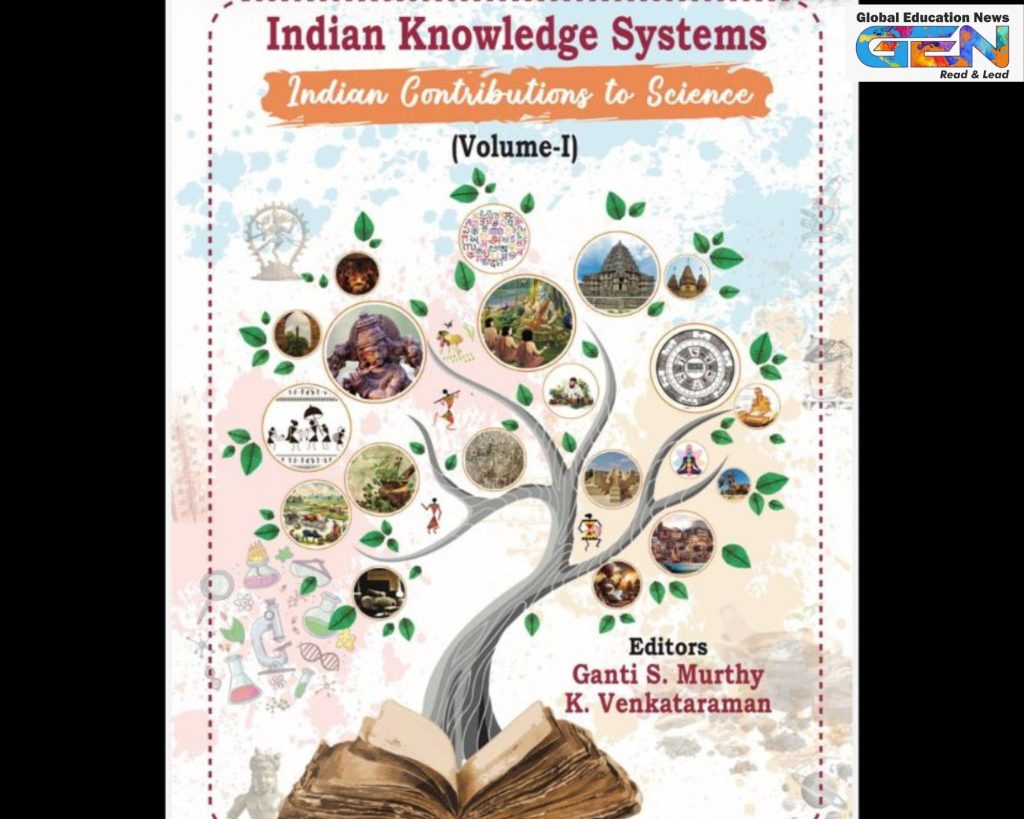
The Union Ministry of Education has unveiled ‘Indian Knowledge Systems: India’s Contribution to Science – Volume I’, a comprehensive 430-page tome that weaves together ancient ingenuity with contemporary relevance. Released under the Indian Knowledge Systems (IKS) division, this inaugural volume—authored by eight distinguished academicians and edited by GK Venkataraman (former curator, National Council of Science Museums) and Ganti S Murthy (IIT Indore professor)—spotlights groundbreaking contributions from Vedic sages to medieval Kerala mathematicians. With a foreword by Professor Anil D Sahasrabudhe (Chairman, National Educational Technology Forum), the book serves as a vital resource for school curricula, the Vidyarthi Vigyan Manthan talent exam, and higher education, aligning seamlessly with the National Education Policy (NEP) 2020’s mandate to integrate traditional knowledge into modern learning. As Union Education Minister Dharmendra Pradhan noted, it stands as a “reflection of India’s rich legacy of scientific enquiry and holistic wisdom,” designed to ignite curiosity and fortify cultural confidence among the youth, propelling the nation toward a developed India by 2047.
Background and Launch
The book’s genesis traces back to NEP 2020’s emphasis on decolonizing education by resurrecting indigenous systems suppressed during centuries of foreign rule. Launched amid a national push for STEM inclusivity, it draws from Vedic texts, medieval treatises, and archaeological evidence to dismantle colonial narratives of Indian “backwardness.” Editors Venkataraman and Murthy describe it as a “celebration of India’s creativity and wisdom,” structured around the ancient Anubandha-Chatustaya framework—outlining the learner (Adhikari), subject (Visaya), purpose (Prayojana), and relevance (Sambandha)—to make complex ideas accessible.
- Publication Context: First in a multi-volume series, it targets Classes 6-12 students, researchers, and enthusiasts, with illustrations like ancient equine eye surgeries to engage young minds.
- Collaborative Effort: Backed by Vijnana Bharati, NCERT, and the National Council of Science Museums, it supports initiatives like Vidyarthi Vigyan Manthan, fostering experiential science education.
- Broader Vision: Echoing Prime Minister Narendra Modi’s Atmanirbhar Bharat, the volume counters historical disruptions—from Arab invasions to British Macaulayism—by highlighting “decolonization and colonization proceeded simultaneously,” urging a revival of holistic, empirical traditions.
This isn’t mere historiography; it’s a blueprint for blending ancient insights with AI-driven innovation, positioning India as a global knowledge leader.
Key Highlights from the Book
Spanning astronomy, mathematics, chemistry, Ayurveda, botany, and sustainable agriculture, the book employs poetic Vedic rhetoric to demystify science, revealing how Indian scholars harmonized empirical rigor with spiritual inquiry—unlike Europe’s medieval science-religion clashes.
| Section | Core Themes | Notable Examples |
|---|---|---|
| Astronomy and Instruments | Empirical sky-mapping for calendars and agriculture | ‘Ghatika Yantra’ water clocks and ‘Samrat Yantra’ sundials for precise planetary tracking, predating European observatories. |
| Mathematics and Geometry | Foundational concepts in algebra, trigonometry, and infinity | Sulba Sutras’ geometric theorems for temple altars; zero’s invention enabling decimal systems, as per Vedic ganita (reckoning). |
| Chemistry and Sustainable Practices | Herbal extractions and eco-harmonious farming | Medicinal plant classifications influencing global pharmacology; zero-waste agricultural models from Rigveda. |
| Impact of Colonization | Intellectual subjugation phases | 19th-century English education policies erasing local STEM, yet resilient underground transmission via gurukuls. |
These vignettes underscore India’s role as a STEM cradle, where numbers preceded geometry, fostering algorithms centuries ahead.
India’s Ancient Contributions to Science
The volume meticulously documents how Indian polymaths pioneered fields long before Western attributions, fostering a narrative of continuous innovation.
- Mathematical Marvels: Vedic literature embedded zero, square roots, and cube roots, with Bhaskaracharya’s 12th-century Siddhanta Shiromani introducing Rolle’s theorem precursors and differential calculus basics. The Kerala School (14th-16th centuries), led by Madhava of Sangamagrama, developed infinite series for pi and trigonometric functions—germs of calculus 300 years before Newton-Leibniz. As the book notes, these weren’t isolated; Jyestadeva’s Yuktibhasa formalized them in Malayalam, bridging computation and philosophy.
- Astronomical Advancements: Aryabhata’s 5th-century Aryabhatiya defined sine functions and half-angle formulas, while Brahmagupta’s 7th-century work tackled planetary motion and gravity’s pull. Instruments like the Ujjain observatory’s eclipse predictors informed agriculture and navigation, with Surya Siddhanta calendars accurate to seconds.
- Medical and Botanical Breakthroughs: Ayurveda, predating Hippocrates by 4,000 years, emphasized yukti (human skill) over daiva (divine fate). The Charaka Samhita (1st century BCE) cataloged 600+ herbal drugs, metabolism, and immunity, while Sushruta’s compendium detailed 300 surgeries, including rhinoplasty and cataract ops on animals via Śālihotra Saṃhitā. Vagbhata’s 7th-century Ashtanga Hridayam integrated preventive care, influencing Islamic and European medicine through Persian translations.
- Holistic Integration: Unlike compartmentalized Western science, Indian traditions fused botany (1,500+ plant profiles) with ethics, as in Bharadvāja’s Vedic principles, promoting sustainable ecosystems and mental health.
These aren’t conjectures; they’re evidenced in palm-leaf manuscripts and UNESCO-recognized texts, challenging Eurocentric timelines.
The Ancient Ayurvedic Conference: A Milestone in Global Medicine
A standout narrative is the fabled Himalayan health summit, chronicled in the Charaka Samhita as a pan-Asian gathering of ācāryas. Vedic sage Bharadvāja unveiled Ayurveda’s triad—etiology (disease causes), symptomatology (symptom mapping), and therapeutics (holistic cures)—debated by luminaries like Atreya. Addressing human, animal, and plant ailments, it codified preventive ethics and herbal synergies, with proceedings surviving as one of the world’s earliest medical archives.
- Legacy Echoes: This “well-documented” event influenced Unani and Tibetan systems, underscoring Ayurveda’s “living relevance” today—e.g., in COVID-era immunity boosters.
- Veterinary Foresight: Illustrations depict horse surgeries, highlighting integrated One Health approaches millennia before WHO’s framework.
As Sahasrabudhe writes in the foreword, it’s “not merely a record of past achievements, but a bridge connecting timeless knowledge to modern scientific inquiry.”
Perspectives and Criticisms
While lauded for cultural revival, the book sparks debate. Critics like Abha Dev Habib (Associate Professor, Miranda House, Delhi University) label it “propagandist,” arguing it “lacks empirical grounding” and romanticizes a “selectively edited past” at quality education’s expense. She warns against “glorified conjecture” over rigorous history, stressing intellect over fabricated pride.
Proponents counter that it empowers marginalized narratives, with Pradhan emphasizing its role in motivating youth for Viksit Bharat. Balanced discourse, per NEP, invites scrutiny to refine future volumes.
Implications for Education and Future Volumes
This release catalyzes NEP’s IKS integration, embedding modules in CBSE/ICSE curricula and IIT research labs. For 26 crore schoolchildren, it promises 15-20% STEM engagement boosts via contests like Vidyarthi Vigyan Manthan. Higher ed sees Ayurveda labs and math simulations drawing global collaborators, targeting a ₹10 lakh crore knowledge economy by 2030.
- Youth Empowerment: Fosters “cultural confidence,” reducing dropout rates in rural STEM (down 10% post-NEP pilots).
- Global Resonance: Positions India in UNESCO dialogues, countering colonial legacies with evidence-based pride.
Upcoming volumes will delve into engineering and linguistics, ensuring a serialized revival.