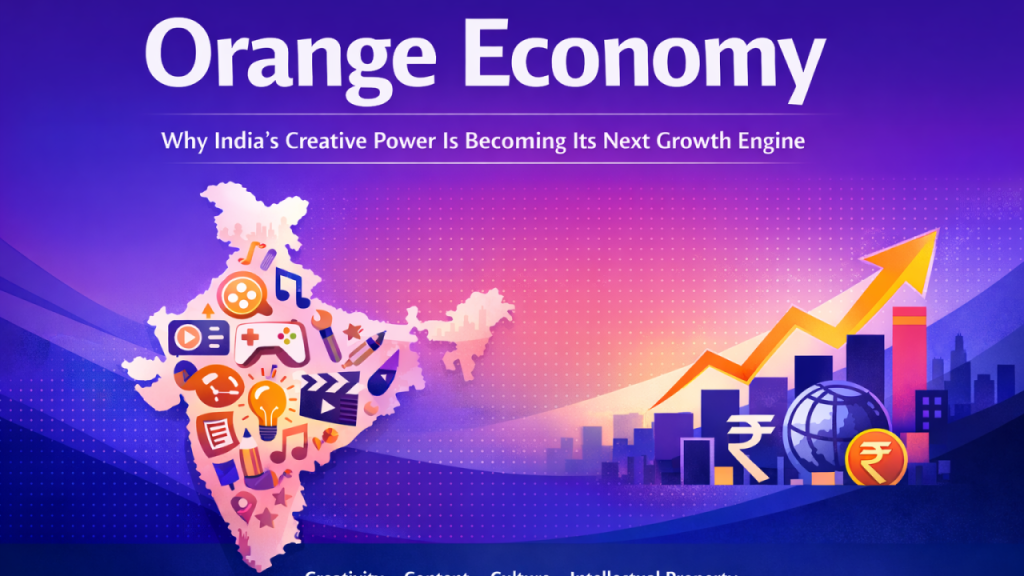
The Orange Economy, also known as the creative economy, refers to economic activities where ideas, creativity and culture are the primary sources of value, rather than physical goods. It includes sectors such as design, animation, gaming, visual effects, digital media, cultural content and fashion — where intellectual property, storytelling and artistic expression create both cultural and commercial impact.
This economy is rapidly gaining recognition as a major engine of job creation, economic growth, and global competitiveness — not just in India, but across innovative markets worldwide.
1. What Is the Orange Economy and Why It Matters for Design
At its core, the Orange Economy is where creativity meets economic value — generating wealth through cultural expression, technology-enabled media, artistic content and design services. Unlike traditional manufacturing sectors, its key asset is human ingenuity.
Design lies at the intersection of this creative ecosystem, serving as a catalyst for innovation, brand identity, storytelling and user experience across industries:
- Digital and brand design
- Product and industrial design
- User Experience (UX) and User Interface (UI) design
- Animation and motion graphics
- Game design and immersive experiences
- Fashion and lifestyle design
The creative economy leverages design not only to support storytelling, but also to boost exports, digital content, tourism and cultural representation — amplifying India’s soft power and global market presence.
2. Policy Boost: India’s Strategic Push for Creative Careers
Recent national policy developments have elevated the Orange Economy from niche to mainstream:
Policy Priorities
- Expansion of content creation infrastructure in education systems
- Proposed Animation, Visual Effects, Gaming & Comics (AVGC) labs in 15,000 secondary schools and 500 colleges, aimed at introducing creative skills early.
- Support for the Indian Institute of Creative Technologies (IICT) as a central training hub for creative careers.
- Plans to establish a new National Institute of Design (NID) to strengthen design education and regional access.
- Strong emphasis on producing future-readiness skills that align with global industry demand.
These moves signal institutionalising design and creative skills as significant career pathways, offering structure, credibility and access previously limited to informal or fragmented markets.
3. Key Career Opportunities in Design-Led Sectors
The Orange Economy opens diverse, future-ready career tracks for creative professionals. These are some of the most promising design-related roles:
A. Digital and Visual Design
- Graphic Designer & Visual Communicator — Crafting brand visuals, promotional graphics and digital artwork.
- Motion Graphics Animator — Designing animated sequences for videos, advertisements and interfaces.
- Brand Identity Designer — Building cohesive brand identity systems for companies and products.
B. Interaction & Experience Design
- UX / UI Designer — Creating intuitive digital experiences for apps, websites, and interactive platforms.
- Product Designer — Integrating aesthetic design with usability and business goals.
- Service Designer — Mapping customer journeys and optimizing holistic user experiences.
C. Creative Tech & Digital Storytelling
- Game Designer / 3D Artist — Developing concepts, levels, characters and user interaction for games and simulations.
- VFX & Animation Artist — Producing visual effects for films, media and digital platforms.
- Immersive Media Designer — Working with AR/VR, mixed reality and experiential content creation.
D. Cross-Disciplinary Design Paths
- Design Researcher — Studying user behaviour and cultural trends to inform design decisions.
- Packaging & Product Stylist — Blending functionality with aesthetic appeal in product design.
- Creative Entrepreneur — Building IP-led design startups or creative consultancies.
These roles reflect how design has expanded far beyond graphics into technology, entertainment, storytelling and innovation ecosystems — making it a core driver of the Orange Economy’s growth narrative.
4. Skills That Future Designers Need
To succeed in the Orange Economy, design professionals must blend artistic creativity with tech fluency and business acumen:
- Digital tools & software proficiency (Adobe Creative Suite, Figma, Blender, Unreal/Unity)
- Storytelling & visual communication skills
- Human-centred design thinking
- Portfolio and practical project experience
- Understanding of IP and creative entrepreneurship
These skills ensure designers not only create impactful work, but also translate creativity into jobs, enterprises and global opportunities.
5. Why The Orange Economy Is a Career Game-Changer
The creative economy’s rise is backed by new economic logic:
- Low barrier to entry but high value output, especially in digital platforms.
- Global demand for visual and digital content continues to grow.
- Design informs technology adoption, user engagement and cultural relevance.
- Creative careers now provide sustainable livelihoods with export potential.
From freelance designers and agency roles to studio leadership and startup founders, the Orange Economy offers career flexibility and scale unheard of in traditional sectors.