New Delhi — September 27, 2026
Delhi is rewriting the rules for Bed & Breakfast establishments, replacing an older legal framework with a proposed system that could allow eligible applications to receive deemed approval within seven working days. The move is part of a wider attempt to simplify registration and modernise the Capital’s homestay sector, but it comes against the backdrop of a deadly Malviya Nagar fire that exposed serious questions about compliance and enforcement.
The Delhi Assembly passed the Bill repealing the existing B&B law in August. The government has said a new Delhi Bed & Breakfast Policy, 2026 will replace it. The draft policy proposes online registration, self-certification and self-renewal, with approval deemed granted if the authorities do not respond within seven working days of a complete application and prescribed fee being submitted.
That is the headline reform.
The harder question is whether faster approvals can coexist with effective safety checks.
Delhi B&B policy: why the seven-day approval rule matters
Under the proposed system, the registration process would move away from a slower approval model toward a more time-bound digital framework.
The draft policy proposes deemed approval within seven working days, compared with the 30-day period under the previous 2007 framework. It also introduces self-certification and self-renewal mechanisms intended to reduce administrative delays.
For homeowners and small hospitality operators, that could significantly change the experience of entering the B&B sector.
Instead of waiting indefinitely for an administrative decision, applicants would have a defined timeline.
But “deemed approval” does not mean that every property would automatically be exempt from safety or legal requirements. The proposed framework still sets conditions for eligible properties, guest records, safety arrangements and other compliance requirements.
Why Delhi is replacing the old B&B law
The policy change comes after years of discussion about whether Delhi’s existing B&B framework was adequate for a changing hospitality market.
The government has described the earlier law as outdated and has been working on a replacement framework. The draft policy was placed in the public domain in May 2026 for feedback.
The proposed model aims to formalise smaller accommodation businesses operating from residential properties while giving visitors clearer standards.
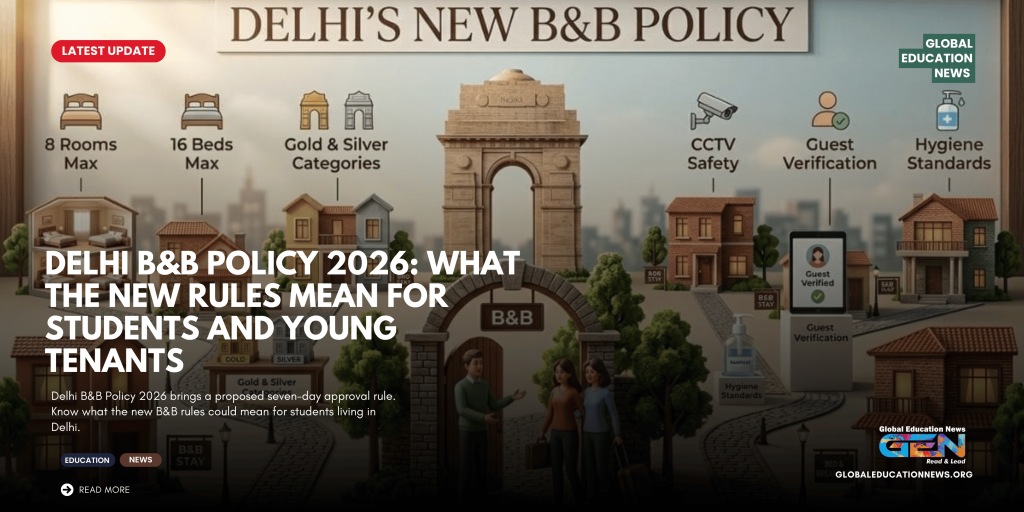
The draft limits eligible establishments to residential properties and proposes a maximum of eight rooms and 16 beds.
That distinction matters.
The proposed B&B model is designed around smaller residential accommodation — not conventional hotels, large guest houses or commercial hospitality complexes.
Gold and Silver: Delhi’s proposed two-tier B&B system
One of the most visible changes in the Delhi B&B Policy 2026 is the proposed classification of properties into Gold and Silver categories.
The categories would be determined by factors including room size, amenities, sanitation, safety arrangements and service standards.
Gold category
The draft proposes a minimum room size of 120 square feet for Gold properties, along with requirements covering furnishings, ventilation, cooling arrangements, drinking water and bathroom facilities.
Silver category
Silver properties would have a lower minimum room-size requirement of 100 square feet, while still meeting prescribed standards for cleanliness, drinking water, cooling and bathroom facilities.
The intention is to create a more recognisable quality framework for travellers rather than treating every B&B as identical.
What safety rules are being proposed?
The new policy is not simply about speeding up registrations.
The draft also proposes several safety and accountability measures. These include CCTV cameras at entrances and common areas, police verification, guest records, fire extinguishers, first-aid facilities and emergency contact information.
Properties would also have to meet specified construction, hygiene and operational requirements.
For foreign guests, establishments would need to maintain the required records and comply with Form C-related obligations.
The proposed framework therefore combines two competing objectives:
faster approvals on one side, stronger compliance requirements on the other.
Whether that balance works will depend heavily on implementation and inspection.
The Malviya Nagar fire changed the context
The policy debate cannot be separated from the Malviya Nagar B&B fire of June 2026.
The blaze at Flourish Stay in the Hauz Rani area killed 23 people, according to later reporting, and triggered scrutiny of the property’s licensing, capacity and fire-safety compliance. The Indian Express reported that the establishment had originally been licensed as a six-room B&B but was allegedly operating on a much larger scale before the fire.
The tragedy also prompted a wider inspection drive.
The Indian Express reported in June that 450 commercial buildings in Delhi had been red-flagged for fire-safety failures or violations of building by-laws.
That backdrop gives the seven-day approval proposal a sharper significance.
The question is no longer simply how quickly a B&B can be registered. It is whether a faster administrative process can be backed by reliable verification and enforcement.
Faster registration does not remove the need for inspections
A central feature of the proposed policy is that the government would retain regulatory powers even within a self-certification system.
Hindustan Times reported that the draft framework would allow the government to inspect establishments whenever required.
That distinction is crucial.
Self-certification shifts some responsibility to the applicant. It does not eliminate the applicant’s obligation to comply with the rules.
Similarly, deemed approval is an administrative mechanism for avoiding prolonged delays. It should not be read as a blanket permission to operate outside fire, construction, municipal or tourism requirements.
Delhi’s existing building-approval system already operates within a broader regulatory structure. The DDA says the Unified Building Bye-Laws for Delhi, 2016 apply across the relevant jurisdiction and were introduced after the earlier 1983 bye-laws.
What happens between the old law and the new policy?
The transition period is another important part of the story.
The Assembly’s repeal of the old B&B law and the creation of a replacement policy are not the same legal event. Reporting on the Assembly proceedings said the government intended to bring the new framework after repealing the 2007 legislation, with the Centre’s rules applying during the interim period.
The practical impact therefore depends on when the replacement framework becomes operational and what final provisions it contains.
The May draft should not automatically be treated as the final policy.
That is particularly relevant for operators planning investments around the proposed seven-day approval system.
What the new Delhi B&B rules could mean for homeowners
If implemented broadly in the proposed form, the policy could make it easier for eligible homeowners to enter the regulated accommodation market.
The government has framed B&Bs as a way to supplement Delhi’s hotel infrastructure, create additional household income and provide visitors with smaller, neighbourhood-based accommodation options.
For travellers, the Gold-Silver classification could also provide a clearer indication of the facilities and standards attached to a registered property.
But the benefits depend on one thing: enforcement.
A digital application can be processed in seven days. Fire-safety compliance cannot be reduced to a checkbox.
How Could the New B&B Policy Affect Students?
For students who live in registered Bed & Breakfast properties while attending colleges, universities or coaching centres in Delhi, changes to the B&B framework could have practical consequences. A clearer online registration system and faster approval process could make it easier for property owners to enter or remain within the regulated B&B system, potentially giving students more formally registered accommodation options.
At the same time, the proposed policy places emphasis on safety requirements, including police verification, guest records, CCTV coverage in specified areas and fire-safety measures. For students, these provisions matter because a B&B is not simply a short-stay accommodation option; for some young people studying away from home, it can effectively become their primary place of residence during the academic year.
The proposed seven-working-day deemed-approval mechanism is primarily an administrative provision for B&B registration rather than a rule giving students a new right to accommodation. Students should therefore distinguish between faster approval for eligible B&B operators and protections or rights available to people staying in those properties. The final policy will determine how these requirements operate in practice.
The policy could also influence accommodation availability and operating costs, depending on how property owners respond to registration, safety and compliance requirements. However, those effects cannot be established until the final framework is notified and implemented.
Key point for students: the seven-day approval proposal does not by itself change a student’s tenancy or guarantee accommodation. Its significance for students will depend on how the final B&B policy regulates registered properties, safety standards and the relationship between operators and occupants.