Mountain View, California — September 27, 2026
Google is 28 years old today. Yet some of the company’s oldest promises were written when Google was still a young search startup, long before Gmail, Android, Google Maps, YouTube and today’s artificial-intelligence race transformed its ambitions.
For Google’s 28th birthday, the company’s early philosophy is back in focus: a list known as “Ten things we know to be true.” First written down during Google’s early years and revisited over time, the principles describe how the company said it wanted to build products, treat users and approach the enormous task of making information accessible.
The striking part is not simply that Google still points to these principles. It is that several of them anticipated debates that continue to surround technology today — speed, advertising, access to information, mobile computing, innovation and the relationship between users and powerful digital platforms.
Google at 28: Why its old principles still matter
Google’s official story begins in the late 1990s, when Larry Page and Sergey Brin were building a search project at Stanford. The company was formally incorporated in 1998 after Sun Microsystems co-founder Andy Bechtolsheim provided a $100,000 cheque. Google later moved from its early garage setup to the Mountain View headquarters now synonymous with the company.
Today, Google operates across search, advertising, smartphones, cloud computing, video, maps and artificial intelligence.
But the company says its basic mission has remained connected to its earliest years: organising the world’s information and making it universally accessible and useful.
That makes the old list more than corporate nostalgia. It is a snapshot of what Google believed a technology company should be before it became a global technology giant.
The 10 Google principles written when the company was young
1. Put the user first
The first principle is perhaps the simplest: products should ultimately serve users rather than merely the company’s internal objectives.
That philosophy was reflected in Google’s emphasis on a clean search interface, useful results and a relatively uncluttered homepage. The company’s early argument was that earning user trust required putting the quality of the experience ahead of short-term commercial interests.
That idea became particularly important as Google’s advertising business grew. Search was not just a product; it became a daily gateway to information for millions of people.
2. Do one thing exceptionally well
Google began with search, and its second principle reflected that focus.
The company argued that concentrating deeply on solving search problems could create expertise that would later help it build other products. That philosophy can be seen in the way search technology eventually influenced products ranging from Gmail to Maps and beyond.
It was a distinctly startup-era idea: master one difficult problem before trying to solve everything.
3. Fast is better than slow
Few principles sound as straightforward — or as relevant to modern internet users.
Google argued that people value their time and want answers quickly. Its early engineers therefore treated speed as a product feature rather than merely a technical achievement.
Google’s own historical account shows how that obsession with speed eventually extended beyond Search to products such as Chrome and mobile services.
The philosophy was simple: waiting should not be part of the search experience.
4. The web works through collective signals
Google’s fourth principle focused on the way information on the internet could help determine which information was valuable.
Its search system used links between webpages as signals, building on the PageRank approach associated with Google’s early search technology. The company described this as a form of collective information gathering: websites could effectively point users toward other useful sources.
The idea was central to Google’s early success because it treated the expanding web itself as part of the information system.
5. Information should follow the user
Google’s early principles also recognised something that would become obvious as smartphones transformed everyday computing: people do not need information only when they are sitting at a desk.
The company highlighted mobile access and pointed to Android as part of its effort to bring internet services to phones.
That prediction proved significant. Search gradually moved from the desktop browser into pockets, cars, watches and other connected devices.
6. Advertising should not undermine search
Google’s early philosophy made a distinction between advertising and organic search results.
The company said advertisements should be identifiable and relevant, while commercial relationships should not simply allow advertisers to buy their way into better search rankings.
This principle sits at the intersection of Google’s product philosophy and its business model. Advertising became one of the company’s largest sources of revenue, making the relationship between commercial interests and search quality an enduring issue.
7. There is always more information to organise
Google’s ambitions quickly expanded beyond ordinary webpages.
The company described efforts to make information from news archives, patents, academic material, images, books, business listings and other sources easier to find.
That approach eventually helped turn Google Search from a tool for finding webpages into a much broader information system.
Google’s own retrospective on Search shows how this evolution continued through products such as Google Images, Google News and later features designed to make answers more useful.
8. Information has no borders
Google’s founders did not describe the mission as an American-only project.
The company said its goal was to make information accessible around the world and across languages. Its early philosophy pointed toward multilingual search, international offices and translation technologies.
That global ambition is now embedded in Google’s reach across countries and languages.
For a company that began with a Stanford research project, the scale of that ambition was enormous.
9. Serious work does not require a traditional corporate image
Google’s ninth principle turned toward company culture.
The founders argued that work could be demanding while still being enjoyable and creative. The famously informal image associated with early Google — from unconventional offices to playful workplace traditions — became part of a broader belief that creativity could flourish outside traditional corporate structures.
It was a philosophy closely associated with the technology industry’s changing workplace culture.
10. Good enough should never be the finish line
The final principle captured Google’s most ambitious idea: improvement should never stop.
The company described innovation as a process of repeatedly questioning what already works and searching for ways to make it better. Its own examples included improvements to spelling correction and Gmail’s early approach to storage.
Google’s later history offers plenty of examples of the same philosophy. The company has repeatedly entered areas that once seemed outside the boundaries of a search engine — from mobile operating systems to artificial intelligence.
From PageRank to AI: how much has actually changed?
The biggest difference between Google’s early years and 2026 is scale.
The young company was primarily trying to make the rapidly expanding web easier to search. Today, Google describes itself as a company working across a vast collection of products and technologies, with artificial intelligence increasingly central to its future.
At its 25th anniversary, Google CEO Sundar Pichai said the company had been investing in AI since its early years, including machine-learning applications such as spelling correction and recommendations.
That history complicates the popular idea that artificial intelligence suddenly appeared at Google in the 2020s. The technology has been part of the company’s development for decades, although generative AI has dramatically expanded the scale and visibility of that work.
The underlying principle, however, remains familiar: build technology that helps people find, understand or use information more effectively.
Google’s 28th birthday brings its early history back into view
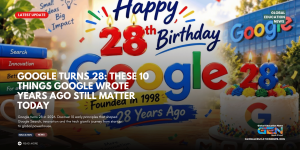
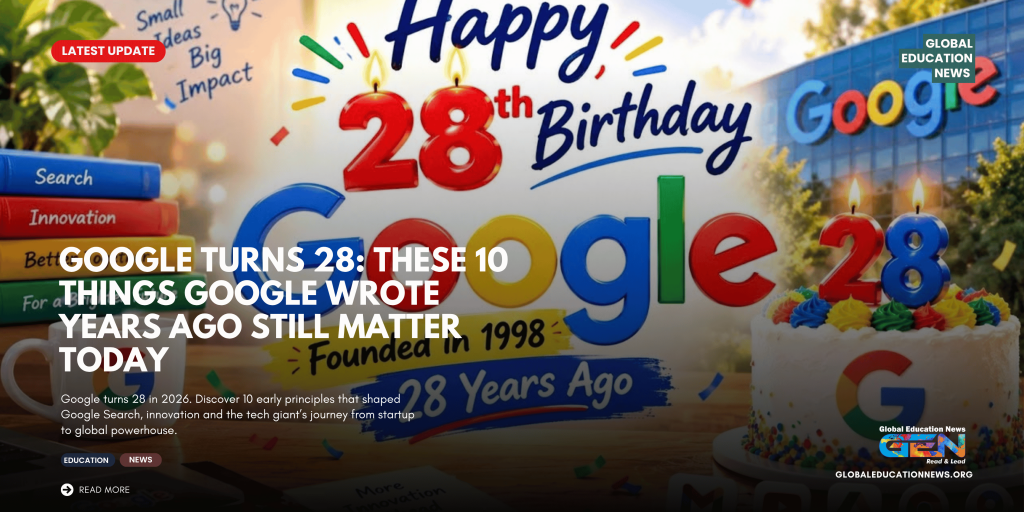
Google is marking its 28th birthday on September 27, 2026, with a nostalgic Doodle that looks back toward the company’s early identity. Google’s official Doodle page also recalls the first Google Doodle, created in 1998 as an out-of-office message while the founders attended the Burning Man festival.
There is a small historical wrinkle in the birthday itself.
Google was incorporated in September 1998, but the company has not always celebrated its birthday on the same date. September 27 became the established celebration date after Google used several different dates in its earlier birthday Doodles.
That makes the 28th birthday less about a single day on a calendar and more about a journey that began with two Stanford researchers, a search algorithm and a very large idea.
The real legacy of Google’s “Ten things we know to be true”
The enduring interest in Google’s early principles comes from the gap between the company it was and the company it became.
In the late 1990s, Google was a young search engine competing in a crowded internet landscape. Twenty-eight years later, its products touch how people search for information, communicate, navigate cities, watch videos, use smartphones and increasingly interact with AI.
The company’s original list does not answer every question raised by that transformation. Nor does a corporate principle automatically demonstrate that every promise has always been fulfilled in practice.
But it does provide something valuable: a record of what Google said mattered when it was still small.
And perhaps that is the most revealing part of the company’s 28th birthday.
The technology has changed enormously. The scale has changed even more.
Yet Google’s oldest challenge remains remarkably close to the one its founders identified at the beginning — figuring out how to help people navigate an ever-growing world of information.