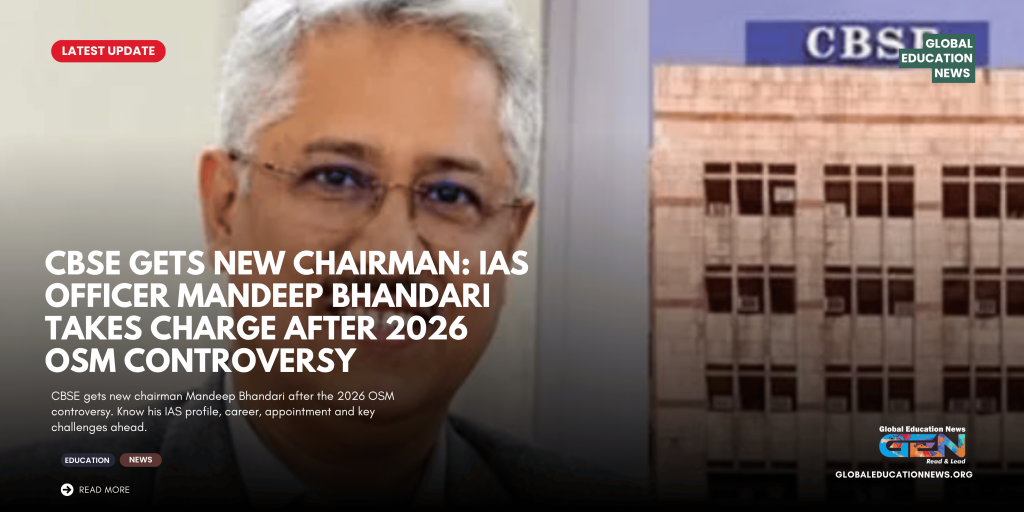
NEW DELHI, INDIA — The CBSE has a new chairman. The Centre has appointed Mandeep K. Bhandari, a 2001-batch IAS officer of the AGMUT cadre, as chairperson of the Central Board of Secondary Education, placing an experienced administrator at the helm of India’s school examination board after a turbulent 2026 examination cycle.
The appointment was approved by the Appointments Committee of the Cabinet (ACC) on September 25, according to the government order cited by multiple reports. The post has been temporarily upgraded to the rank and pay of an Additional Secretary. Bhandari replaces Lokhande Prashant Sitaram, who had been holding additional charge of the CBSE chairperson’s post.
The timing matters. Bhandari arrives at CBSE after the board’s first full-scale rollout of its On-Screen Marking (OSM) system for Class 12 answer sheets triggered complaints from students and parents over scanned answer books, technical problems and post-result services. The government subsequently ordered an inquiry into the procurement of services associated with the system.
For Bhandari, the move marks another major chapter in a career that has taken him from medical college to the Indian Administrative Service and through senior assignments in Jammu and Kashmir and the Union government.
Who Is Mandeep K. Bhandari, the New CBSE Chairman?
Mandeep K. Bhandari is a 2001-batch IAS officer from the AGMUT cadre. Before moving to CBSE, he served as Principal Secretary to the Lieutenant Governor of Jammu and Kashmir and also held additional charge as Chief Executive Officer of the Shri Amarnathji Shrine Board.
His government service profile records his year of IAS appointment as 2001 and identifies his academic qualification as an MBBS degree.
His career has included assignments at district, Union Territory and central-government levels, giving him experience across administration, health, medical education and public-sector institutions.
That background is one of the defining features of the Mandeep Bhandari profile now drawing attention among education-sector observers.
From MBBS Gold Medallist to IAS Officer
Before entering the civil services, Bhandari trained as a doctor.
He completed his MBBS from Dayanand Medical College, Ludhiana, under Punjab University and was a gold medallist, according to his publicly available professional records.
The transition from medicine to administration shaped a career that later brought him into some of Jammu and Kashmir’s most important government assignments.
His previous postings have included Deputy Commissioner of Leh, Deputy Commissioner of Jammu, Divisional Commissioner of Jammu, Additional Development Commissioner of Kathua and Chief Executive Officer of the Shri Mata Vaishno Devi Shrine Board.
He has also handled the Health and Medical Education portfolio in the Jammu and Kashmir government.
The result is an unusual professional trajectory: a medical graduate who moved into civil administration and is now heading an institution responsible for examinations and academic administration for schools across India and abroad.
Mandeep Bhandari’s Central Government Experience
Bhandari’s experience is not limited to Jammu and Kashmir.
At the Centre, he served as Private Secretary to the Union Human Resource Development Minister from January to September 2018 and subsequently worked as Joint Secretary in the Ministry of Health and Family Welfare, according to India Today’s account of his service career.
That central-government experience could prove relevant at CBSE, where examination policy, school affiliation, curriculum, assessment and coordination with the Ministry of Education form part of the board’s responsibilities.
His appointment therefore brings a senior administrator familiar with both field-level governance and central policymaking into the organisation.
Why Mandeep Bhandari’s Appointment Comes at a Critical Time for CBSE
The new CBSE chairman inherits a board dealing with questions around its digital examination infrastructure.
In 2026, CBSE conducted the first full-scale rollout of On-Screen Marking, under which physical answer books were scanned and made available digitally to evaluators. The reform was intended to modernise the evaluation process.
But the post-result period brought complaints from students and parents.
Reports cited issues involving blurred or missing scanned pages, alleged cases of students receiving another student’s answer book, technical glitches and problems related to payment and post-result services. CBSE disputed some allegations concerning improper scanning and maintained that parts of the claims were factually incorrect.
The controversy subsequently moved beyond individual complaints.
The government constituted a committee headed by Capacity Building Commission chairperson S. Radha Chauhan to examine procurement of services for CBSE’s OSM system.
CBSE OSM Controversy: What Went Wrong With On-Screen Marking?
Mandeep Bhandari’s appointment comes against the backdrop of the controversy surrounding CBSE’s new On-Screen Marking (OSM) system, introduced for the digital evaluation of Class 12 answer books in the 2026 board examinations.
Under OSM, physical answer books were scanned and made available digitally to evaluators for assessment. CBSE had issued instructions and conducted mock-evaluation exercises before the system was implemented for the board examinations.
The problems became more visible after the Class 12 results were declared. Students seeking copies of their evaluated answer books reported issues including blurred scans, missing pages and, in some cases, answer books that they alleged did not belong to them. There were also complaints involving the payment mechanism and difficulties accessing material through the portal.
The controversy also expanded beyond individual student complaints. Reporting on the rollout raised questions about technical preparedness, the reliability of the scanning and digital-evaluation process, cybersecurity and the procurement of services connected with OSM. The Indian Express reported that internal trial exercises had flagged technical and evaluation-related concerns before the system was rolled out more widely.
Security became another point of scrutiny after CBSE acknowledged vulnerabilities in the OSM platform operated by its service provider.
The Centre subsequently ordered an inquiry into the procurement of services related to the digital evaluation system. The developments were followed by changes in CBSE’s senior leadership, including the transfer of the then chairperson Rahul Singh and secretary Himanshu Gupta, with Lokhande Prashant Sitaram later holding additional charge of the chairperson’s post.
Why the OSM Issue Matters for the New CBSE Chairman
For Bhandari, the OSM episode will form an important part of the institutional backdrop as he takes charge. The immediate challenge is not simply introducing digital examination technology, but ensuring that scanning accuracy, evaluator access, data security, student access to answer books and post-result services work reliably together.
The controversy has therefore placed examination technology and administrative safeguards firmly on the agenda for CBSE’s new leadership. Bhandari’s tenure begins at a time when students, parents, schools and teachers will be watching how the board strengthens its examination and digital-evaluation systems for future cycles.
Mandeep Bhandari and the Road Ahead for CBSE
The change at the top comes with a clear set of institutional priorities.
CBSE will need to manage the next board-examination cycle while addressing concerns surrounding digital evaluation and maintaining the reliability of its student-facing services.
For students, the most consequential question will not simply be who occupies the chairperson’s office. It will be whether the systems supporting examinations — from answer-sheet evaluation to results and post-result services — work predictably when millions of students depend on them.
Bhandari takes charge with more than two decades of administrative experience behind him. His path from MBBS gold medallist to IAS officer and now CBSE chairman gives the appointment a distinctive personal story, but the larger story is institutional.
The country’s largest school examination board has entered another academic year with a new leader. What follows will be watched closely by students, schools and parents across the CBSE network.