Punjab — September 27, 2026
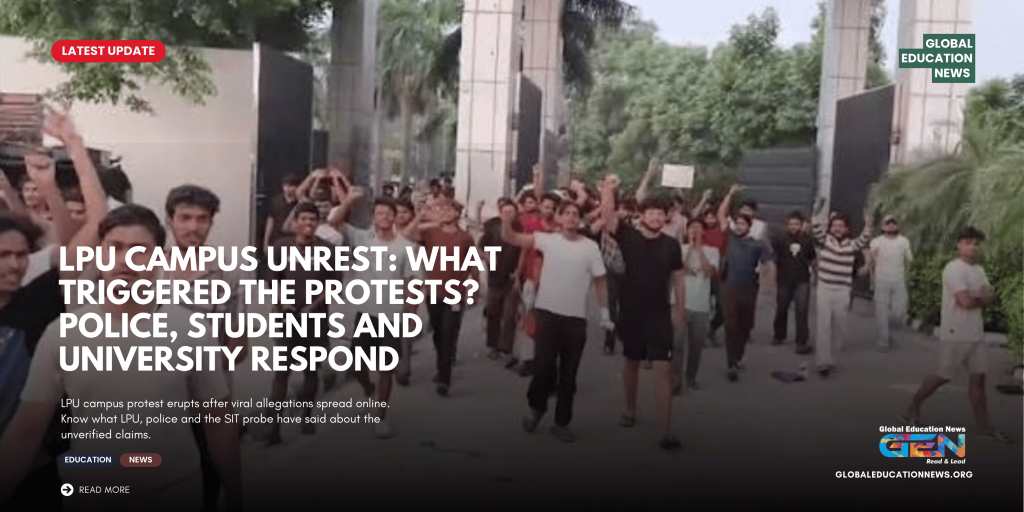
A wave of unrest at Lovely Professional University (LPU) in Phagwara has raised questions far beyond the university campus after unverified allegations spread rapidly across social media. Students gathered in protest, university property was damaged, objects were set on fire and the Jalandhar-Phagwara highway was blocked as anger grew over claims involving an alleged incident concerning a female student.
But there is a crucial distinction at the centre of the story: the allegations circulating online have not been independently established.
LPU has categorically rejected the claims, describing them as “false, baseless and fabricated” and alleging that misleading information was being circulated to damage the university’s reputation. Police, meanwhile, said they had not received a complaint or information confirming the alleged crime. An investigation, including an SIT probe reported by The Tribune, is now expected to establish what actually happened and how the rumours spread.
LPU protest erupts after unverified claims spread online
The immediate trigger for the LPU campus protest was a series of claims circulating through social media about an alleged sexual assault involving a female student, followed by another unverified claim concerning her death.
Students gathered on the university campus and demanded action. What began as a protest later escalated into violence, with reports of damaged windows and other university property, objects being set on fire and a highway blockade outside the campus.
The scale of the reaction made the story spread even faster.
Videos from the campus circulated widely online, showing large groups of students and scenes of property damage. That created a second information cycle: claims about the alleged incident were being shared alongside footage of the protest, making it increasingly difficult for people following the story online to separate confirmed information from allegations and speculation.
What police have confirmed
Kapurthala Senior Superintendent of Police Gaurav Toora said police became aware of the situation after students gathered on campus and blocked the road.
According to police statements reported by multiple outlets, no complaint concerning the alleged crime had been received. Police also said protesters were unable to provide details that independently established the alleged incident at the time.
That does not, by itself, establish that every claim circulating online is false. It establishes something narrower and important: authorities had not received a complaint confirming the alleged incident when the initial unrest unfolded.
Why LPU called the viral allegations “false and fabricated”
LPU Registrar Dr Monica Gulati said the university had no basis to accept the claims being circulated on social media.
The university said certain people were spreading misleading information and creating confusion among students, parents and the wider public. It urged stakeholders not to circulate or amplify unverified information and asked them to rely on official university communications.
The university’s response therefore became a central part of the developing story.
Rather than confirming the allegations, LPU has explicitly rejected them. That position should be kept separate from the police investigation, which is examining the circumstances surrounding the claims and the subsequent unrest.
The LPU campus unrest was about more than a viral post
The protests also exposed a broader problem facing large university campuses in the social-media era: information can travel across thousands of students in minutes, while formal verification can take considerably longer.
At LPU, the situation reportedly intensified as students moved through the campus and gathered near the main entrance. Reports said the protests eventually spilled onto the road outside the university, disrupting traffic on the Jalandhar-Phagwara route.
The Indian Express reported that the unrest began around the girls’ hostel area before expanding as students from different hostels joined the gathering.
The result was a fast-moving campus crisis in which three separate questions became intertwined:
- What actually happened to the student at the centre of the allegations?
- Who originated and circulated the claims?
- Why did the protest escalate into vandalism and a highway blockade?
Only the investigation can establish the answers to those questions.
SIT probe turns the focus from rumours to evidence
An important development is the reported formation of a Special Investigation Team (SIT) to examine the circumstances surrounding the allegations and unrest.
The Tribune reported that senior police officials said student representatives would be kept informed during the investigation.
That shifts the story into a different phase.
The first phase was dominated by social-media messages and rapidly spreading claims. The next depends on evidence — statements, available records, digital material and whatever information investigators can independently verify.
That distinction matters because a viral claim can become widely believed long before authorities have established whether it is true.
What is confirmed — and what remains unverified?
| Issue | What current reporting establishes |
|---|---|
| LPU campus protest | Confirmed; students gathered and the protest escalated |
| Property damage | Reported by multiple news organisations |
| Highway blockade | Reported on the Jalandhar-Phagwara route |
| Viral allegations | Circulated widely on social media |
| LPU’s position | University calls the claims false, baseless and fabricated |
| Police position | Police said they had not received a complaint about the alleged crime |
| Investigation | Police are examining the circumstances; an SIT has been reported |
| Underlying allegation | Not independently established at the time of reporting |
This distinction is especially important for students, parents and anyone encountering screenshots or short videos online.
A video showing a protest can establish that a protest happened. It does not independently establish the allegation that triggered it.
LPU protest follows unrest at another Punjab university
The timing has also attracted attention.
The LPU unrest came a day after protests at Chitkara University, where similar unverified claims circulating online had triggered concern and demonstrations. News reports have drawn parallels between the two incidents because both involved rapidly spreading social-media allegations and subsequent campus unrest.
That broader context raises questions about how quickly unverified information can move through student networks and how universities and law-enforcement agencies respond when large groups of students demand immediate answers.
It also underlines why verification becomes particularly important during a fast-moving campus crisis.
What students and parents should watch next
The most significant developments now are likely to come from the investigation rather than from additional social-media claims.
Authorities will need to establish the factual sequence behind the allegations, determine whether any offence occurred, identify the origin of misinformation if the claims prove unfounded, and assess the circumstances surrounding the property damage and disruption.
For students and parents, the distinction between reported, alleged and verified information is especially important.
LPU has rejected the allegations. Police have said they had no complaint about the alleged crime at the time of the initial response. An investigation is underway. Those are the facts currently established in the public record.
Everything beyond that remains a matter for evidence.
The larger question behind the LPU campus unrest
The LPU episode is ultimately not only a story about one university campus. It is also a reminder of how quickly information — accurate or otherwise — can become a catalyst for real-world events.
A message can reach thousands of students before authorities have verified its first sentence. A video can provide compelling evidence that a protest occurred while leaving the claims behind that protest unanswered.
At LPU, that gap between what was circulating online and what authorities could confirm helped create a tense and rapidly evolving situation.
Now, the responsibility shifts from the social-media feed to the investigation.
The facts will have to catch up with the rumours.