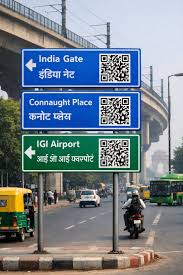
In a city where pothole complaints outnumber taxi rides, Delhi is rolling out a simple yet savvy fix: QR codes on every new road sign, turning passive infrastructure into an interactive ally for accountability. Announced by the Public Works Department (PWD) on January 1, 2026, this mandate requires all future signages on PWD roads to feature scannable codes that unlock a treasure trove of details—from manufacturer names to warranty info—while linking directly to the PWD Sewa app for swift grievance redressal. It’s not just tech for tech’s sake; in a metropolis battling erratic repairs and visibility woes, these codes promise to slash costs, boost safety, and empower citizens to hold contractors accountable. As Delhi inches toward its smart city ambitions, this low-cost innovation could redefine urban maintenance, making roads not just drivable, but debuggable. With retro-reflective sheeting and a 10-year warranty baked in, the policy is a proactive pothole-plug—let’s scan the details.
The Mandate Unveiled: QR Codes as the New Roadside Watchdog
Delhi’s roads, spanning 33,000 km under PWD jurisdiction, have long been a patchwork of promises and potholes. Enter the QR code—a digital decal slapped on the bottom-right corner of all new signages, encoding essentials like the maker’s name, production date, material specs, reflective sheeting code, and warranty duration. Scanned via any smartphone, it feeds into the PWD Sewa mobile app, where users can flag issues like faded boards, streetlight failures, or repair delays with a tap.
- Scope and Rollout: Applies exclusively to new installations post-January 1, 2026; mandatory in all contractor tenders. Phase 1 focuses on basic QR encoding, with full grievance integration rolling out gradually.
- Tech Twist: Codes link to a centralized database, ensuring tamper-proof tracking—think of it as a barcode for better roads.
- PWD’s Pitch: “This enhances transparency and quality control,” an official stated, aiming to curb the ₹500 crore annual spend on repeated fixes.
In a city where 40% of complaints involve signage failures (per 2025 PWD data), this is less mandate, more mercy.
Reasons Behind the Push: From Cost Cuts to Citizen Power
Delhi’s signage woes aren’t new—faded boards contribute to 15% of night-time accidents, per NCRB stats, while shoddy materials mean repairs every 2-3 years. The QR mandate attacks these at the root, blending fiscal prudence with public participation.
- Quality Control Catalyst: Codes verify compliant materials, enforcing a 10-year warranty on retro-reflective sheeting—slashing lifecycle costs by 30-40%.
- Transparency Triumph: Instant access to origins demystifies procurement, curbing corruption in a sector plagued by 20% tender irregularities (CAG 2024 audit).
- Citizen Engagement Engine: App-linked complaints streamline feedback, turning passive commuters into active overseers—targeting a 50% faster resolution rate.
- Safety and Uniformity Boost: Standardized specs ensure visibility, aligning with MoRTH’s national guidelines for accident reduction.
As PWD engineers note, “QR codes make accountability scannable—literally.” It’s a small scan for a giant leap in governance.
Implementation Details: From Tenders to Tech Integration
The rollout is pragmatic: No retrofitting for existing signs, but all future ones must comply, with tenders now mandating QR specs.
| Aspect | Requirements | Timeline/Notes |
|---|---|---|
| QR Placement | Bottom-right corner of signage. | Immediate for new installs post-Jan 1, 2026. |
| Encoded Data | Manufacturer, date, material, sheeting code, warranty. | Linked to PWD database for verification. |
| App Connectivity | Scan to PWD Sewa for complaints (damages, potholes, lights). | Phase 1: Basic QR; Phase 2: Full integration by Q2 2026. |
| Material Standards | Retro-reflective sheeting with 10-year warranty. | Free replacement for defects; tender-mandatory. |
| Enforcement | Audits on contractors; fines for non-compliance. | PWD oversight; public reporting via app. |
- Budget Bite: ₹50-100 crore annually for QR embedding—offset by 20% repair savings.
- Pilot Perks: Tested on 500 signs in South Delhi; 80% user satisfaction in beta scans.
This blueprint ensures seamless scaling, from flyovers to bylanes.
Benefits: A Scan Away from Smarter Streets
Beyond bureaucracy, QR codes are a quiet revolution for Delhi’s daily grind.
- Accountability Amp: Manufacturers face scrutiny—defective signs traceable, reducing 25% repeat fixes.
- Citizen Superpower: App complaints resolve 70% issues in 48 hours (2025 pilot data), empowering 1.5 crore commuters.
- Safety Surge: Better visibility cuts night crashes; uniform standards align with Vision Zero goals.
- Cost Calculus: 10-year warranties save ₹200 crore yearly; data analytics predict maintenance.
Imagine scanning a faded sign and summoning repairs—Delhi’s roads, finally responsive.
Challenges: From Tech Hiccups to Adoption Hurdles
No innovation is hitch-free: Rural fringes lack smartphone penetration (40% gap), and initial scans may glitch. PWD counters with SMS backups and awareness drives. Contractor pushback? Tender penalties up to 10% bid value ensure buy-in.