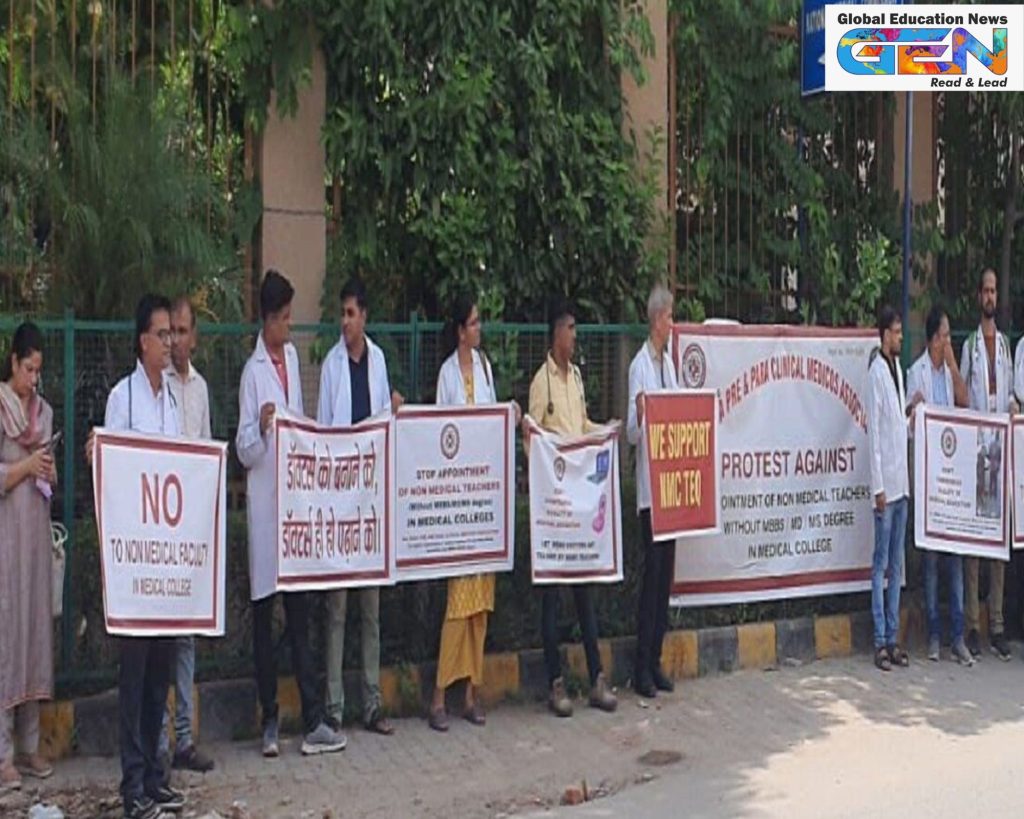
The Delhi High Court has taken a significant step by issuing a notice to the Centre regarding a petition challenging the National Medical Commission (NMC)’s July 2, 2025, amendment to the Teachers Eligibility Qualifications in Medical Institutions Regulations, 2025. Filed by the United Doctors Front (UDF), the plea contests the decision to allow up to 30% non-medical faculty (M.Sc./Ph.D. holders) in core MBBS subjects like Anatomy, Physiology, Biochemistry, Microbiology, and Pharmacology. The court, led by Chief Justice Devendra Kumar Upadhyaya and Justice Tushar Rao Gedela, has scheduled further hearings for September, igniting a critical debate on the quality of medical education in India.
Key Points:
- Delhi High Court seeks Centre’s response on NMC’s July 2, 2025, amendment.
- Petition challenges 30% quota for non-medical faculty in MBBS teaching.
- Case listed for further hearing in September 2025.
Why the 30% Non-Medical Faculty Rule Is Controversial
The NMC’s amendment doubles the previous 15% cap on non-medical faculty, which was intended as a temporary measure when qualified medical faculty were unavailable. The United Doctors Front (UDF) argues that this change undermines the Competency-Based Medical Education (CBME) curriculum, which emphasizes clinical exposure from the first year of MBBS. The plea contends that allowing non-medical faculty—lacking patient-care training—dilutes the clinical foundation of medical education and violates the National Medical Commission Act, 2019.
Key Points:
- NMC’s July 2 amendment raises non-medical faculty limit from 15% to 30%.
- Critics argue it compromises the CBME curriculum and clinical training standards.
- Plea claims the rule violates NMC Act, 2019, and seeks to restore the earlier cap.
Historical Context: Evolving Faculty Norms
Prior to 2020, non-medical faculty (M.Sc./Ph.D. holders) were permitted to occupy up to 30% of teaching posts in pre-clinical and para-clinical departments, with 50% in Biochemistry. In 2020, the NMC reduced this to 15% for Anatomy, Physiology, and Biochemistry, and 0% for Microbiology and Pharmacology to align with the CBME’s clinical focus. The 2025 amendment reverses this, reinstating the 30% quota, prompting concerns about a step backward in medical education quality. The National M.Sc Medical Teachers’ Association (NMMTA) supports the amendment, citing faculty shortages and global practices where non-medical educators play a significant role.
Key Points:
- Pre-2020: Non-medical faculty allowed up to 30% (50% in Biochemistry).
- 2020 NMC rules reduced non-medical faculty to 15% (0% in Microbiology and Pharmacology).
- 2025 amendment restores 30% quota, sparking debate over faculty shortages vs. quality.
Balancing Faculty Shortages and Education Quality
The NMC justifies the increased quota as a solution to chronic faculty shortages, noting that 40–50% of MD seats in non-clinical disciplines remain vacant annually due to MBBS graduates preferring clinical specialties. The NMMTA argues that non-medical educators, common in countries like the U.S. (where only 8–11% of pre-clinical faculty are medical professionals), are equally competent for teaching non-clinical subjects. However, critics, including the UDF, warn that this risks diluting clinical orientation in foundational subjects like Anatomy and Physiology, potentially impacting patient care training.
Key Points:
- NMC cites faculty shortages as reason for allowing 30% non-medical faculty.
- NMMTA highlights global acceptance of non-medical educators in pre-clinical teaching.
- UDF argues that non-medical faculty weaken the clinical focus of MBBS training.
Legal and Constitutional Implications
The UDF’s petition, filed through Advocate Satyam Singh Rajput, claims the NMC’s amendment violates Articles 14 and 21 of the Indian Constitution, which ensure equality and the right to health. It argues that equating non-clinically trained M.Sc./Ph.D. holders with MBBS/MD/MS faculty undermines the rigorous training required for medical educators, affecting students’ career expectations and public health standards. The plea seeks an interim stay on the amendment and a return to the 15% cap, emphasizing the need for clinically qualified faculty.
Key Points:
- Petition claims violation of Articles 14 and 21, impacting equality and right to health.
- Seeks interim stay on 30% quota and restoration of 15% cap.
- Argues non-medical faculty undermine career expectations of MBBS/MD/MS doctors.
Broader Impact on Medical Education
The debate over non-medical faculty highlights a broader tension in India’s medical education system: balancing the need for more educators with maintaining clinical excellence. With the NMC planning to add 75,000 new medical seats over the next five years, the demand for qualified faculty is acute. The outcome of this case could set a precedent for how India addresses faculty shortages while ensuring that MBBS students receive a clinically grounded education essential for future doctors.
Key Points:
- NMC plans to add 75,000 medical seats, increasing faculty demand.
- Case outcome could shape future faculty eligibility standards.
- Emphasis on maintaining clinical excellence in MBBS education.
What’s Next: Awaiting the Centre’s Response
The Delhi High Court’s notice requires the Centre to respond within four weeks, with further hearings scheduled for September 2025. The court’s decision will hinge on balancing the NMC’s pragmatic approach to faculty shortages with the UDF’s call for preserving the clinical integrity of medical education. Stakeholders, including students, educators, and policymakers, await a ruling that could redefine the standards of MBBS teaching in India.
Key Points:
- Centre to respond within four weeks; next hearing in September 2025.
- Ruling could impact standards of medical education nationwide.
- Stakeholders urged to monitor updates on the Delhi High Court proceedings.