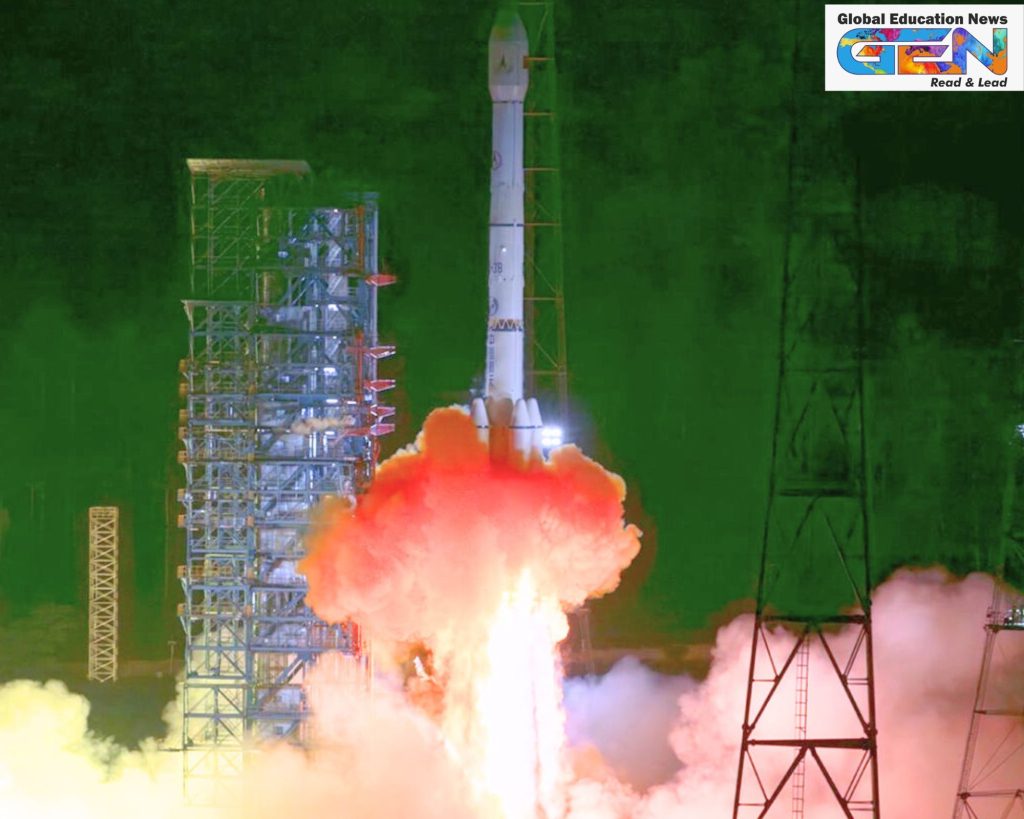
China’s Tianwen-2 mission, launched on May 28, 2025, from the Xichang Satellite Launch Center, marks a bold leap in space exploration. Aboard a Long March 3B rocket, this mission targets the near-Earth asteroid 469219 Kamoʻoalewa, a quasi-satellite that may hold clues to the Moon’s history. With plans to collect 100 grams of asteroid material and later study the enigmatic 311P/PanSTARRS comet, Tianwen-2 is set to redefine China’s role in deep-space exploration. Here’s why this mission is a game-changer:
- Historic Milestone: Aims to make China the third nation to return asteroid samples, after Japan and the U.S.
- Dual Objectives: Combines asteroid sampling with a comet flyby, a first in space mission history.
- Scientific Breakthroughs: Promises insights into the solar system’s origins and Earth’s planetary defense.
- Global Ambition: Part of China’s decade-long roadmap, including Mars and Jupiter missions.
Launched with precision, Tianwen-2 is a testament to China’s growing space prowess.
Decoding Kamoʻoalewa: A Quasi-Moon Mystery
The mission’s first target, 469219 Kamoʻoalewa, is no ordinary asteroid. This 40-100 meter space rock, discovered in 2016 by Hawaii’s Pan-STARRS telescope, orbits the Sun in sync with Earth, earning its “quasi-satellite” status. Suspected to be a fragment of the Moon blasted off by an ancient impact, it’s a cosmic puzzle waiting to be solved. Key mission goals include:
- Sample Collection: Retrieve 100 grams of regolith to analyze its composition and origin.
- Advanced Instruments: Uses 11 scientific payloads, including spectrometers, cameras, and a radar sounder.
- Lunar Insights: Could confirm if Kamoʻoalewa is lunar debris, shedding light on the Moon’s far-side history.
- Planetary Defense: Data will enhance strategies to deflect hazardous asteroids.
With its rapid 27.37-minute rotation and negligible gravity, sampling Kamoʻoalewa is a daring challenge.
Innovative Sampling: Mastering the Asteroid Challenge
Collecting samples from a fast-spinning, low-gravity asteroid like Kamoʻoalewa requires cutting-edge technology. Tianwen-2 employs three innovative methods to ensure success:
- Hover Sampling: The spacecraft hovers close, matching the asteroid’s rotation to scoop material with a robotic arm.
- Touch-and-Go (TAG): A brief landing using a rotating brush head, similar to NASA’s OSIRIS-REx and Japan’s Hayabusa2.
- Anchor-and-Attach: Four robotic arms with drills anchor into the surface for deeper sampling, a first for asteroid missions.
These techniques, powered by solar electric propulsion and autonomous navigation, tackle Kamoʻoalewa’s tricky terrain, ensuring at least 100 grams of material returns to Earth by November 2027.
Beyond the Asteroid: Chasing Comet 311P/PanSTARRS
After dropping its sample capsule in 2027, Tianwen-2 will use Earth’s gravity for a slingshot maneuver to head toward 311P/PanSTARRS, a rare main-belt comet in the asteroid belt between Mars and Jupiter. Arriving in January 2035, the spacecraft will study this 480-meter object, known for its comet-like tails, for at least a year. Key objectives include:
- Remote Sensing: Analyze orbit, shape, and surface composition using high-resolution cameras and spectrometers.
- Comet Mystery: Investigate why 311P/PanSTARRS, an “active asteroid,” ejects dust like a comet.
- Water Origins: Data could reveal if comets delivered water to early Earth.
- Unique Orbit: Study its path, ranging from 1.94 to 2.44 astronomical units from the Sun.
This phase makes Tianwen-2 the first mission to explore a main-belt comet up close, unlocking secrets of the solar system’s evolution.
Tianwen-2’s Place in China’s Space Legacy
Tianwen-2 builds on the success of Tianwen-1, which landed the Zhurong rover on Mars in 2021, making China the second nation to achieve a Martian soft landing. It’s a stepping stone to Tianwen-3, a Mars sample-return mission planned for 2028, and Tianwen-4, targeting Jupiter and Uranus by 2030. Highlights of China’s space program include:
- Lunar Triumphs: Two successful lunar sample-return missions with Chang’e-5 and Chang’e-6.
- Tiangong Space Station: A fully operational, Chinese-built hub for scientific research.
- Ambitious Roadmap: Plans for crewed lunar landings by 2030 and outer solar system exploration.
- Global Leadership: China leads in 21st-century lunar exploration, now expanding to asteroids and comets.
Tianwen-2’s dual mission showcases China’s ability to tackle complex deep-space challenges.
Challenges and Innovations: Pushing the Limits
Tianwen-2 faces unique hurdles, from Kamoʻoalewa’s rapid spin to the high-speed reentry of its sample capsule at 12 km/s. Here’s how China is overcoming them:
- Low-Gravity Landing: Autonomous navigation tackles Kamoʻoalewa’s negligible gravity and fast rotation.
- High-Speed Reentry: A robust capsule, tested with high-altitude parachutes in 2023, ensures safe sample return.
- Long-Duration Mission: Solar electric propulsion supports the 10-year journey to 311P/PanSTARRS.
- Complex Navigation: Matching the asteroid’s speed and spin requires advanced algorithms, often processed on Earth due to computational demands.
These innovations position China as a leader in small-body exploration and planetary defense.
Global Impact: Cooperation and Competition
Tianwen-2 joins a global race in asteroid exploration, following Japan’s Hayabusa missions and NASA’s OSIRIS-REx. While China welcomes international cooperation, U.S. legislative barriers limit NASA collaboration. Key global implications include:
- Scientific Collaboration: CNSA invited international proposals for Tianwen-2’s instruments in 2019.
- Planetary Defense: Sample data could inform strategies to protect Earth from asteroid impacts.
- Shared Knowledge: Studying Kamoʻoalewa and 311P/PanSTARRS will enhance global understanding of solar system origins.
- Future Missions: Tianwen-2’s success will pave the way for Tianwen-3 and beyond, potentially with global partners.
Posts on X reflect excitement, with users calling Tianwen-2 a “bold step” in China’s “space dream.”
How to Engage with Tianwen-2’s Journey
Tianwen-2 is more than a mission—it’s a window into the cosmos. Here’s how you can get involved:
- Follow Updates: Track progress via CNSA or space news outlets like SpaceNews and Xinhua.
- Learn About Asteroids: Explore Kamoʻoalewa’s lunar origins and 311P/PanSTARRS’ comet-like traits.
- Support STEM: Encourage education in space science to inspire the next generation.
- Advocate Cooperation: Push for global collaboration to overcome barriers like U.S. restrictions on NASA.
With samples arriving in 2027 and comet studies by 2035, Tianwen-2 promises a decade of discoveries.
A Cosmic Leap Forward: China’s Stellar Ambition
China’s Tianwen-2 mission is a daring quest to unlock the secrets of Kamoʻoalewa and 311P/PanSTARRS, blending cutting-edge technology with cosmic curiosity. By retrieving asteroid samples and studying a main-belt comet, China is not only joining the ranks of Japan and the U.S. but also pushing the boundaries of planetary science. As part of a visionary roadmap including Tianwen-3 and Tiangong’s success, this mission cements China’s role as a space exploration leader.