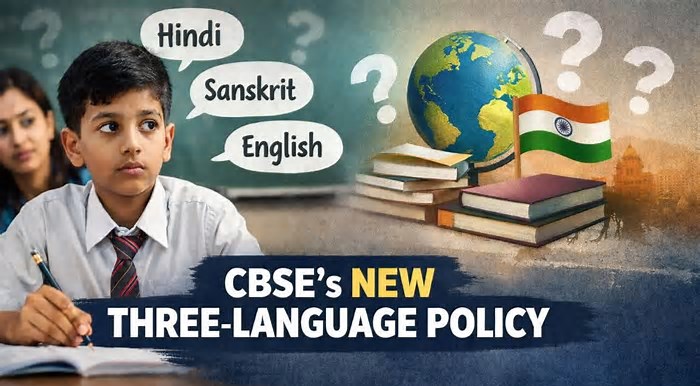
The Central Board of Secondary Education (CBSE) is set to implement its three-language policy from the 2026–27 academic session, starting from Class 6. The reform is aligned with the National Education Policy (NEP) and aims to promote multilingual learning and cultural integration.
Under this policy, students must study three languages, with at least two being Indian languages, marking a significant departure from the earlier system where foreign languages had a stronger presence in many schools.
What Happens to Foreign Languages Like French, German, and Spanish?
One of the biggest concerns emerging from this policy is the declining space for foreign languages in CBSE schools.
- Schools are increasingly prioritising Indian languages to meet policy requirements
- Subjects like French, Spanish, and German are being reduced or removed from core curriculum
- In some cases, they are being shifted to optional or extracurricular activities
Teachers have reported that several schools have already started discontinuing foreign language classes and replacing them with options like Sanskrit.
This shift indicates that while foreign languages are not officially banned, they are gradually being marginalised.
Impact on Teachers: Job Security at Risk
The policy is not just an academic reform—it has serious implications for employment in the education sector.
- Thousands of foreign language teachers may face reduced workload or job loss
- Experts warn that within a few years, many teachers could be forced out of the system
- Schools may try to redistribute teaching duties, but this may not be sustainable
Concerns have been raised that lack of long-term planning could lead to instability for educators who have specialised in foreign languages for years.
Implementation Challenges for Schools
While the policy aims to enhance language learning, its implementation has exposed several practical challenges:
1. Lack of Teaching Resources
Schools have been asked to roll out the policy quickly, but:
- Official textbooks are not fully available yet
- Teaching materials are still being developed
2. Shortage of Qualified Teachers
There is a shortage of trained teachers for certain regional or Indian languages, especially in urban schools.
3. Unclear Assessment Structure
- Schools lack clarity on how the third language will be evaluated
- This creates confusion about academic importance and student focus
Teachers have expressed concern that without proper planning, the policy may create inconsistency in learning outcomes.
A Shift in Educational Priorities
The new policy reflects a broader shift in India’s education system:
- Focus on Indian languages and cultural roots
- Reduced dependence on foreign languages
- Alignment with the vision of NEP 2020 for holistic and inclusive education
It aims to create students who are linguistically diverse and culturally aware, rather than primarily English- or foreign-language-focused.
Debate: Opportunity or Challenge?
The CBSE 3-language policy has sparked a nationwide debate.
Supporters say:
- It promotes national integration and cultural understanding
- Strengthens regional languages and identity
- Enhances cognitive skills through multilingual learning
Critics argue:
- It may increase academic burden on students
- Reduces global exposure by limiting foreign languages
- Creates uncertainty for teachers and schools
The biggest concern remains whether the system is ready for such a large-scale transition.