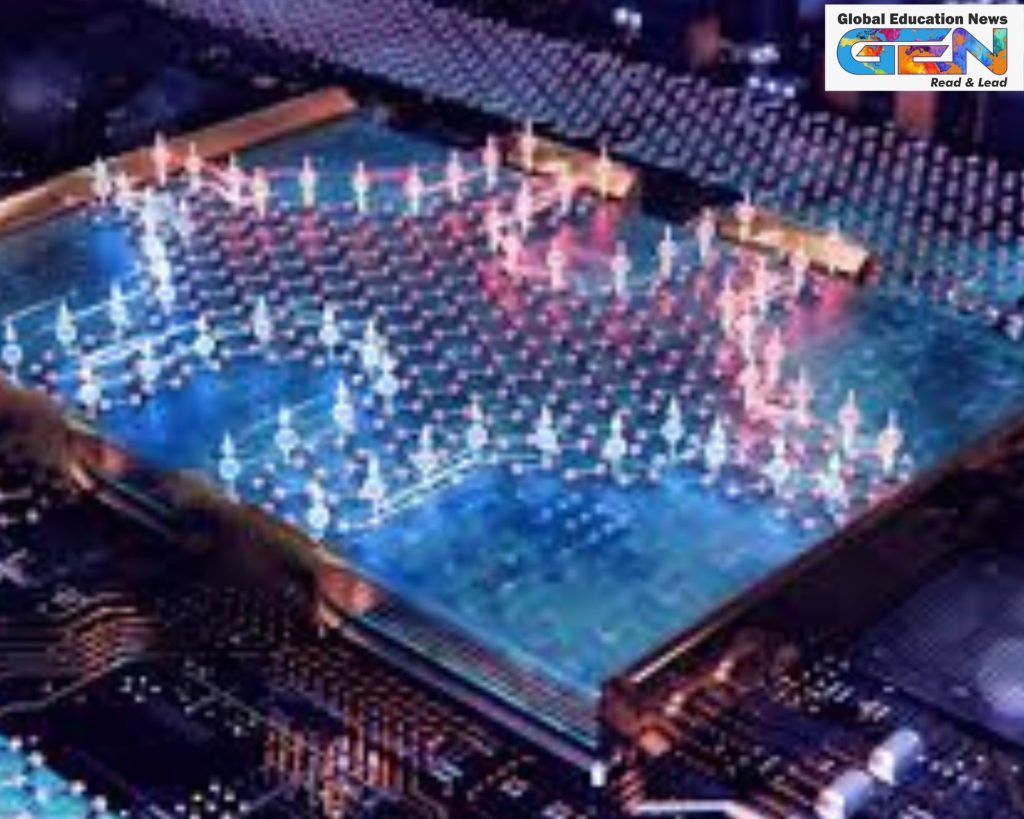
On July 22, 2025, researchers from Florida State University (FSU), MIT, and Japan’s National Institute for Materials Science (NIMS) announced a groundbreaking discovery in graphene physics, published in Nature. Led by Assistant Professor Zhengguang Lu, the team uncovered new electronic states in pentalayer graphene—a stack of five graphene layers sandwiched between boron nitride sheets. This finding, which includes the coexistence of a fractional quantum anomalous Hall effect and an electron crystal state at near-zero temperatures without magnetic fields, could pave the way for ultra-efficient, error-free quantum computers. Here’s how this “exotic” breakthrough could reshape technology
- Why It Matters: Offers a simpler, zero-field platform for fault-tolerant quantum computing.
- Big Picture: Could lead to computers that “sip rather than guzzle power.”
- Source: Dive deeper at earth.com or nature.com.
The Discovery: Coexisting Quantum States
The team’s work builds on a 2024 MIT discovery of fractionalization in pentalayer graphene, where electrons exhibit fractional charge behavior—an “exotic” phenomenon defying conventional physics. Lu’s group advanced this by identifying a unique coexistence in the same graphene device:
- Fractional Quantum Anomalous Hall Effect: Electrons flow along the graphene’s edges as fractions of a single charge, without energy loss, even without a magnetic field. This is marked by vanishing longitudinal resistance and sharp Hall signal plateaus.
- Electron Crystal State: Adjacent to the fractional state, electrons “freeze” into a solid-like, ordered lattice, resembling “electron ice” versus the “liquid” flow of fractional charges.
This coexistence, observed at near-absolute zero (close to -273.15°C), occurs within a narrow gate voltage range, creating a “river of fractional charges” between “frozen banks” of integer charges.
Key Insight: “This is one of the special parts about physics—a tiny difference in a material’s structure can create a system that behaves completely differently,” said Lu.
Why Graphene? The Wonder Material
Graphene, a single layer of carbon atoms in a honeycomb lattice, is the thinnest, strongest, and most conductive material known, isolated in 2004 by Andre Geim and Konstantin Novoselov, earning them the 2010 Nobel Prize in Physics. Its unique properties include:
- High Conductivity: Electrons move with minimal resistance, ideal for faster transistors.
- Strength and Flexibility: Stronger than steel, yet flexible, perfect for durable electronics.
- Quantum Behavior: Its 2D structure amplifies electron interactions, enabling exotic states like those found by Lu’s team.
In this study, pentalayer graphene stacked with hexagonal boron nitride forms a moiré pattern—a spatial interference pattern from slight misalignments—that enhances quantum effects, acting like a “scissor” to isolate useful properties.
Fun Fact: Graphene’s discovery began with sticky tape peeling layers from graphite, the “lead” in pencils
Implications for Quantum Computing
Current quantum computers suffer from errors every microsecond, requiring complex error-correction systems. The new graphene platform offers a game-changer:
- Topological Qubits: The fractional quantum anomalous Hall state supports anyon-like quasiparticles, whose braiding could enable fault-tolerant logic gates, reducing errors.
- Zero-Field Advantage: Unlike earlier systems needing strong magnetic fields (which disrupt superconductors), this platform operates at zero field, allowing direct integration with superconducting Josephson junctions for compact quantum circuits.
- Efficiency Boost: “If paired with a superconductor, the resulting quantum computer will be more efficient than current ones and free of error,” Lu noted, promising devices with minimal power consumption.
Challenges and Next Steps
Despite its promise, challenges remain:
- Scalability: Translating lab results to commercial chips requires scaling to wafer-sized graphene, a hurdle researchers like Walter de Heer have called “feasible” but complex, comparing it to early aviation’s long path to commercial flights.
- Temperature Constraints: The fractional states appear only near absolute zero, requiring advanced cryogenic systems, though simpler than magnetic field setups.
- Manufacturing Integration: While compatible with silicon carbide wafer processes, mass production needs refinement to match silicon’s infrastructure.
Future Plans: The team, including collaborators Long Ju (MIT), Kenji Watanabe, and Takashi Taniguchi (NIMS), aims to pair these states with superconductors and explore other multilayer graphene configurations for new quantum phenomena.
Broader Context: Graphene’s Ongoing Revolution
This breakthrough adds to graphene’s storied history:
- Past Milestones: A 2024 Georgia Tech study created a functional graphene semiconductor with a 0.6 eV bandgap, 10 times more mobile than silicon. Earlier, MIT’s 2021 discovery of graphene ferroelectricity opened new computing paradigms.
- Other Advances: Recent work includes graphene spin currents without magnetic fields (TU Delft, 2025) and energy harvesting from thermal fluctuations (University of Arkansas, 2023).
- Market Potential: The graphene market could reach $1.5 billion by 2027, but scaling remains a bottleneck, per the Graphene Flagship.
Tips for Stakeholders
- Researchers: Explore moiré patterns in other 2D materials like molybdenum disulfide for similar quantum states. Visit physics.fsu.edu for collaboration opportunities.
- Tech Industry: Investigate silicon carbide-based graphene integration, leveraging existing chip manufacturing. Check nature.com for technical details.
- Students: Study quantum physics or materials science to join this field; FSU and MIT offer relevant programs.
- Investors: Monitor graphene startups like Paragraf, which mass-produces graphene devices, for commercial potential.
A New Era for Computing
The July 22, 2025, graphene breakthrough by Zhengguang Lu and collaborators at FSU, MIT, and NIMS marks a pivotal moment in quantum physics. By uncovering coexisting fractional quantum anomalous Hall and electron crystal states in pentalayer graphene, the team has opened a zero-field pathway to ultra-efficient, error-free quantum computers. This discovery, built on graphene’s remarkable conductivity and moiré-enhanced quantum effects, could transform computing, energy, and materials science. Stay updated at earth.com or nature.com, and join the journey to a new generation of technology