September 18, 2025
Delhi, India
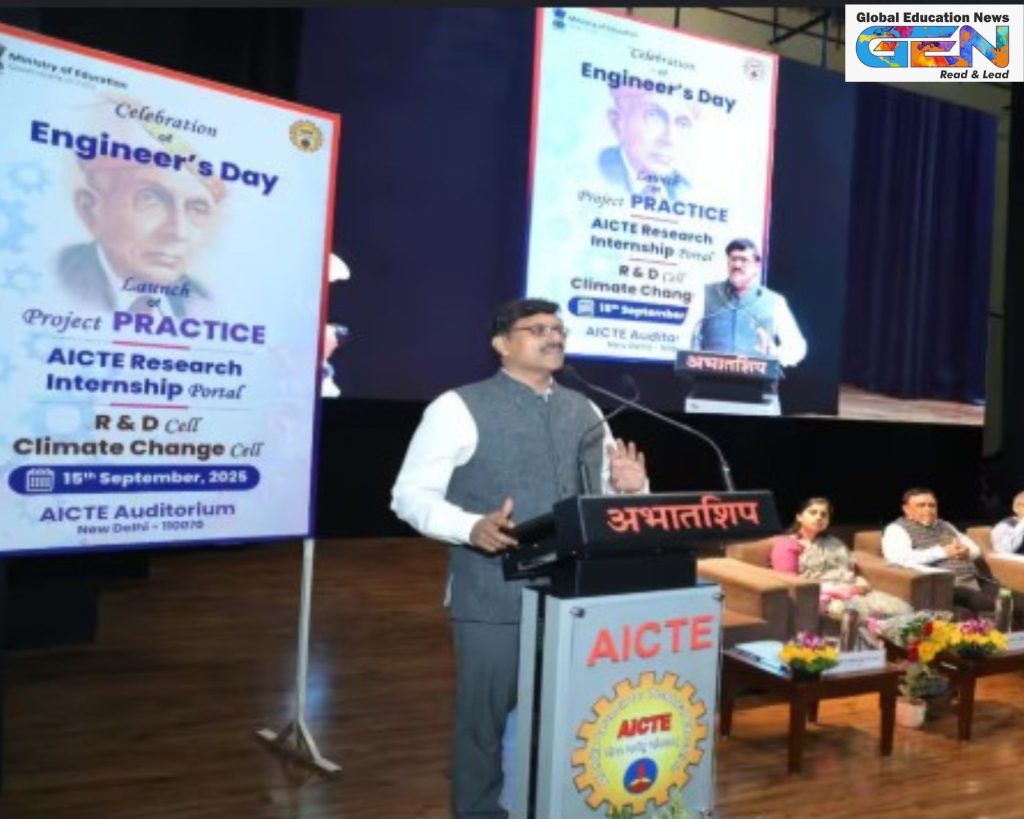
Over 30 lakh engineering students across 5,868 AICTE-approved institutions, many in overlooked tier-2 and tier-3 towns, suddenly armed with live industry projects, AI super-tools, and green innovation labs. That’s the electrifying promise of AICTE’s launches on Engineers’ Day, September 15, 2025. Dr. Vineet Joshi, Secretary of Higher Education, flipped the switch on Project PRACTICE, the AICTE Research Internship (ARI) Portal, and mandatory R&D and Climate Cells—backed by Education Minister Dharmendra Pradhan’s rallying cry for “quality, innovation, and inclusivity.” With a Rs 23.31 crore war chest, these aren’t tweaks; they’re a full-throttle push to make every grad a job magnet and nation-builder, aligning with NEP 2020’s skill-first ethos.
- Key Points:
- Launch date: September 15, 2025 (Engineers’ Day, honoring Mokshagundam Visvesvaraya).
- Reach: 20 lakh students, 10,000 faculty in 1,000 tier-2/3 colleges over 3 years (2025-2028).
- Partners & Funding: Maker Bhavan Foundation (MBF), LEAP, CRISP; equal Rs 11.655 crore split with AICTE.
- Big vision: From rote learning to real-world problem-solving, fostering Viksit Bharat by 2047.
Project PRACTICE: Hands-On Hustle for Employability Superstars
At the core is Project PRACTICE (Project for Advancing Critical Thinking, Industry Connect, and Employability)—a three-phase blitz to supercharge 1,000 under-the-radar colleges. Phase 1 (2025-26) rolls out project-based curricula and faculty bootcamps; Phase 2 amps up industry tie-ups; Phase 3 scales success stories nationwide. Students dive into live gigs like designing sustainable prototypes or AI-driven logistics, ditching textbooks for toolkits. Free AI access—think ChatGPT for brainstorming, Perplexity Go for rapid research—frees minds for big ideas, not grunt work. Prof. TG Sitharam, AICTE Chairman, calls it a “redefinition of learning,” turning aspirational campuses into innovation hubs.
- Key Points:
- Focus: Critical thinking via live projects; employability skills like coding, data analytics, soft skills.
- Perks: Stipends for top performers; mentorship from industry pros; tracked via AICTE’s digital dashboard.
- Impact metrics: 50% placement boost targeted; pilots in 100 colleges show 30% skill uplift already.
- Quote: “Not just employable engineers, but leaders of innovation”—Prof. TG Sitharam.
ARI Portal: Unlocking Research Doors for Tomorrow’s Innovators
Gone are the days of endless email hunts for internships—the ARI Portal is a one-stop digital matchmaker, connecting students to cutting-edge research ops at labs, startups, and corporates. Launched alongside PRACTICE, it lists verified gigs in AI, biotech, renewables, and more, with filters for duration, stipend (up to Rs 20,000/month), and location. Building on AICTE’s National Internship Portal (aiming for 1 crore placements by 2025), ARI emphasizes “learning by doing,” complete with certificates and alumni networks. Early sign-ups surged 40% post-launch, proving its pull for hands-on R&D cred.
- Key Points:
- Features: Verified listings, AI-recommended matches, progress trackers; integrates with college career cells.
- Eligibility: All AICTE students; priority for underrepresented groups via quotas.
- Tie-in: Complements PRACTICE’s industry projects; 5,000 slots targeted in Year 1.
- Pro tip: Log in via aicte-india.org for alerts—first-come, first-served for hot spots like ISRO tie-ups.
R&D and Climate Cells: Mandatory Green Labs for Every Campus
No more optional extras—AICTE’s mandate rolls out R&D Cells and Climate Cells in all approved institutes by 2026, turning every college into a sustainability powerhouse. R&D Cells fund micro-projects (Rs 5-10 lakh grants), host hackathons, and link to global patents, while Climate Cells tackle local eco-challenges like water conservation or EV prototypes through audits and awareness drives. Inspired by NAPCC’s missions, these cells weave ESG into curricula, prepping grads for green jobs exploding by 2030. CRISP’s R. Subrahmanyam hails it as a “lifeline for neglected institutions,” narrowing the elite-rural divide.
- Key Points:
- Rollout: Phased by 2026; annual audits; Rs 50 crore national fund for seed grants.
- Activities: R&D—patent clinics, startup incubators; Climate—carbon footprint tools, tree-tech drives.
- Wins: Aligns with UN SDGs; early adopters report 25% more eco-innovations.
- Challenge: Urban vs. rural—cells get tailored toolkits for resource gaps.
The Ripple Effect: From Campus to Corporates – A Win for All
These initiatives aren’t silos—they sync up for max punch: A PRACTICE project could land an ARI internship, birthing an R&D Cell prototype pitched at a Climate hackathon. With India’s engineering glut (only 45% employable per reports), this could flip the script, boosting GDP via skilled talent. Underserved colleges, often in aspirational districts, get VIP treatment—faculty swaps, guest lectures, even alumni mentorship. As Prof. RK Bhandari notes, it’s “transformative for 5 lakh rural students,” echoing Pradhan’s NEP push for equitable tech ed.
- Key Points:
- Broader stats: 30 lakh+ enrollees; 40% employability gap targeted for 50% close by 2028.
- Success stories: Pilots in Odisha/Jharkhand show 35% internship uptake.
- Global angle: Ties to Atmanirbhar Bharat—export-ready engineers for AI, semiconductors.
Horizon Ahead: Scaling Up for a 2030 Job Boom
By 2028, expect 20 lakh grads with portfolios screaming “hire me”—from AI-optimized supply chains to climate-resilient designs. AICTE’s next moves? Expanding to diplomas and women-focused tracks. As India eyes 5 million green jobs, these cells could lead the charge. For students: Dive in via aicte-india.org. For industry: Partner up for live briefs. This isn’t just reform—it’s rocket fuel for India’s tech dream.
What’s your hack for landing an ARI spot, or a wild PRACTICE project idea? Drop it below—let’s engineer the future!